Department of Cyber Security, Ewha Womans University, 52, Ewhayeodae-gil, Seodaemun-gu, Seoul, 03760, Republic of Korea.
Department of Computer Science, Loyola University Chicago, 1032 W Sheridan Rd, Chicago, 60660, USA.
BMC Med Imaging. 2022 May 20;22(1):94. doi: 10.1186/s12880-022-00818-1.
Computer-aided methods for analyzing white blood cells (WBC) are popular due to the complexity of the manual alternatives. Recent works have shown highly accurate segmentation and detection of white blood cells from microscopic blood images. However, the classification of the observed cells is still a challenge, in part due to the distribution of the five types that affect the condition of the immune system.
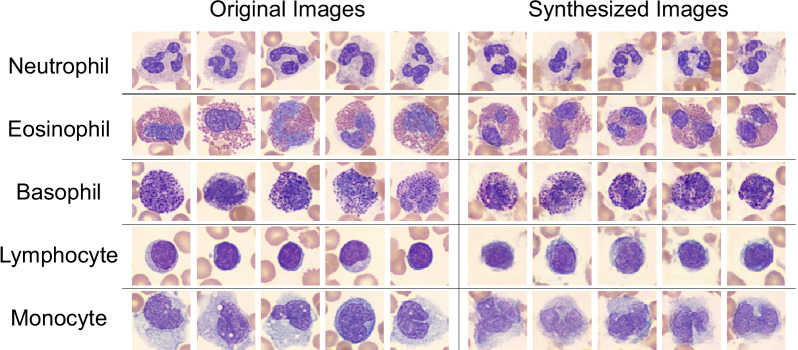
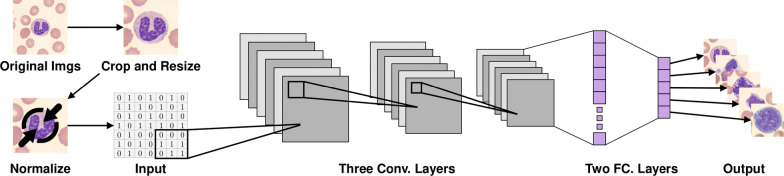
(i) This work proposes W-Net, a CNN-based method for WBC classification. We evaluate W-Net on a real-world large-scale dataset that includes 6562 real images of the five WBC types. (ii) For further benefits, we generate synthetic WBC images using Generative Adversarial Network to be used for education and research purposes through sharing.
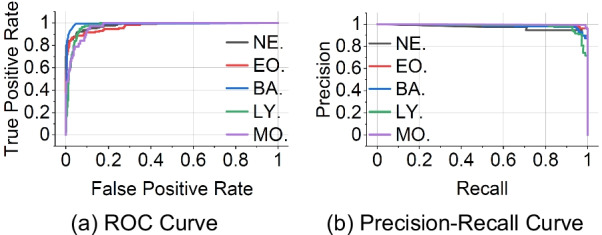
(i) W-Net achieves an average accuracy of 97%. In comparison to state-of-the-art methods in the field of WBC classification, we show that W-Net outperforms other CNN- and RNN-based model architectures. Moreover, we show the benefits of using pre-trained W-Net in a transfer learning context when fine-tuned to specific task or accommodating another dataset. (ii) The synthetic WBC images are confirmed by experiments and a domain expert to have a high degree of similarity to the original images. The pre-trained W-Net and the generated WBC dataset are available for the community to facilitate reproducibility and follow up research work.
This work proposed W-Net, a CNN-based architecture with a small number of layers, to accurately classify the five WBC types. We evaluated W-Net on a real-world large-scale dataset and addressed several challenges such as the transfer learning property and the class imbalance. W-Net achieved an average classification accuracy of 97%. We synthesized a dataset of new WBC image samples using DCGAN, which we released to the public for education and research purposes.
由于手动方法的复杂性,计算机辅助分析白细胞(WBC)的方法很受欢迎。最近的研究工作已经展示了从显微镜血液图像中高度准确地分割和检测白细胞的方法。然而,观察到的细胞的分类仍然是一个挑战,部分原因是五种类型的分布会影响免疫系统的状况。
(i)本工作提出了 W-Net,一种基于卷积神经网络的 WBC 分类方法。我们在一个包括五种 WBC 类型的 6562 张真实图像的真实大规模数据集上评估了 W-Net。(ii)为了进一步的好处,我们使用生成对抗网络生成合成的 WBC 图像,以便通过共享用于教育和研究目的。
(i)W-Net 的平均准确率为 97%。与 WBC 分类领域的最新方法相比,我们表明 W-Net 优于其他基于卷积神经网络和循环神经网络的模型架构。此外,我们展示了在特定任务或适应另一个数据集的微调中使用预训练的 W-Net 的迁移学习上下文的好处。(ii)通过实验和领域专家确认,合成的 WBC 图像与原始图像具有高度的相似性。预训练的 W-Net 和生成的 WBC 数据集可供社区使用,以促进可重复性和后续研究工作。
本工作提出了 W-Net,一种具有少量层的基于卷积神经网络的架构,用于准确地分类五种 WBC 类型。我们在一个真实的大规模数据集上评估了 W-Net,并解决了一些挑战,如迁移学习属性和类不平衡。W-Net 的平均分类准确率为 97%。我们使用 DCGAN 合成了一组新的 WBC 图像样本数据集,并将其发布到公共领域,用于教育和研究目的。