Department of Ophthalmology, Icahn School of Medicine at Mount Sinai, New York, NY 10029, USA.
Vitreoretinal Medicine and Surgery, Midwest Eye Institute, Indianapolis, IN 46290, USA.
Int J Mol Sci. 2023 Jan 29;24(3):2573. doi: 10.3390/ijms24032573.
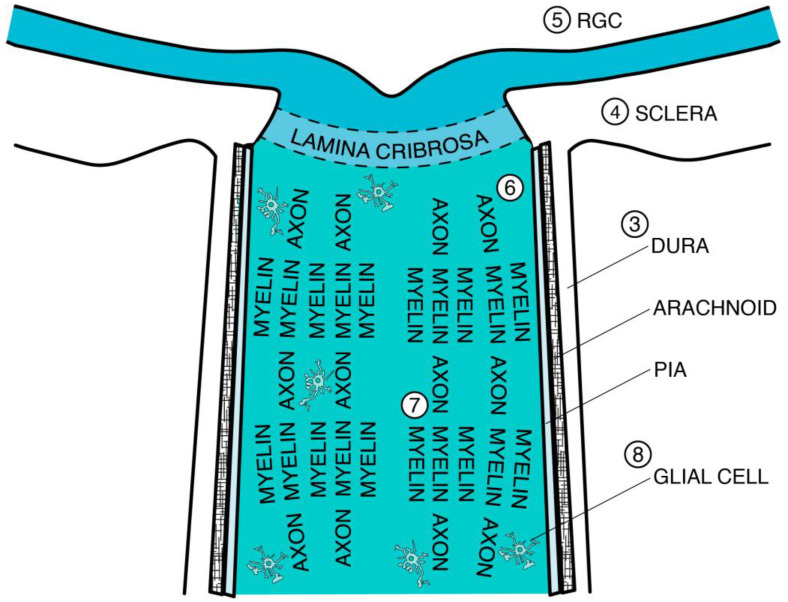
Common risk factors for many ocular pathologies involve non-pathologic, age-related damage to the optic nerve. Understanding the mechanisms of age-related changes can facilitate targeted treatments for ocular pathologies that arise at any point in life. In this review, we examine these age-related, neurodegenerative changes in the optic nerve, contextualize these changes from the anatomic to the molecular level, and appreciate their relationship with ocular pathophysiology. From simple structural and mechanical changes at the optic nerve head (ONH), to epigenetic and biochemical alterations of tissue and the environment, multiple age-dependent mechanisms drive extracellular matrix (ECM) remodeling, retinal ganglion cell (RGC) loss, and lowered regenerative ability of respective axons. In conjunction, aging decreases the ability of myelin to preserve maximal conductivity, even with "successfully" regenerated axons. Glial cells, however, regeneratively overcompensate and result in a microenvironment that promotes RGC axonal death. Better elucidating optic nerve neurodegeneration remains of interest, specifically investigating human ECM, RGCs, axons, oligodendrocytes, and astrocytes; clarifying the exact processes of aged ocular connective tissue alterations and their ultrastructural impacts; and developing novel technologies and pharmacotherapies that target known genetic, biochemical, matrisome, and neuroinflammatory markers. Management models should account for age-related changes when addressing glaucoma, diabetic retinopathy, and other blinding diseases.
许多眼部疾病的共同风险因素涉及视神经的非病理性、与年龄相关的损伤。了解与年龄相关的变化机制可以促进针对眼部疾病的靶向治疗,这些疾病可能在生命的任何阶段发生。在这篇综述中,我们研究了视神经中这些与年龄相关的神经退行性变化,从解剖学到分子水平来阐述这些变化,并认识到它们与眼部病理生理学的关系。从视神经头(ONH)的简单结构和机械变化,到组织和环境的表观遗传和生化改变,多种与年龄相关的机制驱动细胞外基质(ECM)重塑、视网膜神经节细胞(RGC)丧失以及相应轴突的再生能力降低。同时,衰老会降低髓鞘保持最大传导性的能力,即使轴突“成功”再生。然而,神经胶质细胞会过度再生,导致微环境促进 RGC 轴突死亡。更好地阐明视神经神经退行性变仍然是一个关注点,特别是研究人类 ECM、RGCs、轴突、少突胶质细胞和星形胶质细胞;阐明老年眼部结缔组织改变的确切过程及其超微结构影响;并开发针对已知遗传、生化、基质组和神经炎症标志物的新技术和药物疗法。在治疗青光眼、糖尿病视网膜病变和其他致盲性疾病时,管理模型应考虑与年龄相关的变化。