• 文献检索
  • 文档翻译
  • 深度研究
  • 学术资讯
  • Suppr Zotero 插件Zotero 插件
  • 邀请有礼
  • 套餐&价格
  • 历史记录
应用&插件
Suppr Zotero 插件Zotero 插件浏览器插件Mac 客户端Windows 客户端微信小程序
定价
高级版会员购买积分包购买API积分包
服务
文献检索文档翻译深度研究API 文档MCP 服务
关于我们
关于 Suppr公司介绍联系我们用户协议隐私条款
关注我们

Suppr 超能文献

核心技术专利:CN118964589B侵权必究
粤ICP备2023148730 号-1Suppr @ 2026

文献检索

告别复杂PubMed语法,用中文像聊天一样搜索,搜遍4000万医学文献。AI智能推荐,让科研检索更轻松。

立即免费搜索

文件翻译

保留排版,准确专业,支持PDF/Word/PPT等文件格式,支持 12+语言互译。

免费翻译文档

深度研究

AI帮你快速写综述,25分钟生成高质量综述,智能提取关键信息,辅助科研写作。

立即免费体验

使用机器学习模型预测大脑中动脉近端闭塞性中风患者的功能结局

Prediction of Functional Outcome in Stroke Patients with Proximal Middle Cerebral Artery Occlusions Using Machine Learning Models.

作者信息

Ozkara Burak B, Karabacak Mert, Hamam Omar, Wang Richard, Kotha Apoorva, Khalili Neda, Hoseinyazdi Meisam, Chen Melissa M, Wintermark Max, Yedavalli Vivek S

机构信息

Department of Neuroradiology, MD Anderson Cancer Center, Houston, TX 77030, USA.

Department of Neurosurgery, Mount Sinai Health System, New York, NY 10029, USA.

出版信息

J Clin Med. 2023 Jan 20;12(3):839. doi: 10.3390/jcm12030839.

DOI:10.3390/jcm12030839
PMID:36769491
原文链接:https://pmc.ncbi.nlm.nih.gov/articles/PMC9918022/
Abstract

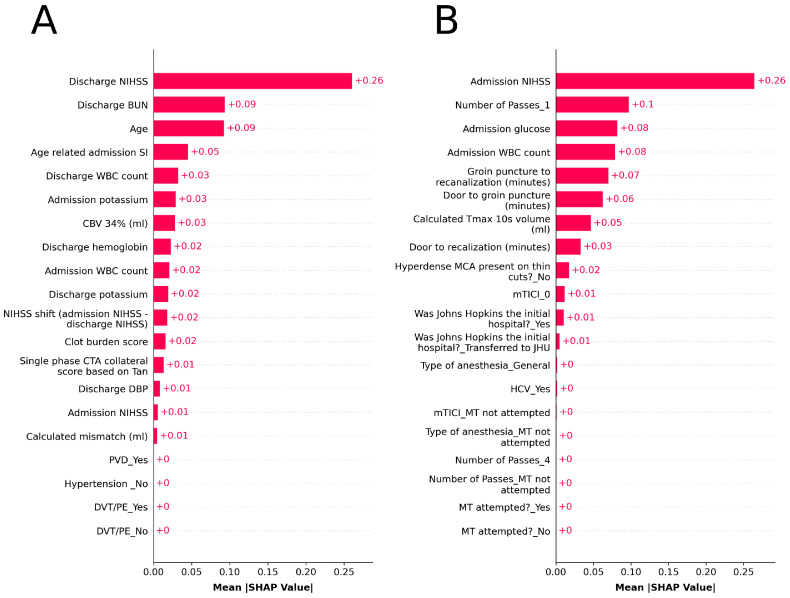
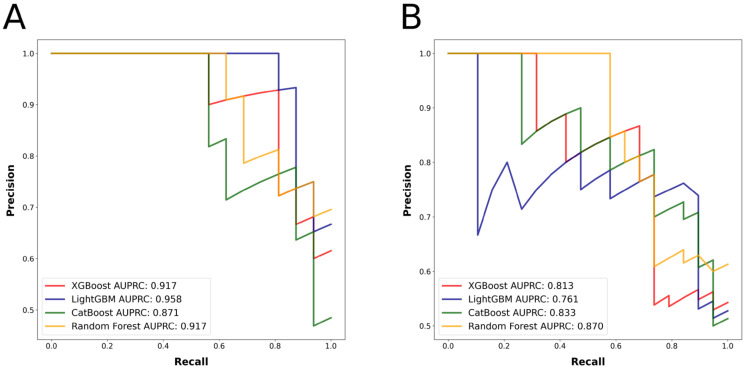
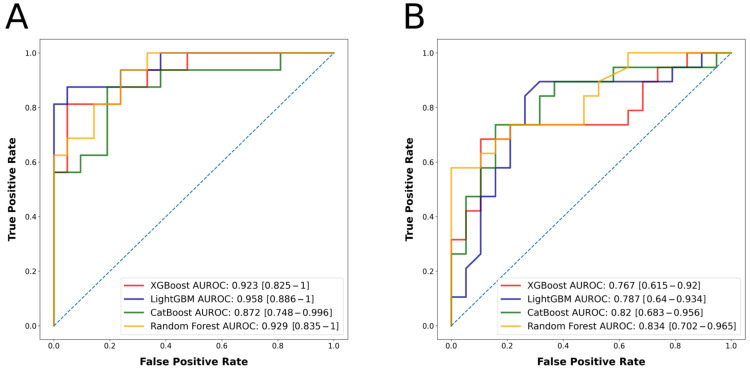
At present, clinicians are expected to manage a large volume of complex clinical, laboratory, and imaging data, necessitating sophisticated analytic approaches. Machine learning-based models can use this vast amount of data to create forecasting models. We aimed to predict short- and medium-term functional outcomes in acute ischemic stroke (AIS) patients with proximal middle cerebral artery (MCA) occlusions using machine learning models with clinical, laboratory, and quantitative imaging data as inputs. Included were consecutive AIS patients with MCA M1 and proximal M2 occlusions. The XGBoost, LightGBM, CatBoost, and Random Forest were used to predict the outcome. Minimum redundancy maximum relevancy was used for selecting features. The primary outcomes were the National Institutes of Health Stroke Scale (NIHSS) shift and the modified Rankin Score (mRS) at 90 days. The algorithm with the highest area under the receiver operating characteristic curve (AUROC) for predicting the favorable and unfavorable outcome groups at 90 days was LightGBM. Random Forest had the highest AUROC when predicting the favorable and unfavorable groups based on the NIHSS shift. Using clinical, laboratory, and imaging parameters in conjunction with machine learning, we accurately predicted the functional outcome of AIS patients with proximal MCA occlusions.

摘要

目前,临床医生需要处理大量复杂的临床、实验室和影像数据,这就需要采用复杂的分析方法。基于机器学习的模型可以利用这些海量数据来创建预测模型。我们旨在使用以临床、实验室和定量影像数据为输入的机器学习模型,预测大脑中动脉(MCA)近端闭塞的急性缺血性卒中(AIS)患者的短期和中期功能结局。纳入的患者为连续的MCA M1和近端M2闭塞的AIS患者。使用XGBoost、LightGBM、CatBoost和随机森林来预测结局。采用最小冗余最大相关性方法进行特征选择。主要结局为90天时的美国国立卫生研究院卒中量表(NIHSS)变化和改良Rankin量表(mRS)评分。在预测90天时的良好和不良结局组方面,受试者操作特征曲线下面积(AUROC)最高的算法是LightGBM。基于NIHSS变化预测良好和不良组时,随机森林的AUROC最高。结合临床、实验室和影像参数以及机器学习,我们准确预测了MCA近端闭塞的AIS患者的功能结局。
https://cdn.ncbi.nlm.nih.gov/pmc/blobs/04ed/9918022/860b3e8a667d/jcm-12-00839-g003.jpg
https://cdn.ncbi.nlm.nih.gov/pmc/blobs/04ed/9918022/eff5261f0968/jcm-12-00839-g001.jpg
https://cdn.ncbi.nlm.nih.gov/pmc/blobs/04ed/9918022/7080d26426de/jcm-12-00839-g002.jpg
https://cdn.ncbi.nlm.nih.gov/pmc/blobs/04ed/9918022/860b3e8a667d/jcm-12-00839-g003.jpg
https://cdn.ncbi.nlm.nih.gov/pmc/blobs/04ed/9918022/eff5261f0968/jcm-12-00839-g001.jpg
https://cdn.ncbi.nlm.nih.gov/pmc/blobs/04ed/9918022/7080d26426de/jcm-12-00839-g002.jpg
https://cdn.ncbi.nlm.nih.gov/pmc/blobs/04ed/9918022/860b3e8a667d/jcm-12-00839-g003.jpg

相似文献

1
Prediction of Functional Outcome in Stroke Patients with Proximal Middle Cerebral Artery Occlusions Using Machine Learning Models.使用机器学习模型预测大脑中动脉近端闭塞性中风患者的功能结局
J Clin Med. 2023 Jan 20;12(3):839. doi: 10.3390/jcm12030839.
2
Development of machine learning models for predicting outcome in patients with distal medium vessel occlusions: a retrospective study.用于预测远端中等血管闭塞患者预后的机器学习模型的开发:一项回顾性研究。
Quant Imaging Med Surg. 2023 Sep 1;13(9):5815-5830. doi: 10.21037/qims-23-154. Epub 2023 Jul 20.
3
Utilizing imaging parameters for functional outcome prediction in acute ischemic stroke: A machine learning study.利用成像参数预测急性缺血性卒中的功能转归:一项机器学习研究。
J Neuroimaging. 2024 May-Jun;34(3):356-365. doi: 10.1111/jon.13194. Epub 2024 Mar 2.
4
Multimodal Predictive Modeling of Endovascular Treatment Outcome for Acute Ischemic Stroke Using Machine-Learning.基于机器学习的急性缺血性脑卒中血管内治疗结局的多模态预测模型
Stroke. 2020 Dec;51(12):3541-3551. doi: 10.1161/STROKEAHA.120.030287. Epub 2020 Oct 12.
5
Revascularization of tandem occlusions in acute ischemic stroke: review of the literature and illustrative case.急性缺血性卒中串联闭塞的血管再通:文献综述及病例展示
Neurosurg Focus. 2017 Apr;42(4):E15. doi: 10.3171/2017.1.FOCUS16521.
6
M1 is not M1 in ischemic stroke: the disability-free survival after mechanical thrombectomy differs significantly between proximal and distal occlusions of the middle cerebral artery M1 segment.M1在缺血性卒中中并非传统意义上的M1:大脑中动脉M1段近端和远端闭塞患者在机械取栓后的无残疾生存期存在显著差异。
J Neurointerv Surg. 2015 Aug;7(8):559-63. doi: 10.1136/neurintsurg-2014-011212. Epub 2014 Jun 24.
7
Predicting 3-month poor functional outcomes of acute ischemic stroke in young patients using machine learning.使用机器学习预测年轻急性缺血性脑卒中患者 3 个月的不良功能结局。
Eur J Med Res. 2024 Oct 10;29(1):494. doi: 10.1186/s40001-024-02056-3.
8
Prognosis of untreated strokes due to anterior circulation proximal intracranial arterial occlusions detected by use of computed tomography angiography.应用计算机断层血管造影术检测到的前循环近端颅内动脉闭塞所致未治疗脑卒中的预后。
JAMA Neurol. 2014 Feb;71(2):151-7. doi: 10.1001/jamaneurol.2013.5007.
9
Machine-learning-based outcome prediction in stroke patients with middle cerebral artery-M1 occlusions and early thrombectomy.基于机器学习的大脑中动脉 M1 段闭塞和早期取栓的卒中患者预后预测。
Eur J Neurol. 2021 Apr;28(4):1234-1243. doi: 10.1111/ene.14651. Epub 2020 Dec 21.
10
Predicting 6-Month Unfavorable Outcome of Acute Ischemic Stroke Using Machine Learning.使用机器学习预测急性缺血性中风6个月不良结局
Front Neurol. 2020 Nov 19;11:539509. doi: 10.3389/fneur.2020.539509. eCollection 2020.

引用本文的文献

1
Prolonged venous transit is associated with lower odds of excellent recovery after reperfusion in anterior large-vessel occlusion stroke.在大脑前循环大血管闭塞性卒中再灌注后,静脉通过时间延长与良好恢复几率较低相关。
Eur J Neurol. 2025 Jan;32(1):e16563. doi: 10.1111/ene.16563.
2
Data-Driven Prognostication in Distal Medium Vessel Occlusions Using Explainable Machine Learning.使用可解释机器学习对远端中等血管闭塞进行数据驱动的预后分析。
AJNR Am J Neuroradiol. 2025 Apr 2;46(4):725-732. doi: 10.3174/ajnr.A8547.
3
Simplifying venous outflow: Prolonged venous transit as a novel qualitative marker correlating with acute stroke outcomes.

本文引用的文献

1
Machine Learning in Action: Stroke Diagnosis and Outcome Prediction.《机器学习实战:中风诊断与预后预测》
Front Neurol. 2021 Dec 6;12:734345. doi: 10.3389/fneur.2021.734345. eCollection 2021.
2
Global, regional, and national burden of stroke and its risk factors, 1990-2019: a systematic analysis for the Global Burden of Disease Study 2019.1990—2019年全球、区域和国家的卒中负担及其风险因素:全球疾病负担研究2019的系统分析
Lancet Neurol. 2021 Oct;20(10):795-820. doi: 10.1016/S1474-4422(21)00252-0. Epub 2021 Sep 3.
3
Thrombectomy for Primary Distal Posterior Cerebral Artery Occlusion Stroke: The TOPMOST Study.
简化静脉流出:延长的静脉传输作为一种与急性中风预后相关的新型定性标志物。
Neuroradiol J. 2025 Feb;38(1):59-63. doi: 10.1177/19714009241269475. Epub 2024 Jul 27.
4
Predicting 90-Day Prognosis in Ischemic Stroke Patients Post Thrombolysis Using Machine Learning.使用机器学习预测缺血性中风患者溶栓后的90天预后
J Pers Med. 2023 Oct 30;13(11):1555. doi: 10.3390/jpm13111555.
5
Role of artificial intelligence and machine learning in the diagnosis of cerebrovascular disease.人工智能和机器学习在脑血管疾病诊断中的作用。
Front Hum Neurosci. 2023 Sep 7;17:1254417. doi: 10.3389/fnhum.2023.1254417. eCollection 2023.
6
Development of machine learning models for predicting outcome in patients with distal medium vessel occlusions: a retrospective study.用于预测远端中等血管闭塞患者预后的机器学习模型的开发:一项回顾性研究。
Quant Imaging Med Surg. 2023 Sep 1;13(9):5815-5830. doi: 10.21037/qims-23-154. Epub 2023 Jul 20.
急性基底动脉远端闭塞性卒中血管内治疗:TOPMOST 研究
JAMA Neurol. 2021 Apr 1;78(4):434-444. doi: 10.1001/jamaneurol.2021.0001.
4
Treatment and Outcome in Stroke Patients With Acute M2 Occlusion and Minor Neurological Deficits.急性 M2 段闭塞和轻度神经功能缺损的脑卒中患者的治疗和结局。
Stroke. 2021 Mar;52(3):802-810. doi: 10.1161/STROKEAHA.120.031672. Epub 2021 Jan 26.
5
Benefit of endovascular thrombectomy for M2 middle cerebral artery occlusion in the ARISE II study.ARISE II 研究中 M2 大脑中动脉闭塞血管内血栓切除术的获益。
J Neurointerv Surg. 2021 Sep;13(9):779-783. doi: 10.1136/neurintsurg-2020-016427. Epub 2020 Nov 20.
6
Clinical Course of Acute Ischemic Stroke Due to Medium Vessel Occlusion With and Without Intravenous Alteplase Treatment.伴有和不伴有静脉内阿替普酶治疗的中等大小血管闭塞性急性缺血性脑卒中的临床病程。
Stroke. 2020 Nov;51(11):3232-3240. doi: 10.1161/STROKEAHA.120.030227. Epub 2020 Oct 19.
7
Multimodal Predictive Modeling of Endovascular Treatment Outcome for Acute Ischemic Stroke Using Machine-Learning.基于机器学习的急性缺血性脑卒中血管内治疗结局的多模态预测模型
Stroke. 2020 Dec;51(12):3541-3551. doi: 10.1161/STROKEAHA.120.030287. Epub 2020 Oct 12.
8
Machine Learning-Based Model for Prediction of Outcomes in Acute Stroke.基于机器学习的急性脑卒中结局预测模型。
Stroke. 2019 May;50(5):1263-1265. doi: 10.1161/STROKEAHA.118.024293.
9
Using Machine Learning to Improve the Prediction of Functional Outcome in Ischemic Stroke Patients.运用机器学习改善缺血性脑卒中患者功能预后预测。
IEEE/ACM Trans Comput Biol Bioinform. 2018 Nov-Dec;15(6):1953-1959. doi: 10.1109/TCBB.2018.2811471. Epub 2018 Mar 1.
10
Thrombectomy versus medical management for large vessel occlusion strokes with minimal symptoms: an analysis from STOPStroke and GESTOR cohorts.症状轻微的大血管闭塞性卒中取栓与药物治疗的比较:来自 STOPStroke 和 GESTOR 队列的分析。
J Neurointerv Surg. 2018 Apr;10(4):325-329. doi: 10.1136/neurintsurg-2017-013243. Epub 2017 Aug 2.