Bird M, McGillion M, Chambers E M, Dix J, Fajardo C J, Gilmour M, Levesque K, Lim A, Mierdel S, Ouellette C, Polanski A N, Reaume S V, Whitmore C, Carter N
School of Nursing, McMaster University, 1280 Main St. W., Hamilton, ON, L8S 4L8, Canada.
DigiComp Kids, Hamilton, Canada.
Res Involv Engagem. 2021 Mar 1;7(1):12. doi: 10.1186/s40900-021-00252-7.
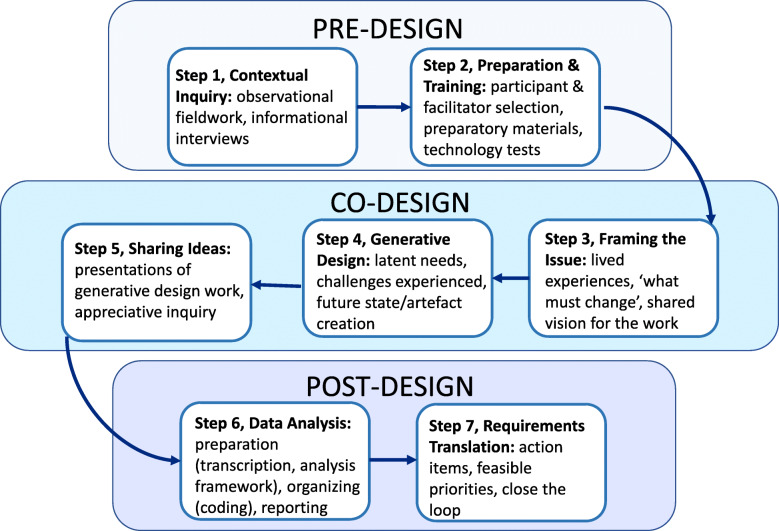
Background Continual improvements to health systems, products, and services are necessary for improvements in health. However, many of these improvements are not incorporated into everyday practice. When designing new health systems, products, and services, involving members of the healthcare community and the public with personal healthcare experience can help to make sure that improvements will be useful and relevant to others like them. Methods Together with healthcare workers and family members with healthcare experience, we developed and applied a step-by-step guide to involving those with personal experience in the design of health system improvements. Results Our guide has three phases- 'Pre-Design', 'Co-Design', and 'Post-Design'. This paper describes each of these phases and illustrates how we applied them to our own project, which is to use virtual healthcare methods to improve care for children with chronic healthcare conditions and their families. In our own work, we found that healthcare workers and family members with personal healthcare experiences were able to use their knowledge and creativity to help us imagine how to improve care for children with chronic healthcare conditions and their families. We have created action items from these family member- and healthcare worker-identified needs, which we will use to shape our virtual healthcare system. Conclusions This paper may be useful for those seeking to involve members of the healthcare community and the public in the creation of better healthcare systems, products, and services. Background Challenges with the adoption, scale, and spread of health innovations represent significant gaps in the evidence-to-practice cycle. In the health innovation design process, a lack of attention paid to the needs of end-users, and subsequent tailoring of innovations to meet these needs, is a possible reason for this deficit. In the creative field of health innovation, which includes the design of healthcare products, systems (governance and organization mechanisms), and services (delivery mechanisms), a framework for both soliciting the needs of end-users and translating these needs into the design of health innovations is needed. Methods To address this gap, our team developed and applied a seven-step methodological framework, called A Generative Co-Design Framework for Healthcare Innovation. This framework was developed by an interdisciplinary team that included patient partners. Results This manuscript contributes a framework and applied exemplar for those seeking to engage end-users in the creative process of healthcare innovation. Through the stages of 'Pre-Design', 'Co-Design', and 'Post-Design', we were able to harness the creative insights of end-users, drawing on their experiences to shape a future state of care. Using an expository example of our own work, the DigiComp Kids project, we illustrate the application of each stage of the Framework. Conclusions A Generative Co-Design Framework for Healthcare Innovation provides healthcare innovators, applied health science researchers, clinicians, and quality improvement specialists with a guide to eliciting and incorporating the viewpoints of end-users while distilling practical considerations for healthcare innovation and design.
背景 卫生系统、产品和服务的持续改进对于健康状况的改善是必要的。然而,许多此类改进并未纳入日常实践。在设计新的卫生系统、产品和服务时,让医疗保健界成员和有个人医疗保健经验的公众参与进来,有助于确保这些改进对与他们类似的其他人有用且相关。方法 我们与有医疗保健经验的医护人员和家庭成员共同制定并应用了一份逐步指南,以让有个人经验的人员参与卫生系统改进设计。结果 我们的指南有三个阶段——“设计前”“共同设计”和“设计后”。本文描述了每个阶段,并说明了我们如何将其应用于我们自己的项目,即使用虚拟医疗方法改善对患有慢性疾病的儿童及其家庭的护理。在我们自己的工作中,我们发现有个人医疗保健经验的医护人员和家庭成员能够利用他们的知识和创造力,帮助我们设想如何改善对患有慢性疾病的儿童及其家庭的护理。我们根据这些家庭成员和医护人员确定的需求制定了行动项目,将用于塑造我们的虚拟医疗系统。结论 本文可能对那些寻求让医疗保健界成员和公众参与创建更好的卫生系统、产品和服务的人有用。背景 卫生创新的采用、规模和推广方面的挑战表明在证据到实践的循环中存在重大差距。在卫生创新设计过程中,对最终用户需求缺乏关注,以及随后未能根据这些需求调整创新,可能是造成这一差距的原因。在包括医疗保健产品、系统(治理和组织机制)和服务(提供机制)设计在内 的卫生创新的创造性领域,需要一个既征求最终用户需求又将这些需求转化为卫生创新设计的框架。方法 为了弥补这一差距,我们的团队开发并应用了一个七步方法框架,称为医疗保健创新生成性共同设计框架。该框架由一个包括患者伙伴的跨学科团队开发。结果 本手稿为那些寻求让最终用户参与医疗保健创新创造性过程的人提供了一个框架和应用范例。通过“设计前”“共同设计”和“设计后”阶段,我们能够利用最终用户的创造性见解,借鉴他们的经验来塑造未来的护理状态。我们以自己的工作——数字健康儿童项目为例,说明了该框架每个阶段的应用。结论 医疗保健创新生成性共同设计框架为医疗保健创新者、应用健康科学研究人员、临床医生和质量改进专家提供了一个指南,以引出并纳入最终用户的观点,同时提炼医疗保健创新和设计的实际考量因素。