Human Performance Research Centre, University of Konstanz, 78464, Konstanz, Germany.
Department of Computer and Information Science, University of Konstanz, 78464, Konstanz, Germany.
Sci Rep. 2023 Feb 14;13(1):2594. doi: 10.1038/s41598-023-29713-7.
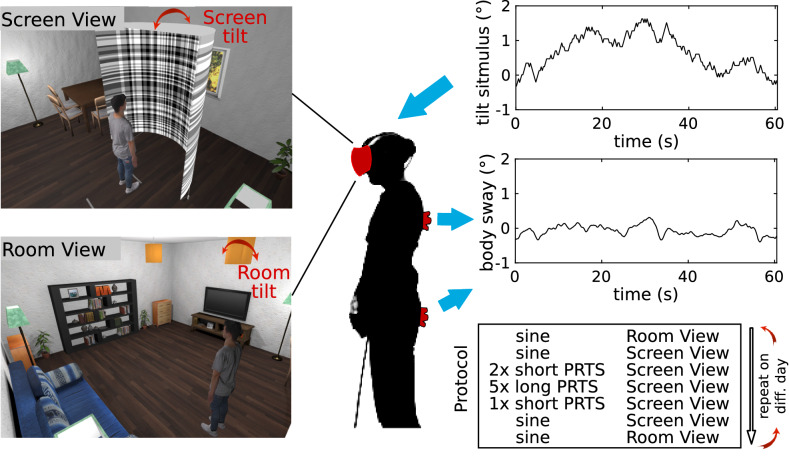
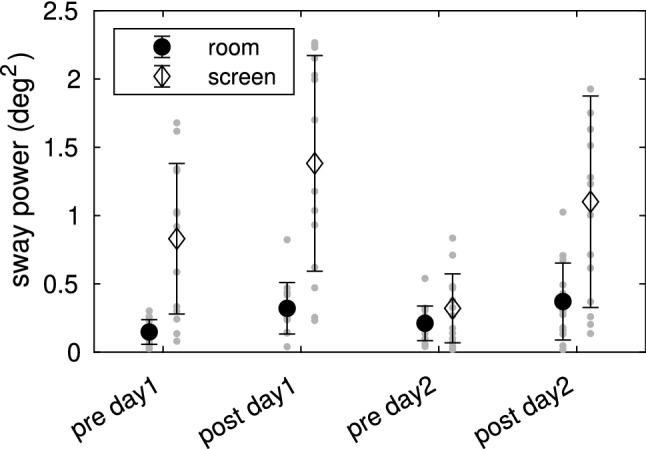
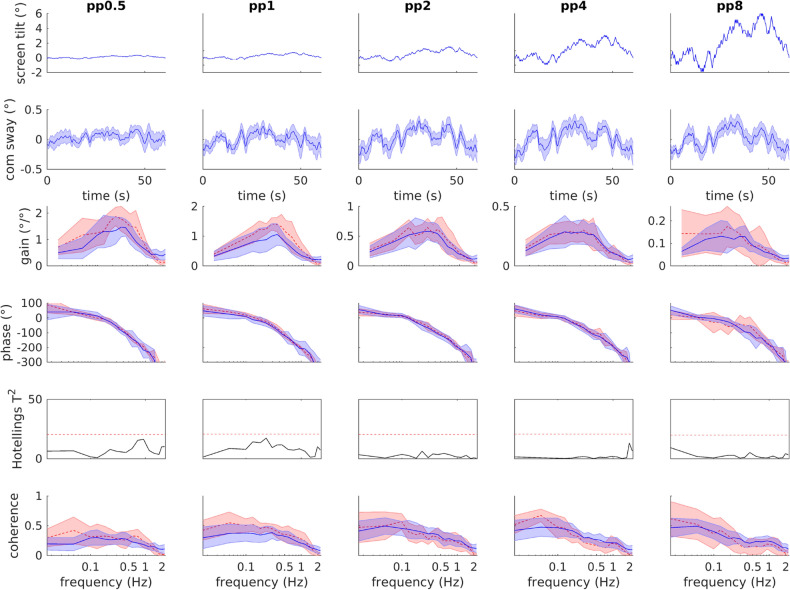
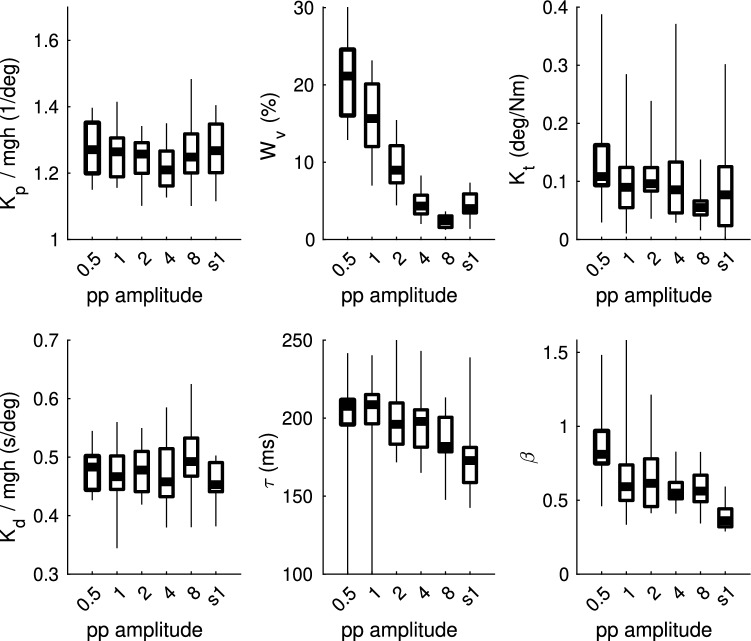
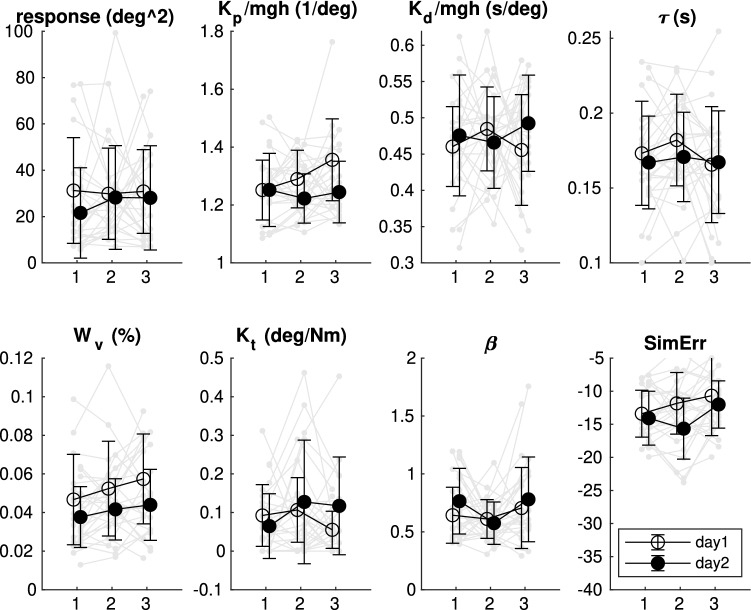
Sensory perturbations are a valuable tool to assess sensory integration mechanisms underlying balance. Implemented as systems-identification approaches, they can be used to quantitatively assess balance deficits and separate underlying causes. However, the experiments require controlled perturbations and sophisticated modeling and optimization techniques. Here we propose and validate a virtual reality implementation of moving visual scene experiments together with model-based interpretations of the results. The approach simplifies the experimental implementation and offers a platform to implement standardized analysis routines. Sway of 14 healthy young subjects wearing a virtual reality head-mounted display was measured. Subjects viewed a virtual room or a screen inside the room, which were both moved during a series of sinusoidal or pseudo-random room or screen tilt sequences recorded on two days. In a between-subject comparison of 10 [Formula: see text] 6 min long pseudo-random sequences, each applied at 5 amplitudes, our results showed no difference to a real-world moving screen experiment from the literature. We used the independent-channel model to interpret our data, which provides a direct estimate of the visual contribution to balance, together with parameters characterizing the dynamics of the feedback system. Reliability estimates of single subject parameters from six repetitions of a 6 [Formula: see text] 20-s pseudo-random sequence showed poor test-retest agreement. Estimated parameters show excellent reliability when averaging across three repetitions within each day and comparing across days (Intra-class correlation; ICC 0.7-0.9 for visual weight, time delay and feedback gain). Sway responses strongly depended on the visual scene, where the high-contrast, abstract screen evoked larger sway as compared to the photo-realistic room. In conclusion, our proposed virtual reality approach allows researchers to reliably assess balance control dynamics including the visual contribution to balance with minimal implementation effort.
感觉扰动是评估平衡基础感觉整合机制的一种有效工具。作为系统识别方法实施时,它们可用于定量评估平衡缺陷并分离潜在原因。然而,这些实验需要受控的扰动和复杂的建模和优化技术。在这里,我们提出并验证了一种虚拟现实实现的运动视觉场景实验,以及基于模型的结果解释。该方法简化了实验的实施,并提供了一个实现标准化分析例程的平台。我们测量了 14 名年轻健康受试者在佩戴虚拟现实头戴式显示器时的摆动。受试者观看了一个虚拟房间或房间内的屏幕,这两个都在一系列正弦或伪随机房间或屏幕倾斜序列中移动,这些序列是在两天内记录的。在 10 个[Formula: see text]6 分钟长的伪随机序列的受试者间比较中,每个序列以 5 个振幅应用,我们的结果与文献中的真实世界移动屏幕实验没有差异。我们使用独立通道模型来解释我们的数据,该模型提供了对平衡的视觉贡献的直接估计,以及描述反馈系统动力学的参数。对六个重复的 6 [Formula: see text]20 秒伪随机序列的单个受试者参数的可靠性估计显示出较差的测试-重测一致性。当在每天内对三个重复进行平均并在两天之间进行比较时,估计的参数显示出极好的可靠性(组内相关系数;视觉权重、时滞和反馈增益的 ICC 0.7-0.9)。摆动响应强烈依赖于视觉场景,高对比度、抽象的屏幕比逼真的房间引起更大的摆动。总之,我们提出的虚拟现实方法允许研究人员以最小的实施工作量可靠地评估平衡控制动力学,包括对平衡的视觉贡献。