Clinical Research Unit (CRU), Egas Moniz Center for Interdisciplinary Research, Egas Moniz School of Health and Science, 2829-511, Almada, Portugal.
Egas Moniz Center for Interdisciplinary Research, Egas Moniz School of Health and Science, 2829-511, Almada, Portugal.
Sci Rep. 2023 Feb 17;13(1):2823. doi: 10.1038/s41598-023-29537-5.
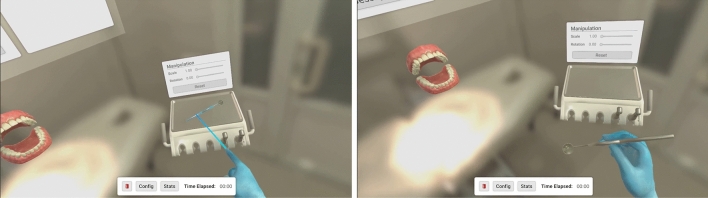
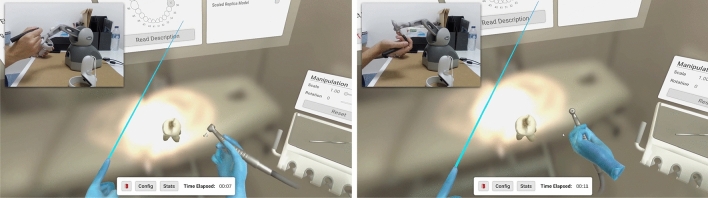
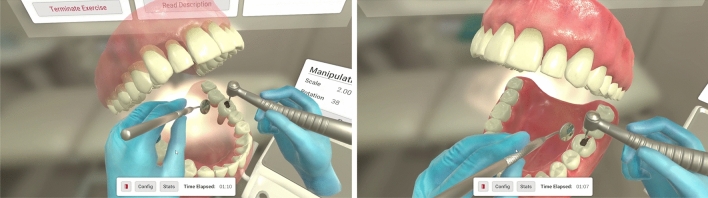
To test and evaluate the second installment of DENTIFY, a virtual reality haptic simulator for Operative Dentistry (OD), on preclinical dental students, by focusing on user performance and self-assessment. Twenty voluntary unpaid preclinical dental students, with different background experience, were enrolled for this study. After the completion of an informed consent, a demographic questionnaire, and being introduced to the prototype (on the first testing session), three testing sessions followed (S1, S2, S3). Each session involved the following steps: (I) free experimentation; (II) task execution; S3 also included (III) completion of questionnaires associated with the experiment (total of 8 Self-Assessment Questions (SAQ)); and (IV) guided interview. As expected, drill time decreased steadily for all tasks when increasing prototype use, verified by RM ANOVA. Regarding performance metrics (Comparisons by Student's t-test and ANOVA) recorded at S3, in overall, a higher performance was verified for participants with the following characteristics: female, non-gamer, no previous VR experience and with over 2 semesters of previous experience of working on phantom models. The correlation between the participants' performance (drill time), for the four tasks, and user self-assessment evaluation, verified by Spearman's rho analysis, allowed to conclude that a higher performance was observed in students who responded that DENTIFY improved their self perception of manual force applied. Regarding the questionnaires, Spearman's rho analysis showed a positive correlation between the improvement DENTIFY inputs on conventional teaching sensed by students, also enhancing their interest in learning OD, their desire to have more simulator hours and the improvement sensed on manual dexterity. All participating students adhered well to the DENTIFY experimentation. DENTIFY allows for student self-assessment and contributes to improving student performance. Simulators with VR and haptic pens for teaching in OD should be designed as a consistent and gradual teaching strategy, allowing multiplicity of simulated scenarios, bimanual manipulation, and the possibility of real-time feedback to allow for the student's immediate self-assessment. Additionally, they should create performance reports per student to ensure self-perception/criticism of their evolution over longer periods of learning time.
为了测试和评估 DENTIFY 的第二部分,这是一款用于口腔操作学(Operative Dentistry,OD)的虚拟现实触觉模拟器,研究对象为口腔医学预科学生,重点关注用户表现和自我评估。本研究共招募了 20 名无偿自愿的口腔医学预科学生,他们具有不同的背景经验。在完成知情同意书、人口统计学问卷并了解原型(在第一次测试会议上)后,他们进行了三次测试会议(S1、S2、S3)。每个会议包括以下步骤:(I)自由实验;(II)任务执行;S3 还包括(III)与实验相关的问卷完成(共 8 个自我评估问题(Self-Assessment Question,SAQ));和(IV)引导式访谈。正如预期的那样,随着原型使用的增加,所有任务的钻头时间都稳步减少,这一点通过 RM ANOVA 得到了验证。关于在 S3 记录的性能指标(通过学生 t 检验和 ANOVA 进行比较),总体而言,具有以下特征的参与者表现更高:女性、非游戏玩家、没有先前的 VR 经验且在虚拟模型上工作超过 2 个学期。通过 Spearman rho 分析参与者表现(钻头时间)与自我评估之间的相关性,对于四个任务,我们得出的结论是,对于那些认为 DENTIFY 提高了他们对手动施加力的自我感知的学生,观察到了更高的表现。关于问卷,Spearman rho 分析显示,学生感知到 DENTIFY 对传统教学的输入改善与他们对学习 OD 的兴趣增加、对手动灵巧性改善的渴望以及对模拟器使用时间增加的渴望之间存在正相关。所有参与的学生都很好地遵守了 DENTIFY 的实验。DENTIFY 允许学生进行自我评估,并有助于提高学生的表现。用于 OD 教学的具有 VR 和触觉笔的模拟器应该设计为一种一致和渐进的教学策略,允许模拟多种场景、双手操作,并提供实时反馈,使学生能够立即进行自我评估。此外,它们应该为每个学生生成性能报告,以确保学生在较长的学习时间内对自己的发展进行自我感知/批评。