Department of Internal Medicine, Affiliated Cancer Hospital of Zhengzhou University & Henan Cancer Hospital, Zhengzhou, Henan, China.
Department of Molecular Pathology, Affiliated Cancer Hospital of Zhengzhou University & Henan Cancer Hospital, Zhengzhou, Henan, China.
Front Immunol. 2023 Feb 7;14:1088685. doi: 10.3389/fimmu.2023.1088685. eCollection 2023.
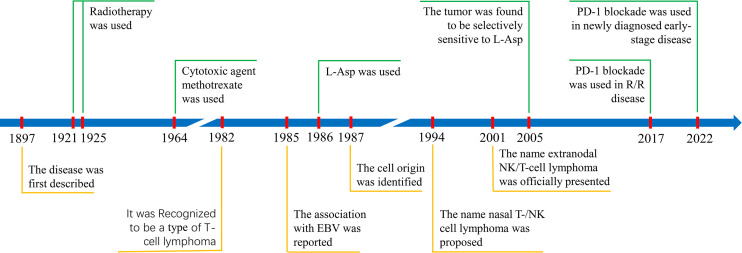
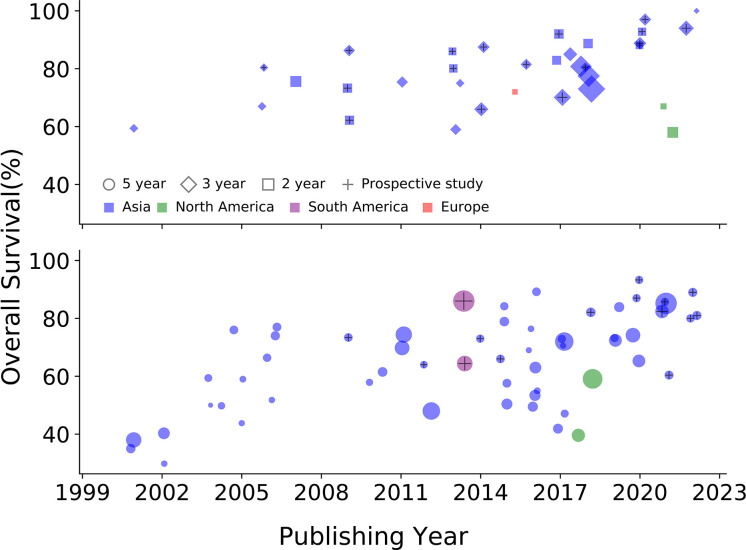
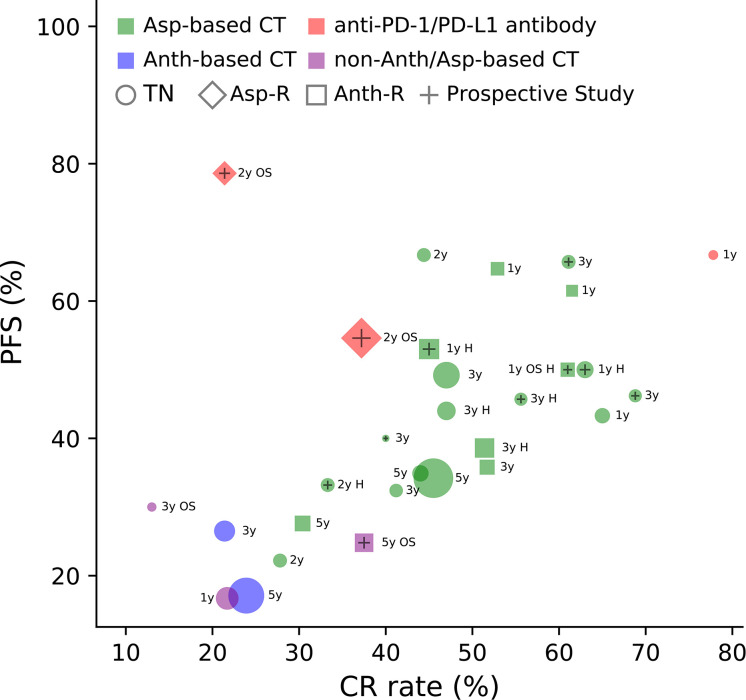
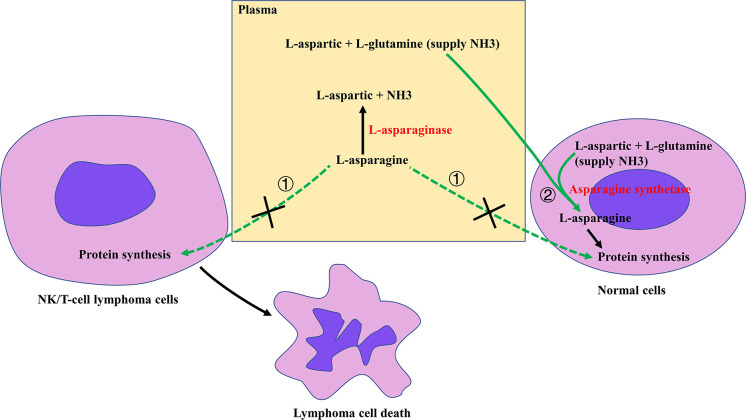
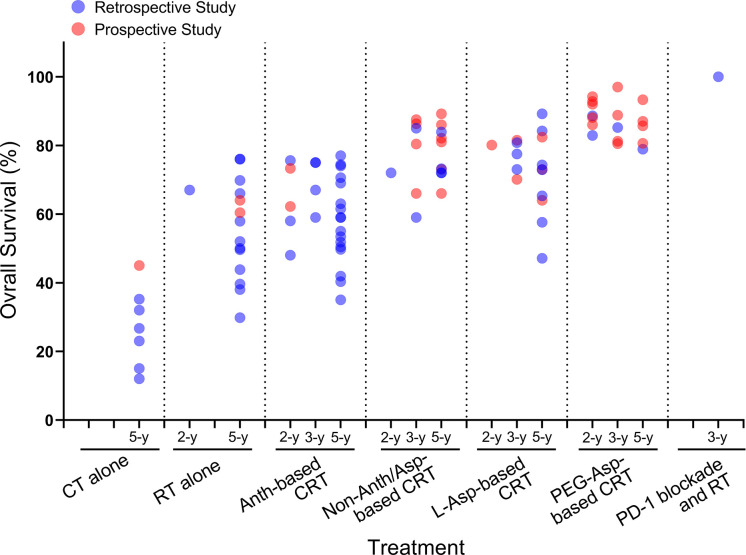
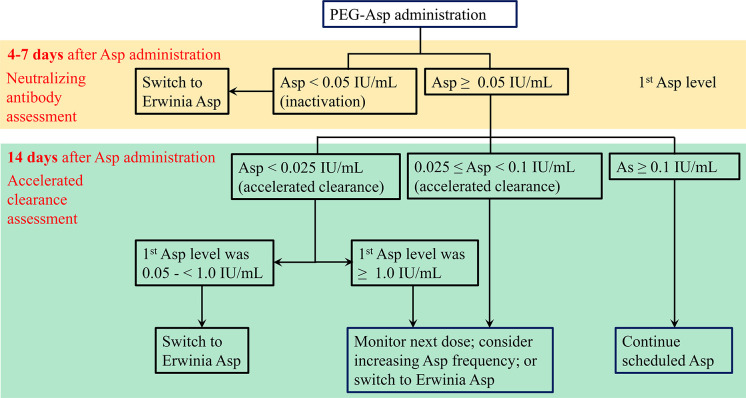
Extranodal NK/T-cell lymphoma (ENKTCL) is the most common subtype of T/NK-cell lymphoma in Asia and Latin America, but very rare in North American and Europe. Patient survival has improved significantly over the past two decades. However, standard treatment has not yet been established, although dozens of prospective trials have been conducted. To help understand how the treatment of ENKTCL has evolved in the past and what trends lie ahead, we have comprehensively reviewed the treatment of this aggressive malignancy, with a particular focus on neglected or unanswered issues, such as the optimal staging method, the best partner of asparaginase (Asp), the individualized administration of Asp, the preferred sequence of CT and RT and so on. Overall, the 5-year overall survival (OS) of patients with Ann Arbor stage I/II disease increased from < 50% in the early 20th century to > 80% in recent years, and the median OS of patients with Ann Arbor stage III/IV disease increased from < 1 year to more than 3 years. The improvement in patient survival is largely attributable to advances in radiation technology and the introduction of Asp and anti-PD-1/PD-L1 immunotherapy into practice. Radiotherapy is essential for patients with early-stage disease, while Asp-based chemotherapy (CT) and PD-1/PD-L1 inhibitors significantly improved the prognosis of patients with advanced-stage disease. ENKTCL management is trending toward simpler regimens, less toxicity, and higher efficacy. Novel drugs, such as manufactured T cells, monoclonal antibodies, and small molecule inhibitors, are being intensively investigated. Based on the fact that ENKTCL is highly resistant to cytotoxic drugs except Asp, and aggressive CT leads to higher toxicity rather than better outcomes, we recommend it is unnecessary to expend additional resources to compare different combinations of Asp with cytotoxic agents. Instead, more efforts should be made to optimize the use of Asp and immunotherapy to maximize efficacy and minimize toxicity, explore ways to overcome resistance to Asp and immunotherapy, identify novel treatment targets, and define subpopulations who may benefit more from specific treatments.
结外 NK/T 细胞淋巴瘤(ENKTCL)是亚洲和拉丁美洲最常见的 T/NK 细胞淋巴瘤亚型,但在北美和欧洲非常罕见。在过去的二十年中,患者的生存率有了显著提高。然而,尽管已经进行了数十项前瞻性试验,但尚未确立标准治疗方法。为了帮助了解过去 ENKTCL 的治疗方法是如何发展的,以及未来的趋势是什么,我们全面回顾了这种侵袭性恶性肿瘤的治疗方法,特别关注了被忽视或未解决的问题,例如最佳分期方法、天冬酰胺酶(Asp)的最佳搭档、Asp 的个体化给药、CT 和 RT 的首选顺序等。总的来说,Ann Arbor 分期 I/II 期患者的 5 年总生存率(OS)从 20 世纪早期的<50%上升到近年来的>80%,Ann Arbor 分期 III/IV 期患者的中位 OS 从<1 年延长至 3 年以上。患者生存率的提高主要归因于放射技术的进步以及将 Asp 和抗 PD-1/PD-L1 免疫疗法引入临床实践。对于早期疾病患者,放疗至关重要,而基于 Asp 的化疗(CT)和 PD-1/PD-L1 抑制剂显著改善了晚期疾病患者的预后。ENKTCL 的治疗方法正朝着更简单的方案、更低的毒性和更高的疗效发展。新型药物,如基因工程 T 细胞、单克隆抗体和小分子抑制剂,正在被深入研究。鉴于除 Asp 外,ENKTCL 对细胞毒性药物高度耐药,且强化 CT 导致更高的毒性而非更好的结果,我们建议没有必要花费额外的资源来比较 Asp 与细胞毒性药物的不同组合。相反,应该努力优化 Asp 和免疫疗法的使用,以最大限度地提高疗效并最小化毒性,探索克服 Asp 和免疫疗法耐药的方法,确定新的治疗靶点,并确定可能从特定治疗中获益更多的亚群。