Pang Qian, Jiang Zilian, Wu Kaihao, Hou Ruixia, Zhu Yabin
Department of Cell Biology and Regenerative Medicine, School of Medicine, Ningbo University, Ningbo 315211, China.
Antibiotics (Basel). 2023 Feb 8;12(2):351. doi: 10.3390/antibiotics12020351.
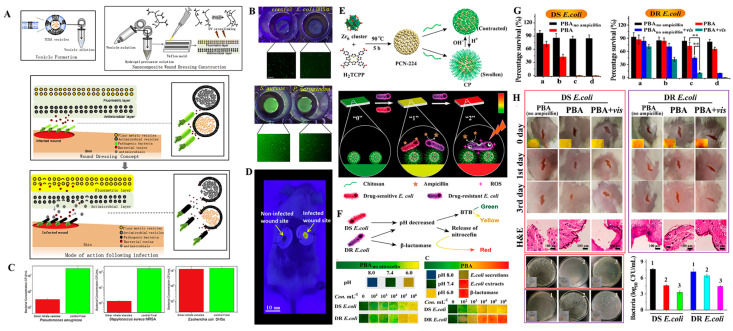
The effective prevention and treatment of bacterial infections is imperative to wound repair and the improvement of patient outcomes. In recent years, nanomaterials have been extensively applied in infection control and wound healing due to their special physiochemical and biological properties. Incorporating antibacterial nanomaterials into wound dressing has been associated with improved biosafety and enhanced treatment outcomes compared to naked nanomaterials. In this review, we discuss progress in the application of nanomaterial-based wound dressings for advanced management of infected wounds. Focus is given to antibacterial therapy as well as the all-in-one detection and treatment of bacterial infections. Notably, we highlight progress in the use of nanoparticles with intrinsic antibacterial performances, such as metals and metal oxide nanoparticles that are capable of killing bacteria and reducing the drug-resistance of bacteria through multiple antimicrobial mechanisms. In addition, we discuss nanomaterials that have been proven to be ideal drug carriers for the delivery and release of antimicrobials either in passive or in stimuli-responsive manners. Focus is given to nanomaterials with the ability to kill bacteria based on the photo-triggered heat (photothermal therapy) or ROS (photodynamic therapy), due to their unparalleled advantages in infection control. Moreover, we highlight examples of intelligent nanomaterial-based wound dressings that can detect bacterial infections in-situ while providing timely antibacterial therapy for enhanced management of infected wounds. Finally, we highlight challenges associated with the current nanomaterial-based wound dressings and provide further perspectives for future improvement of wound healing.
细菌感染的有效预防和治疗对于伤口修复及改善患者预后至关重要。近年来,纳米材料因其特殊的物理化学和生物学特性,已广泛应用于感染控制和伤口愈合领域。与裸纳米材料相比,将抗菌纳米材料融入伤口敷料可提高生物安全性并增强治疗效果。在本综述中,我们讨论了基于纳米材料的伤口敷料在感染伤口高级管理中的应用进展。重点关注抗菌治疗以及细菌感染的一体化检测与治疗。值得注意的是,我们强调了具有内在抗菌性能的纳米颗粒的应用进展,例如能够通过多种抗菌机制杀死细菌并降低细菌耐药性的金属和金属氧化物纳米颗粒。此外,我们还讨论了已被证明是用于被动或刺激响应方式递送和释放抗菌剂的理想药物载体的纳米材料。由于其在感染控制方面具有无与伦比的优势,重点关注基于光触发热(光热疗法)或活性氧(光动力疗法)杀死细菌的纳米材料。此外,我们还强调了基于智能纳米材料的伤口敷料的实例,这些敷料可以原位检测细菌感染,同时提供及时的抗菌治疗,以加强对感染伤口的管理。最后,我们强调了当前基于纳米材料的伤口敷料所面临的挑战,并为伤口愈合的未来改进提供了进一步的展望。