Melhorn James, Alamoudi Asma, Mentzer Alexander J, Fraser Emily, Fries Anastasia, Cassar Mark Philip, Kwok Andrew, Knight Julian Charles, Raman Betty, Talbot Nick P, Petousi Nayia
Nuffield Department of Clinical Medicine (NDM), University of Oxford, Oxford, United Kingdom.
Oxford NIHR Biomedical Research Centre, University of Oxford, Oxford, United Kingdom.
Front Med (Lausanne). 2023 Feb 10;10:1056506. doi: 10.3389/fmed.2023.1056506. eCollection 2023.
In acute severe COVID-19, patients present with lung inflammation and vascular injury, accompanied by an exaggerated cytokine response. In this study, our aim was to describe the inflammatory and vascular mediator profiles in patients who were previously hospitalized with COVID-19 pneumonitis, months after their recovery, and compare them with those in patients recovering from severe sepsis and in healthy controls.
A total of 27 different cytokine, chemokine, vascular endothelial injury and angiogenic mediators were measured in the plasma of forty-nine patients 5.0 ± 1.9 (mean ± SD) months after they were hospitalized with COVID-19 pneumonia, eleven patients 5.4 ± 2.9 months after hospitalization with acute severe sepsis, and 18 healthy controls.
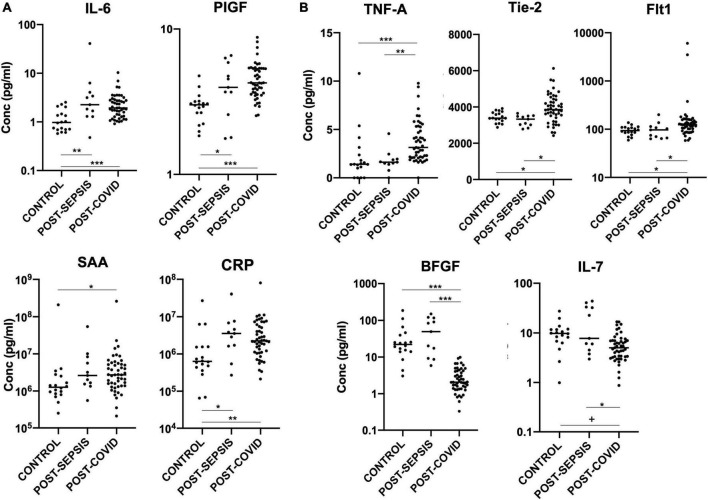
Compared with healthy controls, IL-6, TNFα, SAA, CRP, Tie-2, Flt1, and PIGF were significantly increased in the post-COVID group, and IL-7 and bFGF were significantly reduced. While IL-6, PIGF, and CRP were also significantly elevated in post-Sepsis patients compared to controls, the observed differences in TNFα, Tie-2, Flt-1, IL-7 and bFGF were unique to the post-COVID group. TNFα levels significantly correlated with the severity of acute COVID-19 illness (spearman's r = 0.30, < 0.05). Furthermore, in post-COVID patients, IL-6 and CRP were each strongly negatively correlated with gas transfer factor %predicted (spearman's r = -0.51 and r = -0.57, respectively, < 0.002) and positively correlated with computed tomography (CT) abnormality scores at recovery (r = 0.28 and r = 0.46, < 0.05, respectively).
A unique inflammatory and vascular endothelial damage mediator signature is found in plasma months following acute COVID-19 infection. Further research is required to determine its pathophysiological and clinical significance.
在急性重症新型冠状病毒肺炎(COVID-19)中,患者会出现肺部炎症和血管损伤,并伴有细胞因子反应过度。在本研究中,我们的目的是描述先前因COVID-19肺炎住院的患者在康复数月后的炎症和血管介质谱,并将其与从严重脓毒症中康复的患者以及健康对照者的谱进行比较。
在49例因COVID-19肺炎住院5.0±1.9(均值±标准差)个月后的患者、11例因急性重症脓毒症住院5.4±2.9个月后的患者以及18名健康对照者的血浆中,检测了总共27种不同的细胞因子、趋化因子、血管内皮损伤和血管生成介质。
与健康对照者相比,COVID-19康复组中白细胞介素-6(IL-6)、肿瘤坏死因子α(TNFα)、血清淀粉样蛋白A(SAA)、C反应蛋白(CRP)、酪氨酸激酶2(Tie-2)、血管内皮生长因子受体1(Flt1)和胎盘生长因子(PIGF)显著升高,而IL-7和碱性成纤维细胞生长因子(bFGF)显著降低。与对照者相比,脓毒症康复患者的IL-6、PIGF和CRP也显著升高,但观察到的TNFα、Tie-2、Flt-1、IL-7和bFGF的差异是COVID-19康复组所特有的。TNFα水平与急性COVID-19疾病的严重程度显著相关(斯皮尔曼相关系数r = 0.30,P < 0.05)。此外,在COVID-19康复患者中,IL-6和CRP分别与预测的气体交换因子%呈强烈负相关(斯皮尔曼相关系数分别为r = -0.51和r = -0.57,P < 0.002),与康复时的计算机断层扫描(CT)异常评分呈正相关(分别为r = 0.28和r = 0.46,P < 0.05)。
在急性COVID-19感染数月后的血浆中发现了独特的炎症和血管内皮损伤介质特征。需要进一步研究以确定其病理生理和临床意义。