Dhar Eshita, Upadhyay Umashankar, Huang Yaoru, Uddin Mohy, Manias George, Kyriazis Dimosthenis, Wajid Usman, AlShawaf Hamza, Syed Abdul Shabbir
Graduate Institute of Biomedical Informatics, College of Medical Science and Technology, Taipei Medical University, Taipei.
International Center for Health Information Technology, College of Medical Science and Technology, Taipei Medical University, Taipei.
Digit Health. 2023 Feb 26;9:20552076231158022. doi: 10.1177/20552076231158022. eCollection 2023 Jan-Dec.
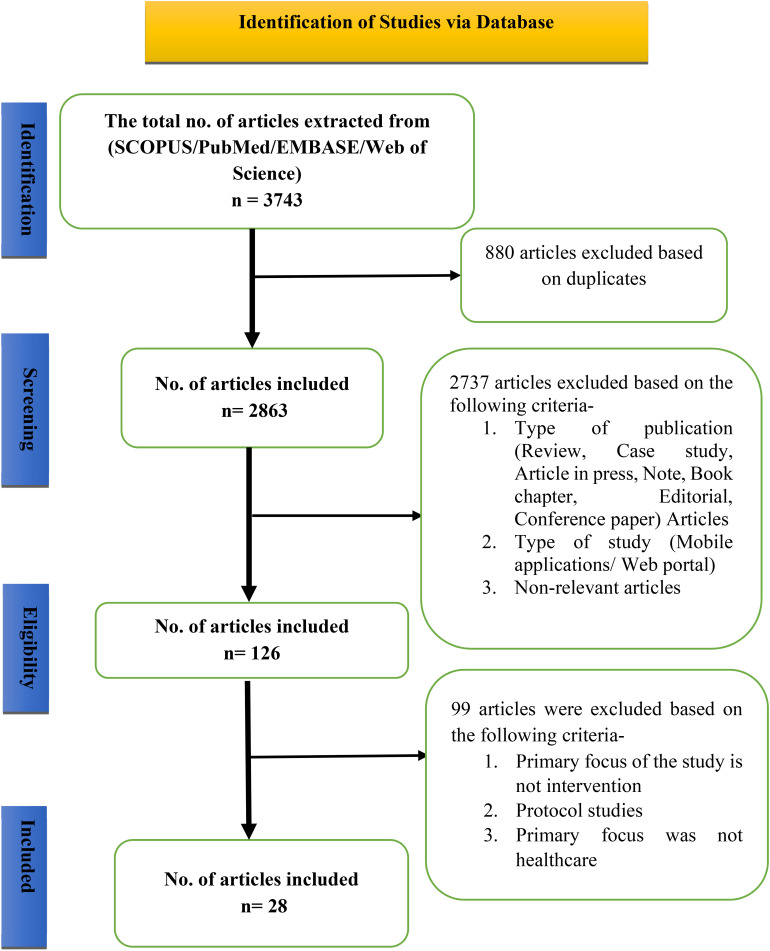
Due to the challenges and restrictions posed by COVID-19 pandemic, technology and digital solutions played an important role in the rendering of necessary healthcare services, notably in medical education and clinical care. The aim of this scoping review was to analyze and sum up the most recent developments in Virtual Reality (VR) use for therapeutic care and medical education, with a focus on training medical students and patients. We identified 3743 studies, of which 28 were ultimately selected for the review. The search strategy followed the most recent Preferred Reporting Items for Systematic Reviews and Meta-Analysis for scoping review (PRISMA-ScR) guidelines. 11 studies (39.3%) in the field of medical education assessed different domains, such as knowledge, skills, attitudes, confidence, self-efficacy, and empathy. 17 studies (60.7%) focused on clinical care, particularly in the areas of mental health, and rehabilitation. Among these, 13 studies also investigated user experiences and feasibility in addition to clinical outcomes. Overall, the findings of our review reported considerable improvements in terms of medical education and clinical care. VR systems were also found to be safe, engaging, and beneficial by the studies' participants. There were huge variations in studies with respect to the study designs, VR contents, devices, evaluation methods, and treatment periods. In the future, studies may focus on creating definitive guidelines that can help in improving patient care further. Hence, there is an urgent need for researchers to collaborate with the VR industry and healthcare professionals to foster a better understanding of contents and simulation development.
由于新冠疫情带来的挑战和限制,技术及数字解决方案在提供必要的医疗服务方面发挥了重要作用,尤其是在医学教育和临床护理领域。本范围综述的目的是分析和总结虚拟现实(VR)在治疗护理和医学教育中的最新进展,重点关注对医学生和患者的培训。我们确定了3743项研究,最终选择了其中28项进行综述。检索策略遵循了最新的系统评价和Meta分析扩展综述的首选报告项目(PRISMA-ScR)指南。医学教育领域的11项研究(39.3%)评估了不同领域,如知识、技能、态度、信心、自我效能感和同理心。17项研究(60.7%)聚焦于临床护理,特别是心理健康和康复领域。其中,13项研究除了临床结果外,还调查了用户体验和可行性。总体而言,我们综述的结果表明在医学教育和临床护理方面有了显著改善。研究参与者还发现VR系统是安全、有趣且有益的。在研究设计、VR内容、设备、评估方法和治疗周期方面存在巨大差异。未来,研究可能会侧重于制定明确的指南,以进一步帮助改善患者护理。因此,研究人员迫切需要与VR行业和医疗专业人员合作,以更好地理解内容和模拟开发。