Ferioun Mohamed, Srhiouar Nassira, Bouhraoua Said, El Ghachtouli Naïma, Louahlia Saïd
Natural Resources and Environmental Laboratory. Taza Polydisciplinary Faculty, Sidi Mohamed Ben Abdellah University, Fez, Morocco.
Microbial Biotechnology and Bioactive Molecules Laboratory, Sciences and Technology Faculty, Sidi Mohamed Ben Abdellah University, Fez, Morocco.
Heliyon. 2023 Feb 10;9(2):e13643. doi: 10.1016/j.heliyon.2023.e13643. eCollection 2023 Feb.
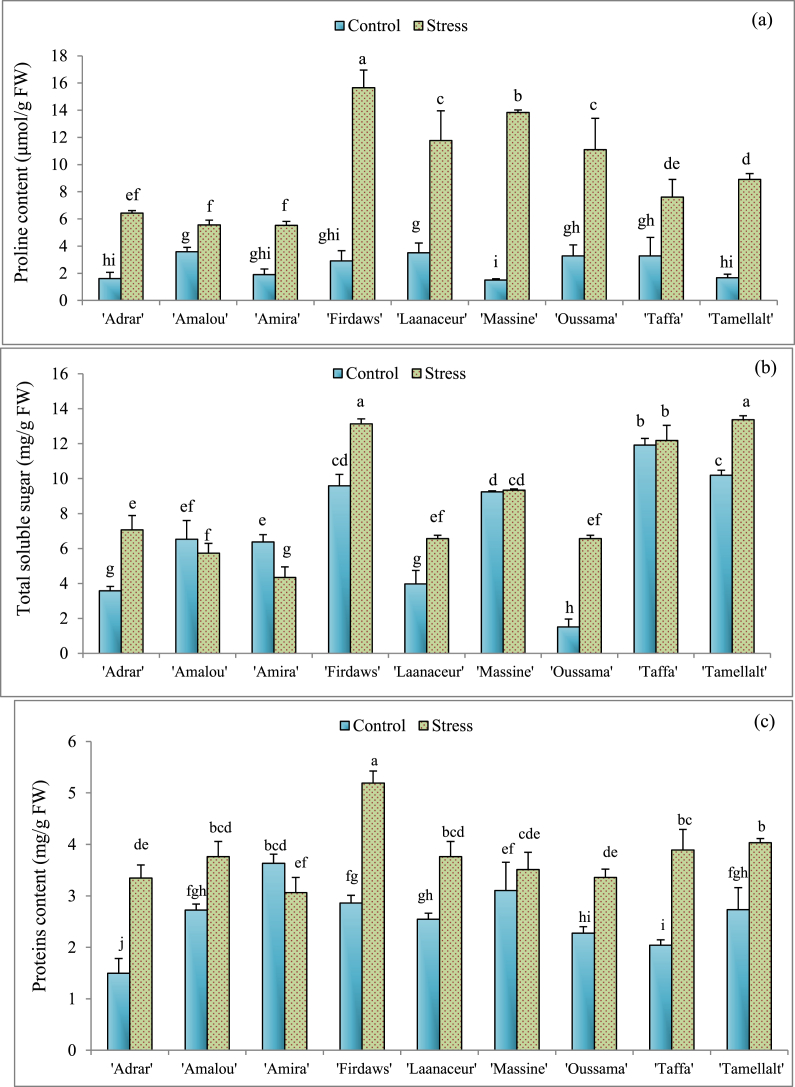
Barley ( L.) is the second most consumed and cultivated cereal by the Moroccan population. However, it is predicted that frequent drought periods, caused by climate change, can cause problems in plant growth. Thus, the selection of drought-tolerant barley cultivars is essential to ensure the security of barley's needs. We aimed to screen drought stress tolerance in Moroccan barley cultivars. We tested the drought tolerance of nine Moroccan barley cultivars ('Adrar', 'Amalou', 'Amira', 'Firdaws', 'Laanaceur', 'Massine', 'Oussama', 'Taffa', and 'Tamellalt') based on physiological and biochemical parameters. Drought stress was applied by maintaining field capacity at 40% (90% for the control), and plants were randomly arranged in a greenhouse at 25 °C under natural light conditions. Drought stress decreased relative water content (RWC), shoot dry weight (SDW), and chlorophyll content (SPAD index), but significantly increased electrolyte leakage, hydrogen peroxide, malondialdehyde (MDA), water-soluble carbohydrates, and soluble protein contents, as well as catalase (CAT) and ascorbate peroxidase (APX) activities. High levels of SDW, RWC, CAT, and APX activities were recorded in 'Firdaws', 'Laanaceur', 'Massine', 'Taffa', and 'Oussama', which can be interpreted by high drought tolerance. On the other hand, 'Adrar', 'Amalou', 'Amira', and 'Tamellalt' showed higher values of MDA and HO content, which can be linked with drought sensitivity. Physiological and biochemical parameter changes are discussed in terms of barley's tolerance to drought. Tolerant cultivars could be a good background for barley breeding in areas known for the alternative of long dry spells.
大麦(L.)是摩洛哥人消费和种植的第二大谷物。然而,据预测,气候变化导致的频繁干旱期会给植物生长带来问题。因此,选择耐旱的大麦品种对于确保大麦需求的安全至关重要。我们旨在筛选摩洛哥大麦品种的耐旱胁迫能力。我们基于生理和生化参数测试了九个摩洛哥大麦品种(“阿德拉尔”、“阿马卢”、“阿米拉”、“菲尔多斯”、“拉纳瑟尔”、“马辛”、“奥萨马”、“塔法”和“塔梅拉特”)的耐旱性。通过将田间持水量维持在40%(对照为90%)来施加干旱胁迫,植株在25°C的温室中自然光条件下随机排列。干旱胁迫降低了相对含水量(RWC)、地上部干重(SDW)和叶绿素含量(SPAD指数),但显著增加了电解质渗漏、过氧化氢、丙二醛(MDA)、水溶性碳水化合物和可溶性蛋白含量,以及过氧化氢酶(CAT)和抗坏血酸过氧化物酶(APX)活性。“菲尔多斯”、“拉纳瑟尔”、“马辛”、“塔法”和“奥萨马”的SDW、RWC、CAT和APX活性水平较高,这可以解释为具有高耐旱性。另一方面,“阿德拉尔”、“阿马卢”、“阿米拉”和“塔梅拉特”的MDA和HO含量较高,这可能与干旱敏感性有关。从大麦对干旱的耐受性方面讨论了生理和生化参数的变化。在以长期干旱交替为特征的地区,耐旱品种可能是大麦育种的良好基础。