State Key Laboratory of Surface Physics and Department of Physics, Human Phenome Institute, Academy for Engineering and Technology, Key Laboratory of Micro and Nano Photonic Structures (Ministry of Education), Yiwu Research Institute, Fudan University, Shanghai 200433, China.
Department of Pathology, Fudan University Shanghai Cancer Center, Shanghai 200032, China.
Theranostics. 2023 Feb 21;13(4):1342-1354. doi: 10.7150/thno.81784. eCollection 2023.
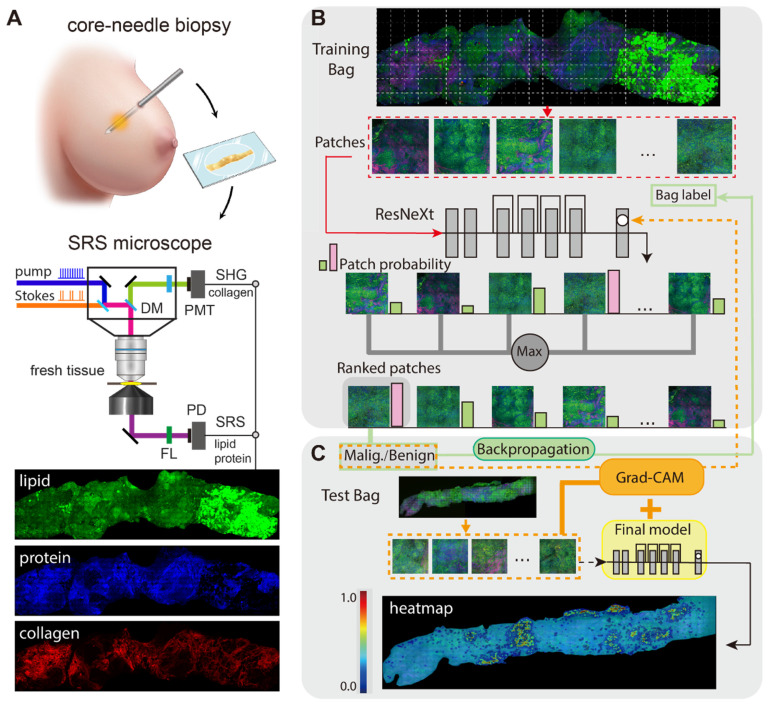
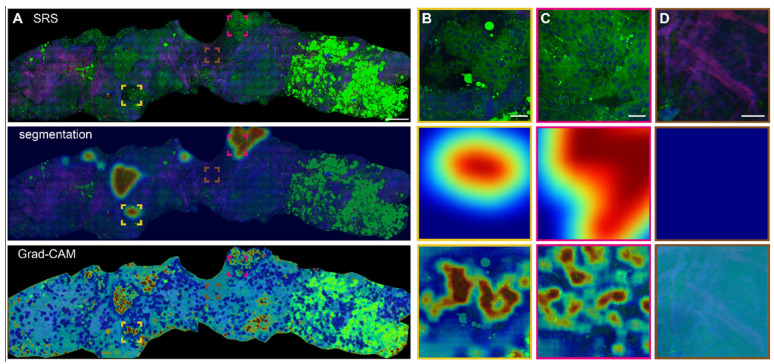
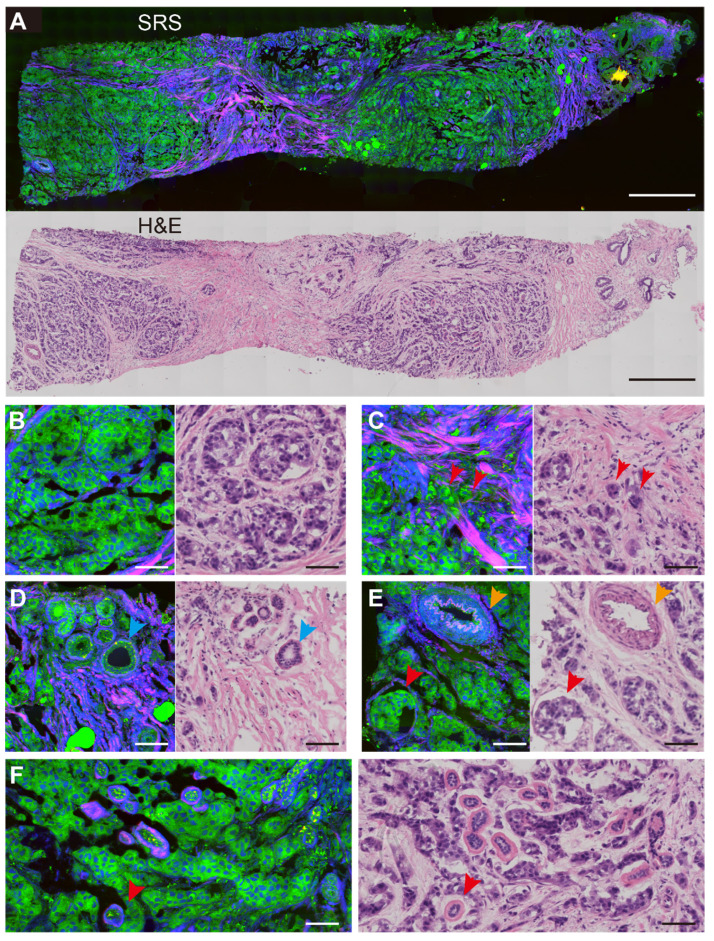
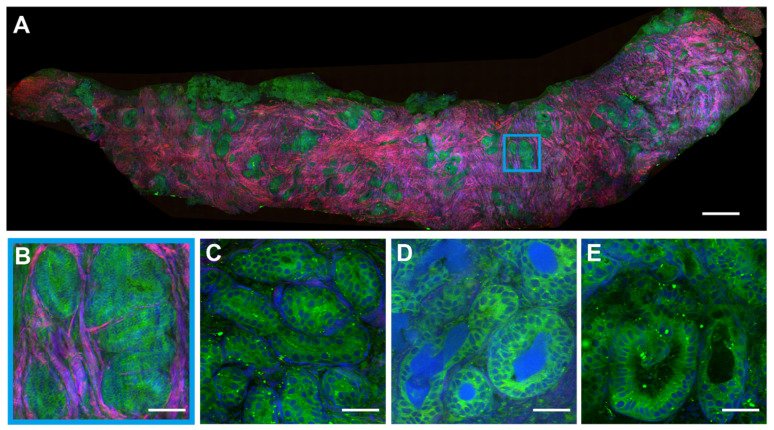
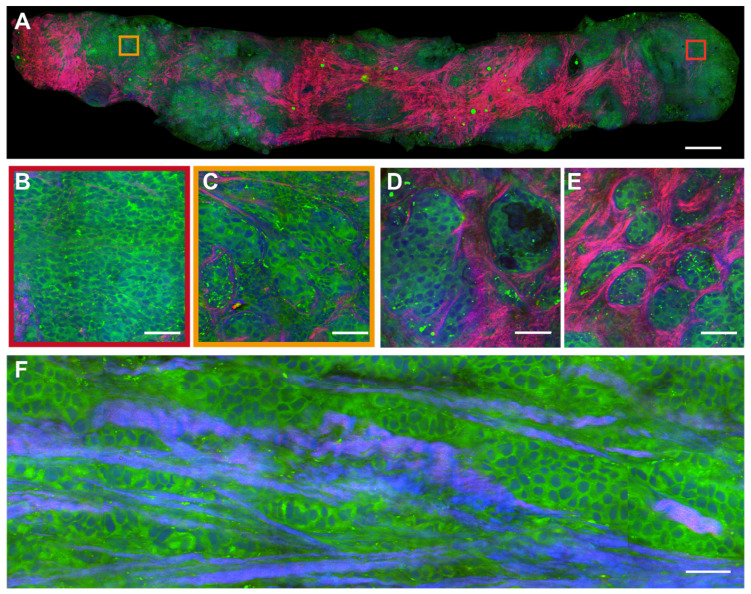
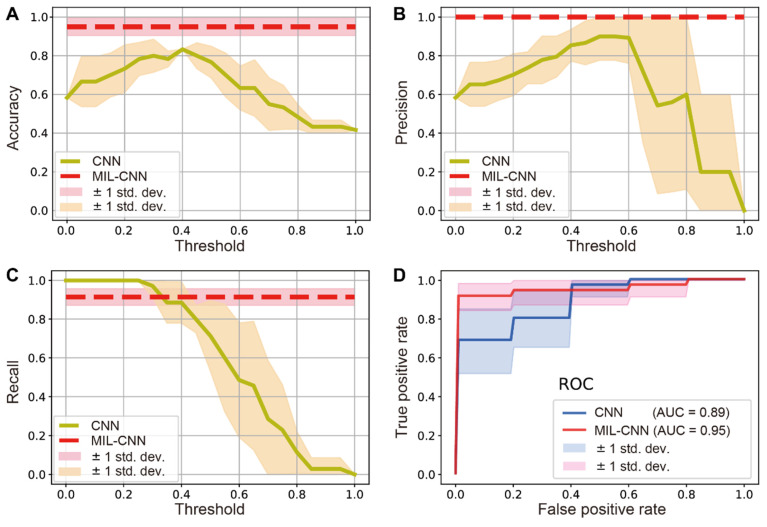
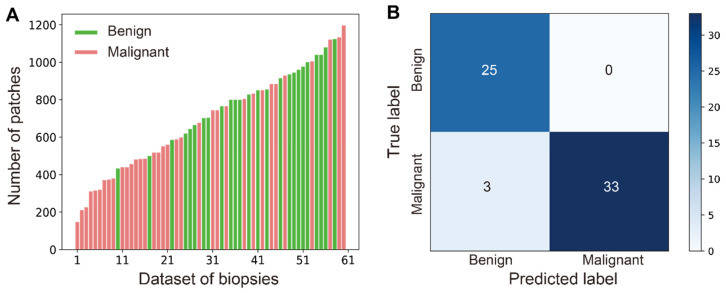
Core-needle biopsy (CNB) plays a vital role in the initial diagnosis of breast cancer. However, the complex tissue processing and global shortage of pathologists have hindered traditional histopathology from timely diagnosis on fresh biopsies. In this work, we developed a full digital platform by integrating label-free stimulated Raman scattering (SRS) microscopy with weakly-supervised learning for rapid and automated cancer diagnosis on un-labelled breast CNB. We first compared the results of SRS imaging with standard hematoxylin and eosin (H&E) staining on adjacent frozen tissue sections. Then fresh unprocessed biopsy tissues were imaged by SRS to reveal diagnostic histoarchitectures. Next, weakly-supervised learning, i.e., the multi-instance learning (MIL) model was conducted to evaluate the ability to differentiate between benign and malignant cases, and compared with the performance of supervised learning model. Finally, gradient-weighted class activation mapping (Grad-CAM) and semantic segmentation were performed to spatially resolve benign/malignant areas with high efficiency. We verified the ability of SRS in revealing essential histological hallmarks of breast cancer in both thin frozen sections and fresh unprocessed biopsy, generating histoarchitectures well correlated with H&E staining. Moreover, we demonstrated that weakly-supervised MIL model could achieve superior classification performance to supervised learnings, reaching diagnostic accuracy of 95% on 61 biopsy specimens. Furthermore, Grad-CAM allowed the trained MIL model to visualize the histological heterogeneity within the CNB. Our results indicate that MIL-assisted SRS microscopy provides rapid and accurate diagnosis on histologically heterogeneous breast CNB, and could potentially help the subsequent management of patients.
核心针活检 (CNB) 在乳腺癌的初步诊断中起着至关重要的作用。然而,复杂的组织处理和全球病理学家短缺阻碍了传统的组织病理学对新鲜活检进行及时诊断。在这项工作中,我们通过整合无标记的受激拉曼散射 (SRS) 显微镜与弱监督学习,为未标记的乳腺癌 CNB 上的快速和自动癌症诊断开发了一个全数字平台。我们首先比较了 SRS 成像与相邻冷冻组织切片上标准苏木精和伊红 (H&E) 染色的结果。然后,对新鲜未处理的活检组织进行 SRS 成像以揭示诊断性组织架构。接下来,进行弱监督学习,即多实例学习 (MIL) 模型,以评估区分良性和恶性病例的能力,并与监督学习模型的性能进行比较。最后,进行梯度加权类激活映射 (Grad-CAM) 和语义分割,以高效地空间解析良性/恶性区域。我们验证了 SRS 在揭示乳腺癌在薄冷冻切片和新鲜未处理活检中的基本组织学特征的能力,生成的组织架构与 H&E 染色高度相关。此外,我们证明了弱监督 MIL 模型可以达到优于监督学习的分类性能,在 61 个活检标本上达到 95%的诊断准确性。此外,Grad-CAM 允许训练有素的 MIL 模型对 CNB 内的组织学异质性进行可视化。我们的结果表明,MIL 辅助的 SRS 显微镜为组织学异质的乳腺癌 CNB 提供了快速准确的诊断,并且有可能有助于患者的后续管理。