Radiation Safety and Quality Assurance Division, National Cancer Center Hospital, Chuo-ku, Tokyo, Japan.
Department of Radiological Sciences, Graduate School of Human Health Sciences, Tokyo Metropolitan University, Higashioku, Arakawa-ku, Tokyo, Japan.
J Appl Clin Med Phys. 2023 May;24(5):e13915. doi: 10.1002/acm2.13915. Epub 2023 Mar 19.
We measure the dose distribution of gated delivery for different target motions and estimate the gating latency in a magnetic resonance-guided radiotherapy (MRgRT) system.
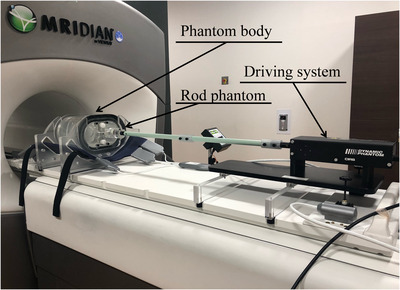
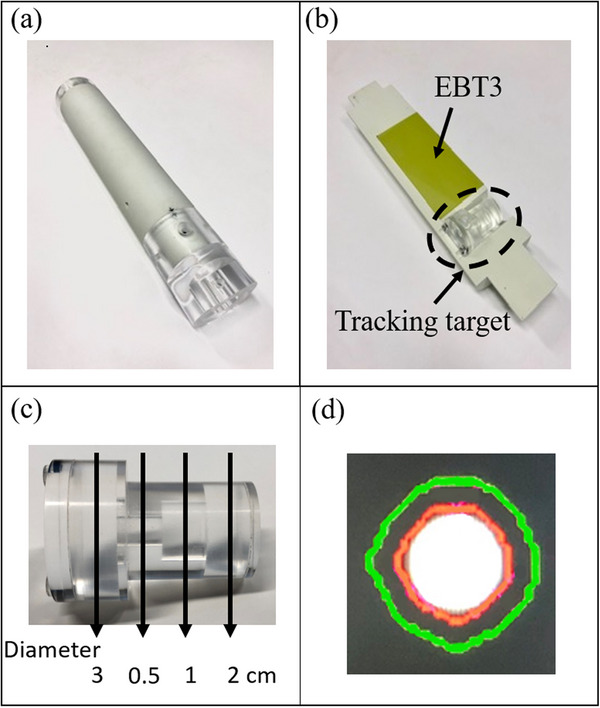
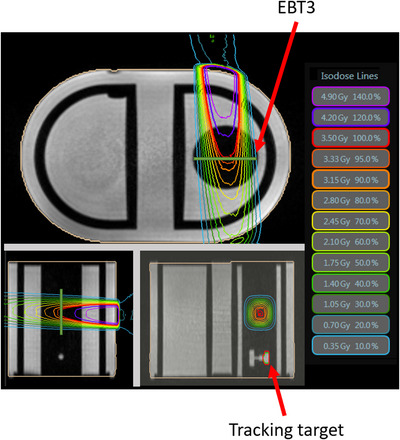
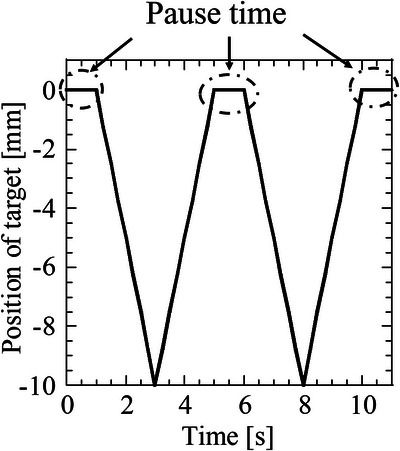
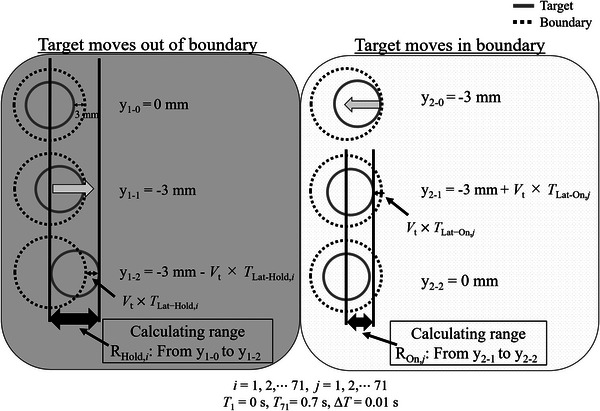
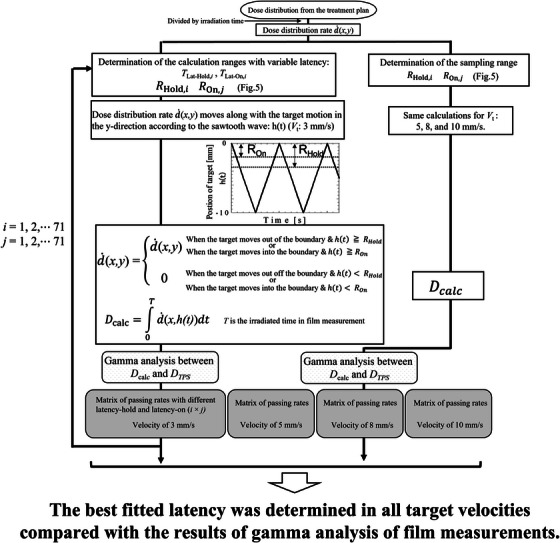
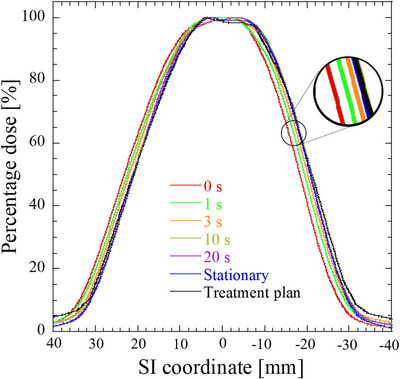
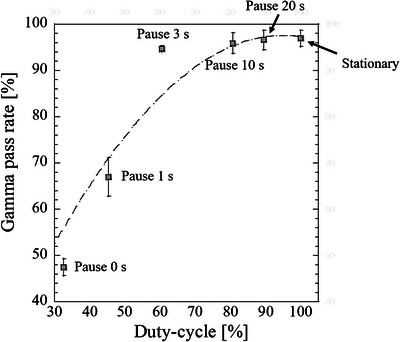
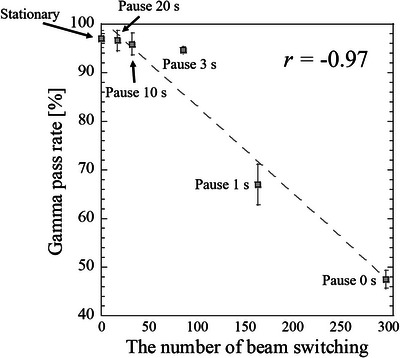
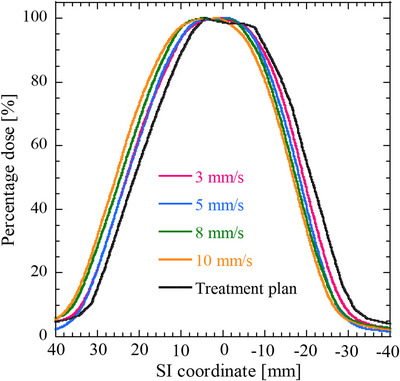
The dose distribution accuracy of the gated MRgRT system (MRIdian, Viewray) was investigated using an in-house-developed phantom that was compatible with the magnetic field and gating method. This phantom contains a simulated tumor and a radiochromic film (EBT3, Ashland, Inc.). To investigate the effect of the number of beam switching and target velocity on the dose distribution, two types of target motions were applied. One is that the target was periodically moved at a constant velocity of 5 mm/s with different pause times (0, 1, 3, 10, and 20 s) between the motions. During different pause times, different numbers of beams were switched on/off. The other one is that the target was moved at velocities of 3, 5, 8, and 10 mm/s without any pause (i.e., continuous motion). The gated method was applied to these motions at MRIdian, and the dose distributions in each condition were measured using films. To investigate the relation between target motion and dose distribution in the gating method, we compared the results of the gamma analysis of the calculated and measured dose distributions. Moreover, we analytically estimated the gating latencies from the dose distributions measured using films and the gamma analysis results.
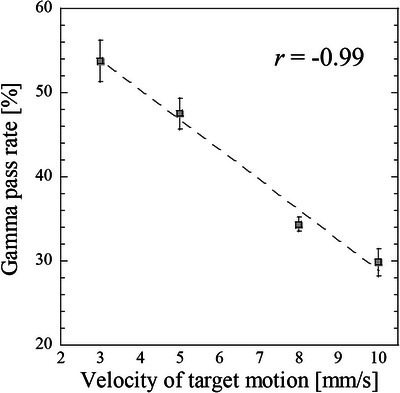
The gamma pass rate linearly decreased with increasing beam switching and target velocity. The overall gating latencies of beam-hold and beam-on were 0.51 ± 0.17 and 0.35 ± 0.05 s, respectively.
Film measurements highlighted the factors affecting the treatment accuracy of the gated MRgRT system. Our analytical approach, employing gamma analysis on films, can be used to estimate the overall latency of the gated MRgRT system.
我们测量了不同目标运动的门控输送剂量分布,并估计了磁共振引导放射治疗(MRgRT)系统中的门控延迟。
使用与磁场和门控方法兼容的内部开发的体模来研究门控 MRgRT 系统(MRIdian,Viewray)的剂量分布准确性。该体模包含模拟肿瘤和光致变色胶片(EBT3,Ashland,Inc.)。为了研究光束切换次数和目标速度对剂量分布的影响,应用了两种类型的目标运动。一种是目标以 5mm/s 的恒定速度周期性移动,运动之间的停顿时间不同(0、1、3、10 和 20s)。在不同的停顿时间内,切换开/关的光束数量不同。另一种是目标以 3、5、8 和 10mm/s 的速度移动,没有任何停顿(即连续运动)。将门控方法应用于这些运动,使用胶片测量每个条件下的剂量分布。为了研究门控方法中目标运动与剂量分布之间的关系,我们比较了计算和测量剂量分布的伽马分析结果。此外,我们还从使用胶片测量的剂量分布和伽马分析结果分析估计了门控延迟。
伽马通过率随光束切换和目标速度的增加而线性降低。光束保持和光束开启的总门控延迟分别为 0.51±0.17 和 0.35±0.05s。
胶片测量强调了影响门控 MRgRT 系统治疗准确性的因素。我们的分析方法,在胶片上使用伽马分析,可以用来估计门控 MRgRT 系统的总延迟。