Department of Obstetrics and Gynecology, Oregon Health & Science University, Portland.
Department of Obstetrics and Gynecology, Brigham and Women's Hospital, Boston, Massachusetts.
JAMA Netw Open. 2023 Mar 1;6(3):e233684. doi: 10.1001/jamanetworkopen.2023.3684.
Many states enacted 20-week abortion bans from 2011 to 2018. Such bans affect individuals who receive diagnoses of fetal anomalies and aneuploidy in the second trimester, preventing pregnant individuals from having the choice of whether or not to continue the pregnancy.
To examine the trends of neonatal Down syndrome rates and assess the association between enactment of 20-week abortion bans and rates of Down syndrome diagnosis.
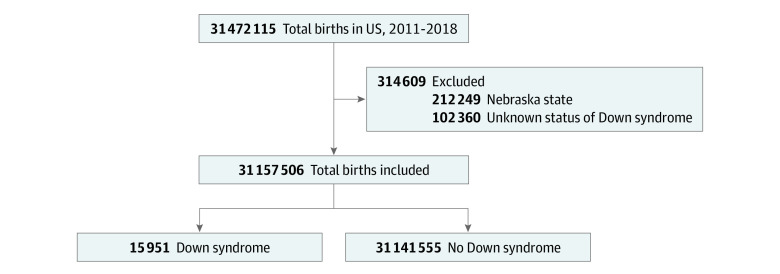
DESIGN, SETTING, AND PARTICIPANTS: This population-based, historical cohort study used National Vital Statistics System data on 31 157 506 births in the US from 2011 to 2018. Statistical analysis was performed from May 2021 to February 2023.
States were categorized as those with or without a 20-week abortion ban enacted during the study period.
Demographic characteristics between the ban and no-ban states were compared using χ2 tests and 2-sample t tests. Multivariable logistic regression evaluated the adjusted odds of Down syndrome among births in states that enacted 20-week abortion bans after the abortion ban enactment, adjusting for state, year of birth, maternal race and ethnicity, age, educational level, insurance, and number of prenatal visits.
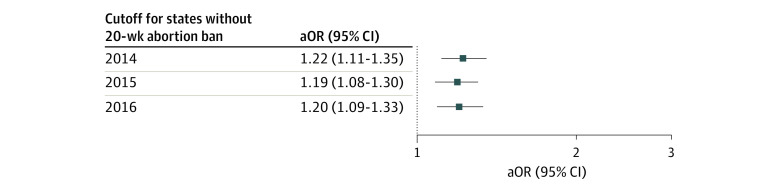
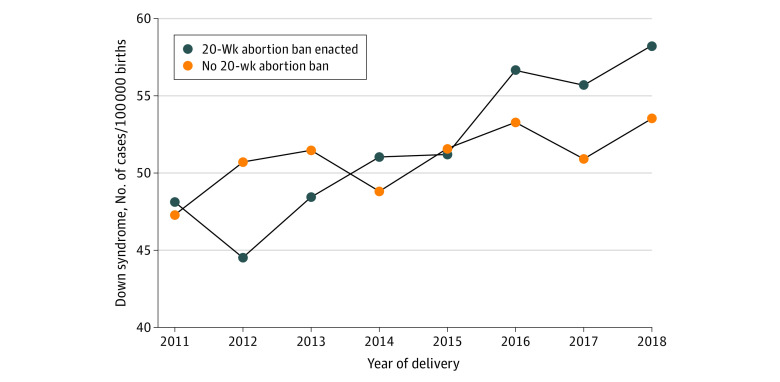
The cohort consisted of 31 157 506 births (mean [SD] maternal age, 28.4 [5.9] years) in the United States, of whom 15 951 neonates (0.05%) received a diagnosis of Down syndrome at birth. A total of 17 states enacted 20-week abortion bans during the study period, and 33 states did not enact bans. In both states with and states without bans, the birth prevalence of neonatal Down syndrome increased over time; in states with bans, rates increased from 48.0 to 58.4 per 100 000 births; in states without bans, rates increased from 47.4 to 53.3 per 100 000 births. In multivariable logistic regression assessing the interaction of time and presence of a 20-week abortion ban, the odds of Down syndrome were higher in states that enacted 20-week abortion bans after enactment of the law compared with the years prior to enactment of the ban (adjusted odds ratio, 1.22; 95% CI, 1.11-1.35).
In the US from 2011 to 2018, neonatal Down syndrome diagnoses increased more in states that enacted 20-week abortion bans compared with states that did not enact bans. Because these abortion bans were enacted throughout the study period and are known to inhibit choice in patient decision-making, it is possible that the difference in the rates of diagnosis is associated with these policies.
许多州在 2011 年至 2018 年颁布了 20 周堕胎禁令。这些禁令影响了在第二孕期被诊断出胎儿异常和非整倍体的个人,使怀孕的个人无法选择是否继续妊娠。
检查新生儿唐氏综合征率的趋势,并评估 20 周堕胎禁令的颁布与唐氏综合征诊断率之间的关联。
设计、地点和参与者:本研究为基于人群的历史队列研究,使用了美国国家生命统计系统 2011 年至 2018 年 31157506 例出生的数据。统计分析于 2021 年 5 月至 2023 年 2 月进行。
将各州分为在研究期间颁布或未颁布 20 周堕胎禁令的州。
使用 χ2 检验和 2 样本 t 检验比较禁令和无禁令州之间的人口统计学特征。多变量逻辑回归评估了在堕胎禁令颁布后颁布 20 周堕胎禁令的州中,出生时唐氏综合征的调整后几率,调整了州、出生年份、产妇种族和民族、年龄、教育程度、保险和产前检查次数。
该队列包括美国 31157506 例出生(母亲平均[SD]年龄,28.4[5.9]岁),其中 15951 例新生儿(0.05%)在出生时被诊断为唐氏综合征。在研究期间,共有 17 个州颁布了 20 周堕胎禁令,33 个州没有颁布禁令。在颁布禁令和没有颁布禁令的州,新生儿唐氏综合征的出生率都随着时间的推移而增加;在颁布禁令的州,发病率从每 10 万活产 48.0 例增加到 58.4 例;在没有颁布禁令的州,发病率从每 10 万活产 47.4 例增加到 53.3 例。在评估时间和 20 周堕胎禁令存在的相互作用的多变量逻辑回归中,与禁令颁布前的年份相比,在颁布 20 周堕胎禁令的州,唐氏综合征的几率更高(调整后的优势比,1.22;95%CI,1.11-1.35)。
在美国,2011 年至 2018 年间,颁布 20 周堕胎禁令的州与未颁布禁令的州相比,唐氏综合征的诊断率增加更多。由于这些堕胎禁令在整个研究期间都被颁布,并且已知会限制患者决策中的选择,因此诊断率的差异可能与这些政策有关。