Cluster for Pioneering Research, RIKEN, Saitama, 351-0198, Japan.
Commun Biol. 2023 Mar 21;6(1):299. doi: 10.1038/s42003-023-04694-5.
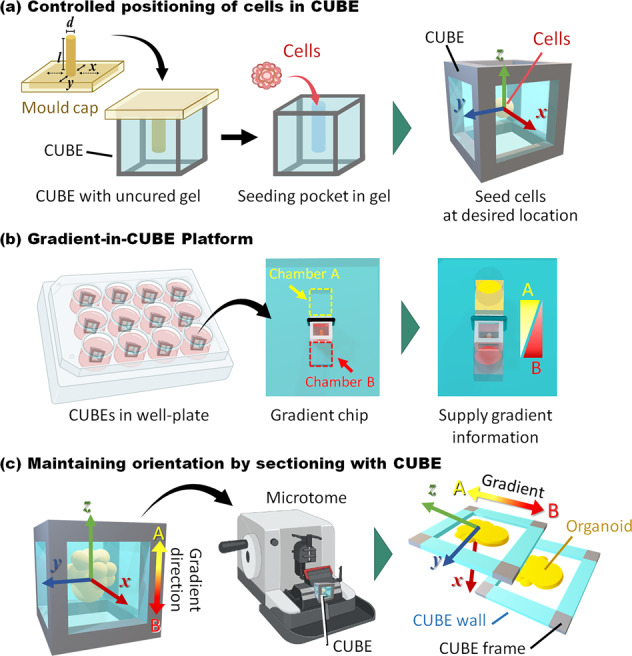
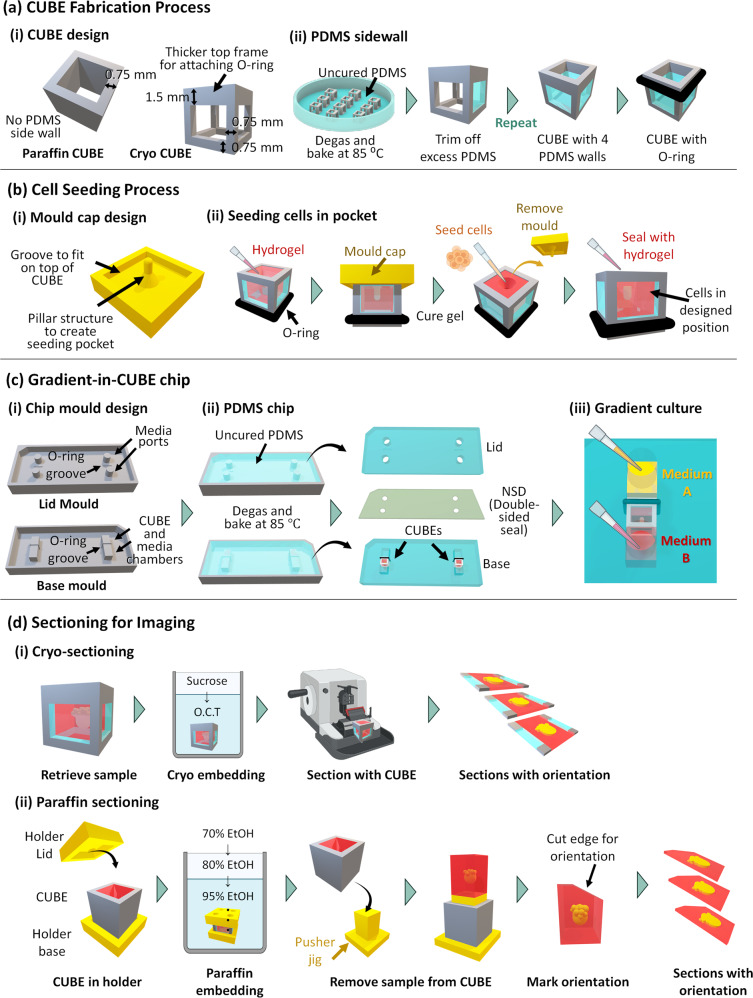
Advancements in organoid culture have led to various in vitro mini-organs that mimic native tissues in many ways. Yet, the bottleneck remains to generate complex organoids with body axis patterning, as well as keeping the orientation of organoids during post-experiment analysis processes. Here, we present a workflow for culturing organoids with morphogen gradient using a CUBE culture device, followed by sectioning samples with the CUBE to retain information on gradient direction. We show that hiPSC spheroids cultured with two separated differentiation media on opposing ends of the CUBE resulted in localized expressions of the respective differentiation markers, in contrast to homogeneous distribution of markers in controls. We also describe the processes for cryo and paraffin sectioning of spheroids in CUBE to retain gradient orientation information. This workflow from gradient culture to sectioning with CUBE can provide researchers with a convenient tool to generate increasingly complex organoids and study their developmental processes in vitro.
类器官培养的进步已经产生了各种在体外模拟天然组织的迷你器官。然而,目前的瓶颈仍然是生成具有体轴模式的复杂类器官,以及在实验后分析过程中保持类器官的方向。在这里,我们提出了一种使用 CUBE 培养装置培养具有形态发生梯度的类器官的工作流程,然后使用 CUBE 对样品进行切片,以保留梯度方向的信息。我们表明,在 CUBE 的两端分别培养具有两种分离分化培养基的 hiPSC 球体导致各自分化标志物的局部表达,而对照中标志物呈均匀分布。我们还描述了在 CUBE 中对球体进行冷冻和石蜡切片的过程,以保留梯度方向信息。这种从梯度培养到 CUBE 切片的工作流程可为研究人员提供一种方便的工具,以生成越来越复杂的类器官并在体外研究它们的发育过程。