University of Waterloo, Ontario, Canada.
McGill University, Montreal, Quebec, Canada.
Pers Soc Psychol Rev. 2023 Nov;27(4):414-433. doi: 10.1177/10888683231157961. Epub 2023 Mar 23.
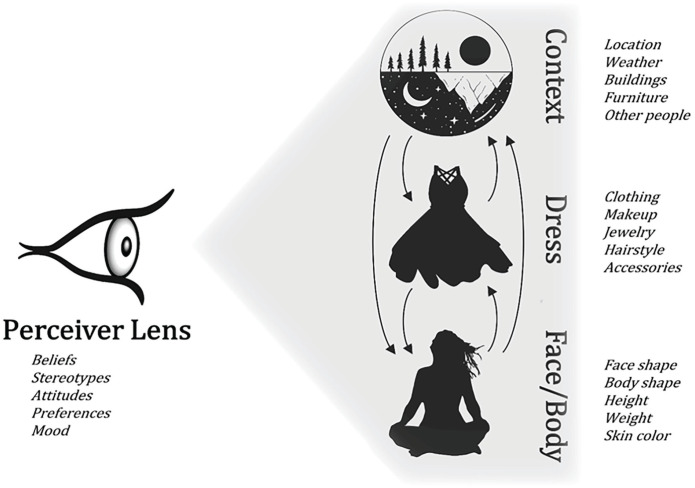
Clothing, hairstyle, makeup, and accessories influence first impressions. However, target dress is notably absent from current theories and models of person perception. We discuss three reasons for this minimal attention to dress in person perception: high theoretical complexity, incompatibility with traditional methodology, and underappreciation by the groups who have historically guided research in person perception. We propose a working model of person perception that incorporates target dress alongside target face, target body, context, and perceiver characteristics. Then, we identify four types of inferences for which perceivers rely on target dress: social categories, cognitive states, status, and aesthetics. For each of these, we review relevant work in social cognition, integrate this work with existing dress research, and propose future directions. Finally, we identify and offer solutions to the theoretical and methodological challenges accompanying the psychological study of dress.
Why is it that people often agonize over what to wear for a job interview, a first date, or a party? The answer is simple: They understand that others' first impressions of them rely on their clothing, hairstyle, makeup, and accessories. Many people might be surprised, then, to learn that psychologists' theories about how people form first impressions of others have little to say about how people dress. This is true in part because the meaning of clothing is so complex and culturally dependent. We propose a working model of first impressions that identifies four types of information that people infer from dress: people's social identities, mental states, status, and aesthetic tastes. For each of these, we review existing research on clothing, integrate this research with related work from social psychology more broadly, and propose future directions for research.
服装、发型、妆容和配饰会影响第一印象。然而,在当前的人际感知理论和模型中,目标着装却明显缺失。我们讨论了人们对人际感知中着装关注甚少的三个原因:理论复杂性高、与传统方法不兼容,以及历史上指导人际感知研究的群体对此重视不足。我们提出了一个包含目标着装、目标面部、目标身体、情境和感知者特征的人际感知工作模型。然后,我们确定了感知者依赖目标着装进行的四种推断:社会类别、认知状态、地位和审美。对于每一种推断,我们回顾了社会认知领域的相关工作,将这些工作与现有的着装研究相结合,并提出了未来的研究方向。最后,我们确定了并提出了解决与心理着装研究相关的理论和方法挑战的方案。
为什么人们在参加工作面试、第一次约会或派对时经常会为穿什么衣服而苦恼?答案很简单:他们知道别人对他们的第一印象取决于他们的服装、发型、妆容和配饰。许多人可能会感到惊讶,那么,心理学家关于人们如何形成对他人的第一印象的理论几乎没有涉及到人们的着装。部分原因是服装的含义如此复杂且依赖于文化。我们提出了一个关于第一印象的工作模型,该模型确定了人们从着装中推断出的四种信息:人们的社会身份、心理状态、地位和审美品味。对于每一种信息,我们都回顾了现有的关于服装的研究,将这些研究与更广泛的社会心理学研究相结合,并提出了未来的研究方向。