Redwood Lisa, Fox Greg J, Nguyen Thu Anh, Bernarys Sarah, Mason Paul, Vu Van Anh, Nguyen Viet Nhung, Mitchell Ellen M H
The Faculty of Medicine and Health, The University of Sydney, Central Clinical School, The University of Sydney, Camperdown, New South Wales, Australia.
The Woolcock Institute of Medical Research, Ba Dinh District, Hanoi, Vietnam.
PLOS Glob Public Health. 2022 Jun 22;2(6):e0000681. doi: 10.1371/journal.pgph.0000681. eCollection 2022.
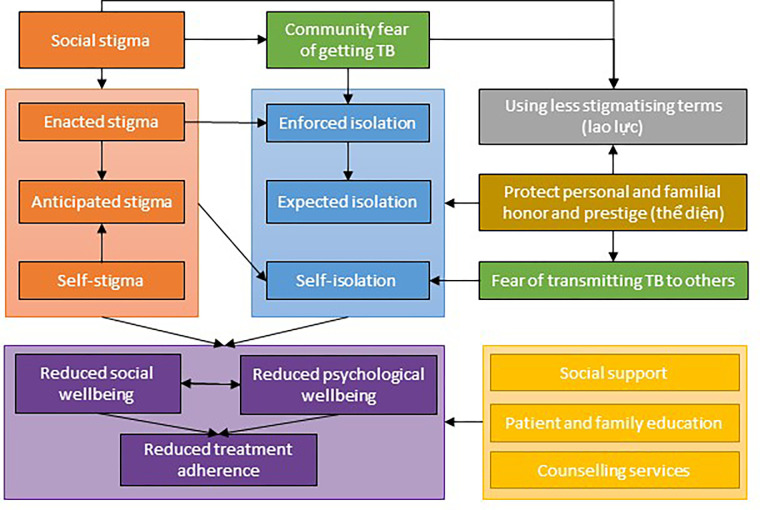
Stigma and isolation are common in people with tuberculosis (TB). Social isolation contributes to reduced health outcomes and TB treatment adherence. Stigma and the drivers of isolation in people with Drug-Resistant (DR)-TB may include modifiable advice and practices of family and Health Care Workers (HCW). This study aimed to understand the drivers of isolation and stigma from the perspective of people with DR-TB in Vietnam. A greater understanding of stigma and isolation is important to identify and balance patients' needs and disease transmission risk. In-depth interviews were conducted with 12 people with DR-TB and seven HCWs who care for people with DR-TB in two provinces in Vietnam. Interviews were audio-recorded, transcribed verbatim and translated to English. Data collection and analysis were conducted simultaneously. The data were then analysed using a thematic framework approach. Stigma and extended isolation were common experiences among people with DR-TB. To mitigate stigma, people with DR-TB used the local term 'lao lực' to describe their condition to others which is believed to be a less infectious and less stigmatising type of TB. This study identified that although HCW informed people with DR-TB of when they were no longer infectious and isolation was no longer required, their infection control advice was not always consistent. Despite knowing they were no longer infectious, most people with DR-TB continued to self-isolate to minimise the perceived repercussions of societal stigma, to protect their 'thể diện' (honour, prestige, reputation), and eliminate all risk of transmitting DR-TB to their family. This study identified three interconnected drivers of self-isolation in Vietnam, including fear of infecting others, fear of stigmatization, and to protect family reputation. TB control programmes need to better understand the social aspects of DR-TB to enable them to better support patients. Educating HCW to provide evidence-based infection control advice is vital.
耻辱感和隔离在结核病患者中很常见。社会隔离会导致健康状况下降以及结核病治疗依从性降低。耐多药结核病患者的耻辱感和隔离驱动因素可能包括家庭和医护人员可改变的建议及做法。本研究旨在从越南耐多药结核病患者的角度了解隔离和耻辱感的驱动因素。更好地理解耻辱感和隔离对于识别并平衡患者需求及疾病传播风险很重要。对越南两个省份的12名耐多药结核病患者和7名照顾耐多药结核病患者的医护人员进行了深入访谈。访谈进行了录音,逐字转录并翻译成英文。数据收集和分析同时进行。然后使用主题框架方法对数据进行分析。耻辱感和长期隔离是耐多药结核病患者的常见经历。为了减轻耻辱感,耐多药结核病患者使用当地术语“劳力”向他人描述自己的病情,人们认为这是一种传染性较小且耻辱感较低的结核病类型。本研究发现,尽管医护人员告知耐多药结核病患者他们何时不再具有传染性且不再需要隔离,但他们的感染控制建议并不总是一致的。尽管知道自己不再具有传染性,但大多数耐多药结核病患者仍继续自我隔离,以尽量减少社会耻辱感带来的预期影响,保护他们的“体面”(荣誉、威望、声誉),并消除将耐多药结核病传播给家人的所有风险。本研究确定了越南自我隔离的三个相互关联的驱动因素,包括害怕传染他人、害怕被污名化以及保护家庭声誉。结核病控制项目需要更好地了解耐多药结核病的社会层面,以便能够更好地支持患者。教育医护人员提供基于证据的感染控制建议至关重要。