Ancient Genomics Laboratory, Francis Crick Institute, 1 Midland Road, NW1 1AT London, UK.
Department of Genetics, Perelman School of Medicine, University of Pennsylvania, 415 Curie Blvd, Philadelphia, PA 19104, USA.
Curr Biol. 2023 Apr 10;33(7):1365-1371.e3. doi: 10.1016/j.cub.2023.02.049. Epub 2023 Mar 23.
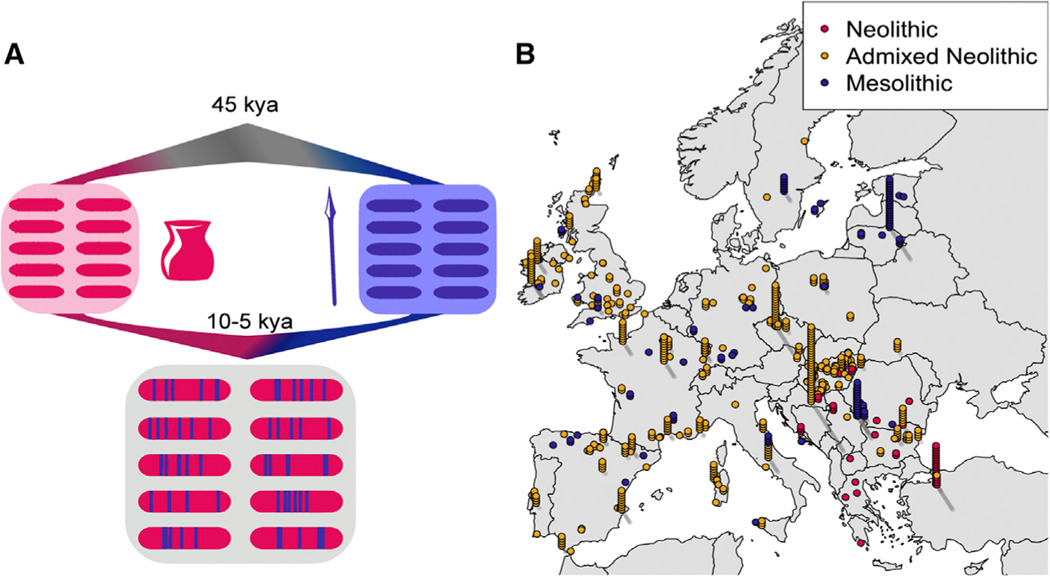
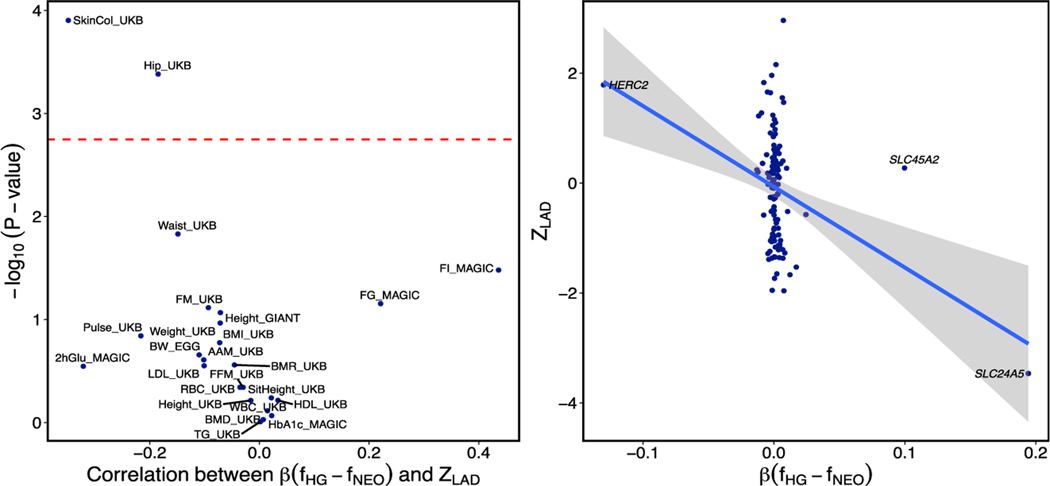
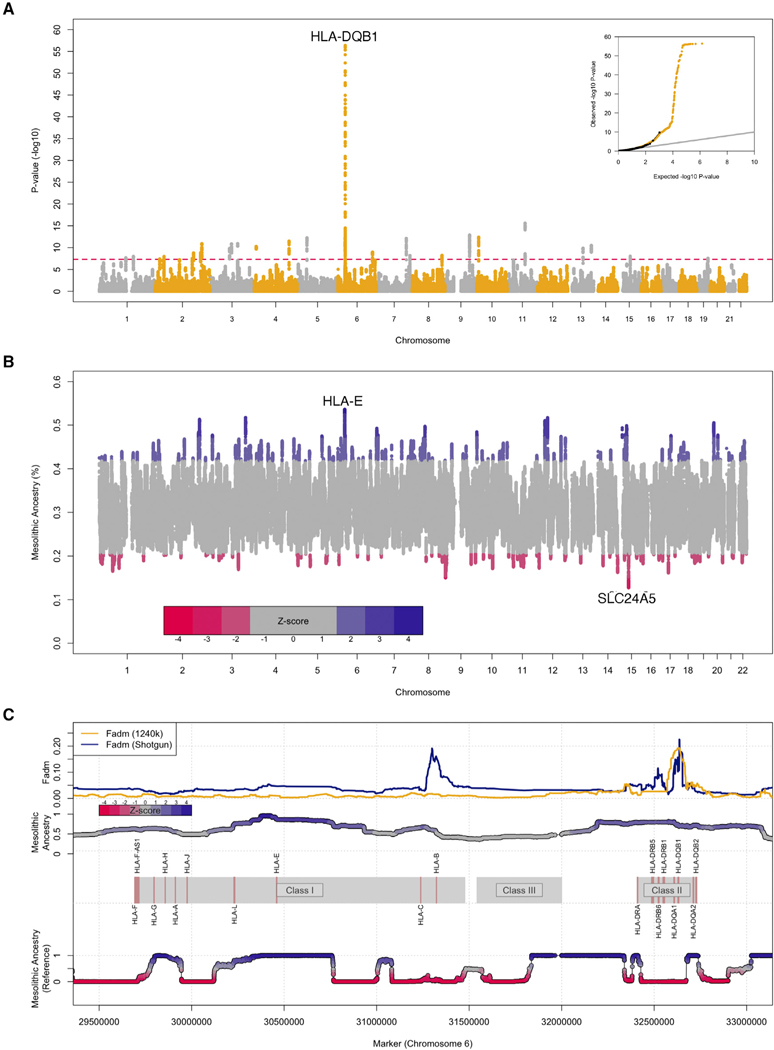
Ancient DNA has revealed multiple episodes of admixture in human prehistory during geographic expansions associated with cultural innovations. One important example is the expansion of Neolithic agricultural groups out of the Near East into Europe and their consequent admixture with Mesolithic hunter-gatherers. Ancient genomes from this period provide an opportunity to study the role of admixture in providing new genetic variation for selection to act upon, and also to identify genomic regions that resisted hunter-gatherer introgression and may thus have contributed to agricultural adaptations. We used genome-wide DNA from 677 individuals spanning Mesolithic and Neolithic Europe to infer ancestry deviations in the genomes of admixed individuals and to test for natural selection after admixture by testing for deviations from a genome-wide null distribution. We find that the region around the pigmentation-associated gene SLC24A5 shows the greatest overrepresentation of Neolithic local ancestry in the genome (|Z| = 3.46). In contrast, we find the greatest overrepresentation of Mesolithic ancestry across the major histocompatibility complex (MHC; |Z| = 4.21), a major immunity locus, which also shows allele frequency deviations indicative of selection following admixture (p = 1 × 10). This could reflect negative frequency-dependent selection on MHC alleles common in Neolithic populations or that Mesolithic alleles were positively selected for and facilitated adaptation in Neolithic populations to pathogens or other environmental factors. Our study extends previous results that highlight immune function and pigmentation as targets of adaptation in more recent populations to selection processes in the Stone Age.
古 DNA 揭示了人类史前时期在与文化创新相关的地理扩张过程中多次发生混合。一个重要的例子是新石器时代农业群体从近东扩张到欧洲,并与中石器时代的狩猎采集者混合。这一时期的古代基因组为研究混合在为选择提供新的遗传变异方面的作用提供了机会,也为识别抵抗狩猎采集者渗入的基因组区域提供了机会,这些区域可能为农业适应做出了贡献。我们使用了来自跨越中石器时代和新石器时代欧洲的 677 个人的全基因组 DNA,推断混合个体基因组中的祖先偏差,并通过测试全基因组零分布的偏差来测试混合后的自然选择。我们发现,与色素沉着相关的基因 SLC24A5 周围的区域在基因组中表现出最强烈的新石器时代本地祖先的代表性(|Z|=3.46)。相比之下,我们在主要组织相容性复合体(MHC;|Z|=4.21)中发现了最强烈的中石器时代祖先的代表性,这是一个主要的免疫基因座,它也显示出混合后选择的等位基因频率偏差(p=1×10)。这可能反映了在新石器时代群体中常见的 MHC 等位基因的负频率依赖性选择,或者中石器时代的等位基因受到了正选择,并促进了新石器时代群体对病原体或其他环境因素的适应。我们的研究扩展了先前的研究结果,即强调免疫功能和色素沉着作为最近群体适应选择过程的目标。