Hussain Ali Yossra, Sabu Chooralil Varghese, Balasubramanian Karthikeyan, Manyam Rajasekhar Reddy, Kidambi Raju Sekar, T Sadiq Ahmed, Farhan Alaa K
Department of Computer Sciences, University of Technology, Bagdad 110066, Iraq.
Department of Computer Sciences & Engineering, Rajagiri School of Engineering & Technology, Kochi 682039, Kerala, India.
Bioengineering (Basel). 2023 Mar 2;10(3):320. doi: 10.3390/bioengineering10030320.
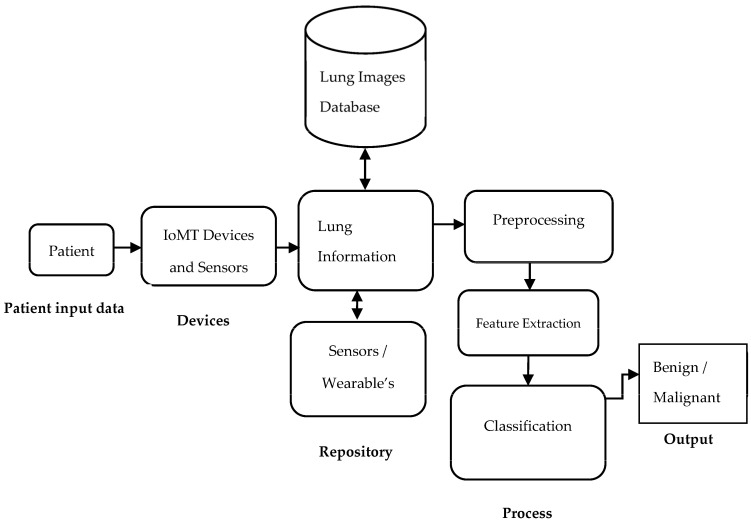
Recently, deep learning and the Internet of Things (IoT) have been widely used in the healthcare monitoring system for decision making. Disease prediction is one of the emerging applications in current practices. In the method described in this paper, lung cancer prediction is implemented using deep learning and IoT, which is a challenging task in computer-aided diagnosis (CAD). Because lung cancer is a dangerous medical disease that must be identified at a higher detection rate, disease-related information is obtained from IoT medical devices and transmitted to the server. The medical data are then processed and classified into two categories, benign and malignant, using a multi-layer CNN (ML-CNN) model. In addition, a particle swarm optimization method is used to improve the learning ability (loss and accuracy). This step uses medical data (CT scan and sensor information) based on the Internet of Medical Things (IoMT). For this purpose, sensor information and image information from IoMT devices and sensors are gathered, and then classification actions are taken. The performance of the proposed technique is compared with well-known existing methods, such as the Support Vector Machine (SVM), probabilistic neural network (PNN), and conventional CNN, in terms of accuracy, precision, sensitivity, specificity, F-score, and computation time. For this purpose, two lung datasets were tested to evaluate the performance: Lung Image Database Consortium (LIDC) and Linear Imaging and Self-Scanning Sensor (LISS) datasets. Compared to alternative methods, the trial outcomes showed that the suggested technique has the potential to help the radiologist make an accurate and efficient early lung cancer diagnosis. The performance of the proposed ML-CNN was analyzed using Python, where the accuracy (2.5-10.5%) was high when compared to the number of instances, precision (2.3-9.5%) was high when compared to the number of instances, sensitivity (2.4-12.5%) was high when compared to several instances, the F-score (2-30%) was high when compared to the number of cases, the error rate (0.7-11.5%) was low compared to the number of cases, and the computation time (170 ms to 400 ms) was low compared to how many cases were computed for the proposed work, including previous known methods. The proposed ML-CNN architecture shows that this technique outperforms previous works.
最近,深度学习和物联网(IoT)已在医疗监测系统中广泛用于决策。疾病预测是当前实践中新兴的应用之一。在本文所述的方法中,肺癌预测是通过深度学习和物联网实现的,这在计算机辅助诊断(CAD)中是一项具有挑战性的任务。由于肺癌是一种危险的疾病,必须以更高的检测率进行识别,因此从物联网医疗设备获取疾病相关信息并传输到服务器。然后使用多层卷积神经网络(ML-CNN)模型对医学数据进行处理并分为良性和恶性两类。此外,使用粒子群优化方法来提高学习能力(损失和准确率)。此步骤基于医疗物联网(IoMT)使用医学数据(CT扫描和传感器信息)。为此,收集来自IoMT设备和传感器的传感器信息和图像信息,然后采取分类行动。将所提出技术的性能与著名的现有方法进行比较,如支持向量机(SVM)、概率神经网络(PNN)和传统卷积神经网络,比较指标包括准确率、精确率、灵敏度、特异性、F分数和计算时间。为此,测试了两个肺部数据集以评估性能:肺部图像数据库联盟(LIDC)和线性成像与自扫描传感器(LISS)数据集。与替代方法相比,试验结果表明所提出的技术有可能帮助放射科医生进行准确、高效的早期肺癌诊断。使用Python分析了所提出的ML-CNN的性能,与实例数量相比,准确率(2.5-10.5%)较高,与实例数量相比,精确率(2.3-9.5%)较高,与多个实例相比,灵敏度(2.4-12.5%)较高,与病例数量相比,F分数(2-30%)较高,与病例数量相比,错误率(0.7-11.5%)较低,与所提出工作(包括先前已知方法)计算的病例数量相比,计算时间(170毫秒至400毫秒)较低。所提出的ML-CNN架构表明该技术优于先前的工作。