Stanford University School of Medicine, Stanford, CA, USA.
Center for Academic Medicine, 453 Quarry Road, Palo Alto, CA, 94304, USA.
BMC Infect Dis. 2023 Mar 29;23(1):183. doi: 10.1186/s12879-023-08157-4.
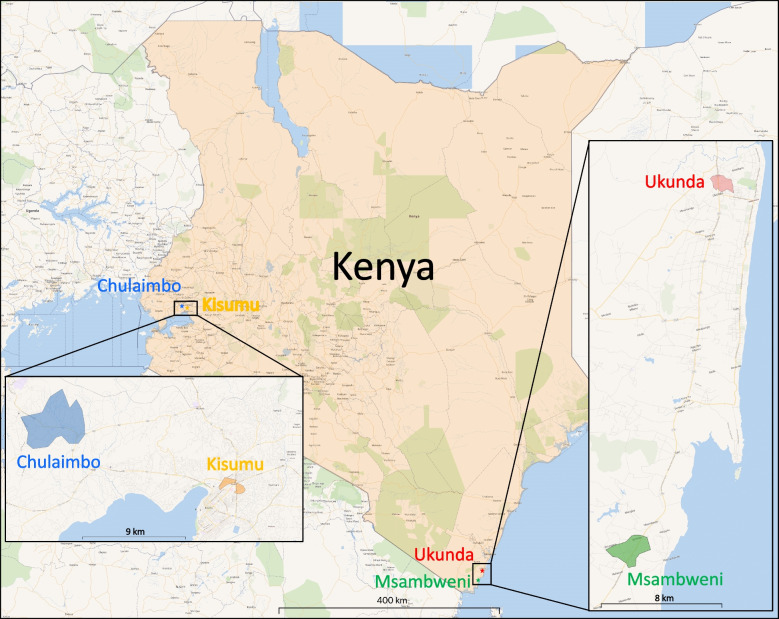
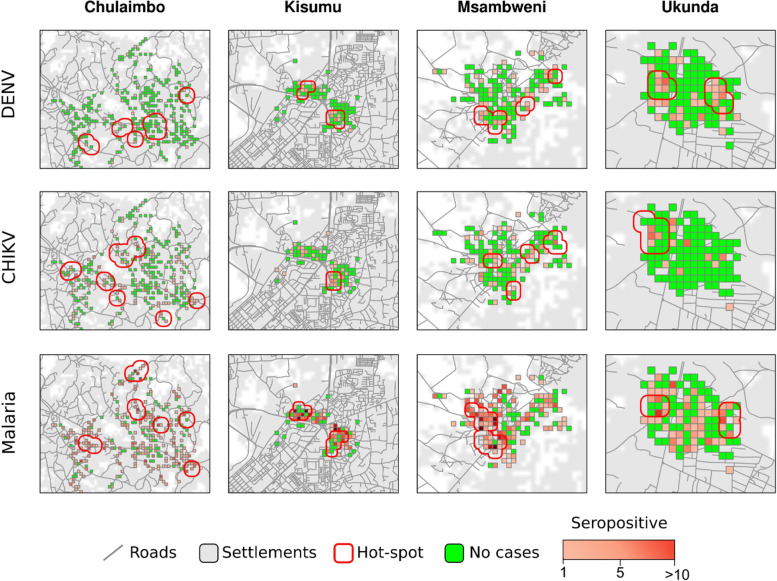
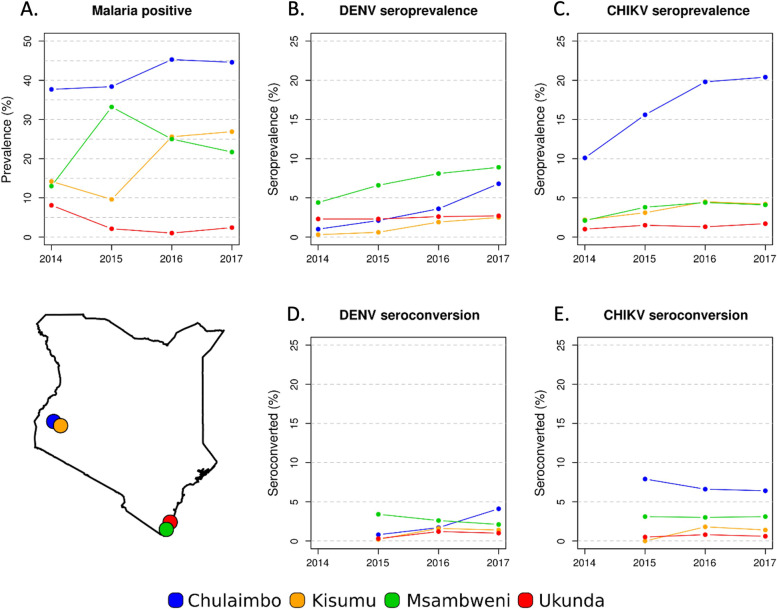
Malaria, chikungunya virus (CHIKV), and dengue virus (DENV) are endemic causes of fever among children in Kenya. The risks of infection are multifactorial and may be influenced by built and social environments. The high resolution overlapping of these diseases and factors affecting their spatial heterogeneity has not been investigated in Kenya. From 2014-2018, we prospectively followed a cohort of children from four communities in both coastal and western Kenya. Overall, 9.8% were CHIKV seropositive, 5.5% were DENV seropositive, and 39.1% were malaria positive (3521 children tested). The spatial analysis identified hot-spots for all three diseases in each site and in multiple years. The results of the model showed that the risk of exposure was linked to demographics with common factors for the three diseases including the presence of litter, crowded households, and higher wealth in these communities. These insights are of high importance to improve surveillance and targeted control of mosquito-borne diseases in Kenya.
疟疾、基孔肯雅热病毒(CHIKV)和登革热病毒(DENV)是肯尼亚儿童发热的地方性病因。感染的风险是多因素的,可能受到建筑和社会环境的影响。这些疾病及其影响其空间异质性的因素在肯尼亚尚未得到深入研究。2014 年至 2018 年,我们前瞻性地随访了肯尼亚沿海和西部四个社区的儿童队列。总体而言,9.8%的儿童呈基孔肯雅热病毒血清阳性,5.5%的儿童呈登革热病毒血清阳性,39.1%的儿童疟疾阳性(3521 名儿童接受了检测)。空间分析在每个地点和多个年份均确定了这三种疾病的热点。模型的结果表明,暴露风险与人口统计学因素有关,三种疾病的共同因素包括这些社区存在垃圾、家庭拥挤和更高的财富。这些发现对于改善肯尼亚蚊媒疾病的监测和有针对性的控制具有重要意义。