ETH Zurich, Department of Health Sciences and Technology, 8092, Zurich, Switzerland.
ETH Zurich, Department of Materials, 8093, Zurich, Switzerland.
Nat Commun. 2023 Apr 3;14(1):1848. doi: 10.1038/s41467-023-37629-z.
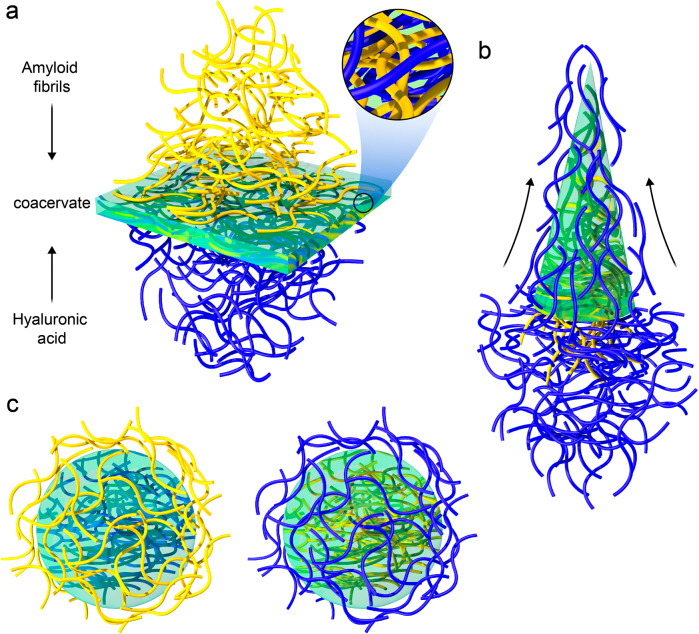
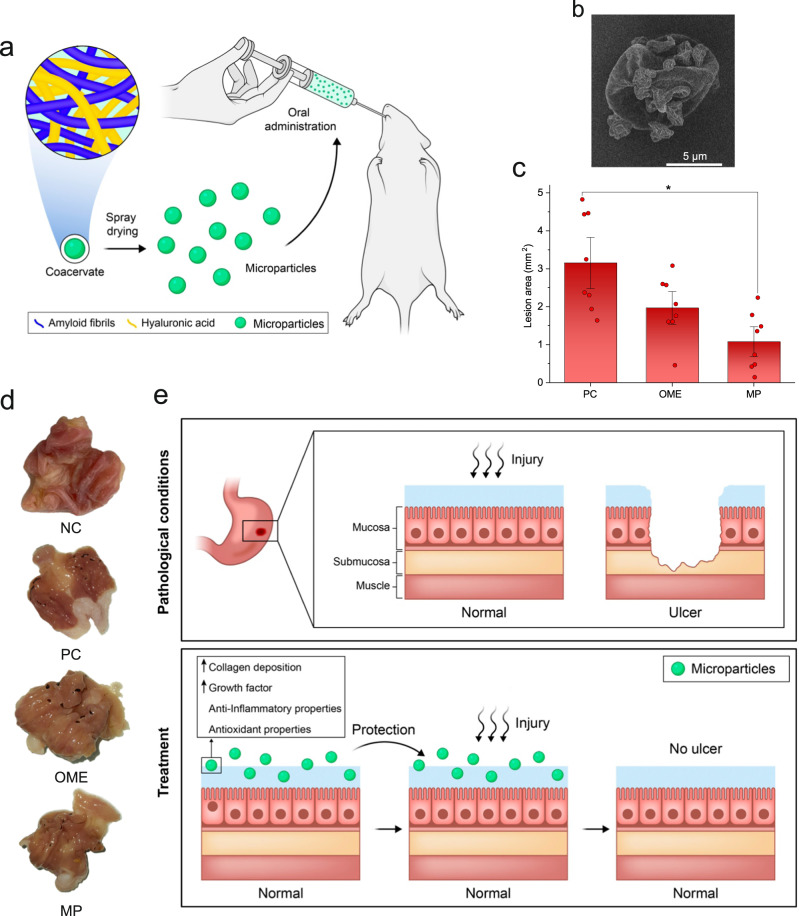
Coacervation via liquid-liquid phase separation provides an excellent opportunity to address the challenges of designing nanostructured biomaterials with multiple functionalities. Protein-polysaccharide coacervates, in particular, offer an appealing strategy to target biomaterial scaffolds, but these systems suffer from the low mechanical and chemical stabilities of protein-based condensates. Here we overcome these limitations by transforming native proteins into amyloid fibrils and demonstrate that the coacervation of cationic protein amyloids and anionic linear polysaccharides results in the interfacial self-assembly of biomaterials with precise control of their structure and properties. The coacervates present a highly ordered asymmetric architecture with amyloid fibrils on one side and the polysaccharide on the other. We demonstrate the excellent performance of these coacervates for gastric ulcer protection by validating via an in vivo assay their therapeutic effect as engineered microparticles. These results point at amyloid-polysaccharides coacervates as an original and effective biomaterial for multiple uses in internal medicine.
凝聚作用通过液-液相分离提供了一个极好的机会,可以解决设计具有多种功能的纳米结构生物材料的挑战。特别是蛋白质-多糖凝聚物提供了一种有吸引力的策略来靶向生物材料支架,但这些系统受到基于蛋白质的凝聚物的机械和化学稳定性低的限制。在这里,我们通过将天然蛋白质转化为淀粉样纤维来克服这些限制,并证明阳离子蛋白淀粉样纤维和阴离子线性多糖的凝聚导致具有精确控制其结构和性质的生物材料的界面自组装。凝聚物呈现出高度有序的不对称结构,一侧是淀粉样纤维,另一侧是多糖。我们通过体内试验验证了它们作为工程化微球的治疗效果,证明了这些凝聚物在胃溃保护方面的优异性能。这些结果表明,淀粉样纤维-多糖凝聚物是一种原始而有效的生物材料,可在临床医学中多方面应用。