
核壳结构荧光蛋白纳米粒子:在高功率生物混合发光二极管中实现零热猝灭的新范例。
Core-Shell Structured Fluorescent Protein Nanoparticles: New Paradigm Toward Zero-Thermal-Quenching in High-Power Biohybrid Light-Emitting Diodes.
机构信息
Chair of Biogenic Functional Materials, Technical University of Munich, Schulgasse, 22, 94315, Straubing, Germany.
Laboratory for Biomolecular Nanotechnology, Department of Physics, Technical University of Munich, Am Coulombwall 4a, 85748, Garching, Germany.
出版信息
Adv Sci (Weinh). 2023 Jun;10(16):e2300069. doi: 10.1002/advs.202300069. Epub 2023 Apr 4.
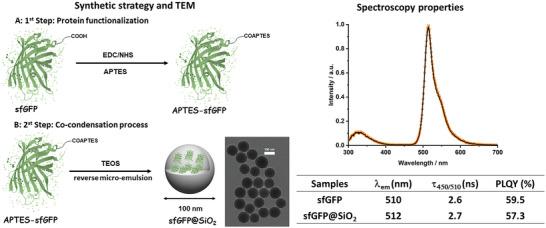
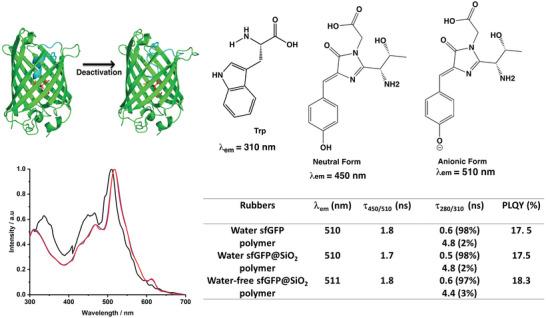
Stable and efficient high-power biohybrid light-emitting diodes (Bio-HLEDs) using fluorescent proteins (FPs) in photon downconverting filters have not been achieved yet, reaching best efficiencies of 130 lm W stable for >5 h. This is related to the rise of the device temperature (70-80 °C) caused by FP-motion and quick heat-transmission in water-based filters, they lead to a strong thermal emission quenching followed by the quick chromophore deactivation via photoinduced H-transfer. To tackle both issues at once, this work shows an elegant concept of a new FP-based nanoparticle, in which the FP core is shielded by a SiO -shell (FP@SiO ) with no loss of the photoluminescence figures-of-merit over years in foreign environments: dry powder at 25 °C (ambient) or constant 50 °C, as well as suspensions in organic solvents. This enables the preparation of water-free photon downconverting coatings with FP@SiO , realizing on-chip high-power Bio-HLEDs with 100 lm W stable for >120 h. Both thermal emission quenching and H-transfer deactivation are suppressed, since the device temperature holds <40 °C and remote high-power Bio-HLEDs exhibit final stabilities of 130 days compared to reference devices with water-based FP@SiO (83 days) and FP-polymer coatings (>100 h). Hence, FP@SiO is a new paradigm toward water-free zero-thermal-quenching biophosphors for first-class high-power Bio-HLEDs.
使用在光子下转换滤光片中的荧光蛋白(FPs)来实现稳定且高效的大功率生物混合发光二极管(Bio-HLEDs),尚未取得成功,最佳效率达到 130 lm W 且稳定超过 5 h。这与 FP 运动引起的器件温度升高(70-80°C)以及水基滤光片中的快速热传递有关,这会导致强烈的热辐射猝灭,随后通过光诱导 H 转移快速猝灭发色团。为了同时解决这两个问题,本工作展示了一种基于新型 FP 的纳米粒子的优雅概念,其中 FP 核被 SiO2 壳屏蔽(FP@SiO2),在异国环境下多年来不会损失光致发光的优劣分数:在 25°C(环境温度)或 50°C 的恒定温度下的干粉,以及在有机溶剂中的悬浮液。这使得可以制备无水分光下转换涂层的 FP@SiO2,实现具有 100 lm W 且稳定超过 120 h 的片上大功率 Bio-HLED。由于器件温度<40°C,并且远程大功率 Bio-HLED 的最终稳定性为 130 天,而与具有水基 FP@SiO2(83 天)和 FP-聚合物涂层(>100 h)的参考器件相比,热辐射猝灭和 H 转移失活均得到抑制。因此,FP@SiO2 是一种面向无水零热猝灭生物荧光粉的新范例,适用于一流的大功率 Bio-HLED。



 Zotero 插件