Centre for Longitudinal Studies, UCL Social Research Institute, University College London, London, United Kingdom.
ESRC Centre for Society and Mental Health, King's College London, Melbourne House, London, United Kingdom.
PLoS Med. 2023 Apr 4;20(4):e1004145. doi: 10.1371/journal.pmed.1004145. eCollection 2023 Apr.
Growing evidence suggests that population mental health outcomes have worsened since the pandemic started. The extent that these changes have altered common age-related trends in psychological distress, where distress typically rises until midlife and then falls after midlife in both sexes, is unknown. We aimed to analyse whether long-term pre-pandemic psychological distress trajectories were disrupted during the pandemic, and whether these changes have been different across cohorts and by sex.
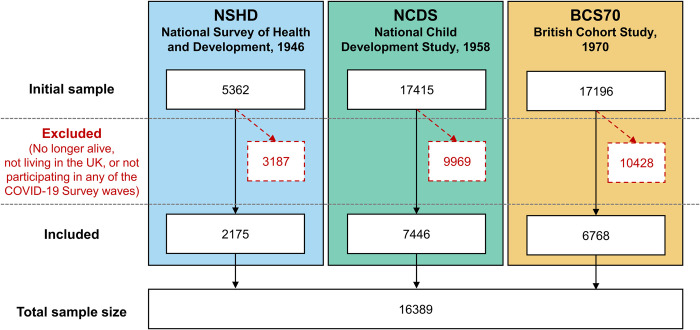
We used data from three nationally representative birth cohorts comprising all people born in Great Britain in a single week of 1946 (National Survey of Health and Development, NSHD), 1958 (National Child Development Study, NCDS), or 1970 (British Cohort Study, BCS70). The follow-up data used spanned 39 years in NSHD (1982 to 2021), 40 years in NCDS (1981 to 2001), and 25 years in BCS70 (1996 to 2021). We used psychological distress factor scores, as measured by validated self-reported questionnaires (NSHD: Present State Examination, Psychiatric Symptoms Frequency, and 28- and 12-item versions of General Health Questionnaire; NCDS and BCS70: Malaise Inventory; all: 2-item versions of Generalized Anxiety Disorder scale and Patient Health Questionnaire). We used a multilevel growth curve modelling approach to model the trajectories of distress across cohorts and sexes and obtained estimates of the differences between the distress levels observed during the pandemic and those observed at the most recent pre-pandemic assessment and at the peak in the cohort-specific pre-pandemic distress trajectory, located at midlife. We further analysed whether pre-existing cohort and sex inequalities had changed with the pandemic onset using a difference-in-differences (DiD) approach. The analytic sample included 16,389 participants. By September/October 2020, distress levels had reached or exceeded the levels of the peak in the pre-pandemic life-course trajectories, with larger increases in younger cohorts (standardised mean differences [SMD] and 95% confidence intervals of SMDNSHD,pre-peak = -0.02 [-0.07, 0.04], SMDNCDS,pre-peak = 0.05 [0.02, 0.07], and SMDBCS70,pre-peak = 0.09 [0.07, 0.12] for the 1946, 1958, and 1970 birth cohorts, respectively). Increases in distress were larger among women than men, widening pre-existing sex inequalities (DiD and 95% confidence intervals of DiDNSHD,sex,pre-peak = 0.17 [0.06, 0.28], DiDNCDS,sex,pre-peak = 0.11 [0.07, 0.16], and DiDBCS70,sex,pre-peak = 0.11 [0.05, 0.16] when comparing sex inequalities in the pre-pandemic peak in midlife to those observed by September/October 2020). As expected in cohort designs, our study suffered from high proportions of attrition with respect to the original samples. Although we used non-response weights to restore sample representativeness to the target populations (those born in the United Kingdom in 1946, 1958, and 1970, alive and residing in the UK), results may not be generalisable to other sections within the UK population (e.g., migrants and ethnic minority groups) and countries different than the UK.
Pre-existing long-term psychological distress trajectories of adults born between 1946 and 1970 were disrupted during the COVID-19 pandemic, particularly among women, who reached the highest levels ever recorded in up to 40 years of follow-up data. This may impact future trends of morbidity, disability, and mortality due to common mental health problems.
越来越多的证据表明,自疫情开始以来,人群的心理健康状况已经恶化。目前尚不清楚这些变化是否改变了常见的与年龄相关的心理困扰趋势,在两性中,困扰通常在中年之前上升,然后在中年之后下降。我们旨在分析在疫情期间,长期的大流行前心理困扰轨迹是否被打乱,以及这些变化是否因队列和性别而异。
我们使用了三个具有全国代表性的出生队列的数据,这些队列包括在 1946 年一周内出生的所有英国人(国民健康与发展调查,NSHD)、1958 年(全国儿童发展研究,NCDS)或 1970 年(英国队列研究,BCS70)。使用的随访数据跨越了 NSHD 的 39 年(1982 年至 2021 年)、NCDS 的 40 年(1981 年至 2001 年)和 BCS70 的 25 年(1996 年至 2021 年)。我们使用了经过验证的自我报告问卷测量的心理困扰因素得分(NSHD:当前状态检查、精神症状频率和 28 项和 12 项一般健康问卷;NCDS 和 BCS70:不适量表;两者均为一般焦虑障碍量表和患者健康问卷的 2 项版本)。我们使用多层次增长曲线建模方法来模拟不同队列和性别的困扰轨迹,并获得了在大流行期间观察到的困扰水平与最近一次大流行前评估和在特定队列的大流行前困扰轨迹的中年高峰期观察到的困扰水平之间的差异估计。我们还进一步分析了大流行的发生是否改变了预先存在的队列和性别不平等。使用差异中的差异(DiD)方法。分析样本包括 16389 名参与者。到 2020 年 9 月/10 月,困扰水平已经达到或超过了大流行前生命轨迹高峰时的水平,年轻队列的增幅更大(标准化平均差异 [SMD] 和 SMDNSHD,pre-peak = -0.02 [-0.07, 0.04]、SMDNCDS,pre-peak = 0.05 [0.02, 0.07]和 SMDBCS70,pre-peak = 0.09 [0.07, 0.12],分别为 1946、1958 和 1970 年出生的队列)。困扰的增加在女性中比男性更大,扩大了预先存在的性别不平等(DiD 和 95%置信区间的 DiDNSHD,sex,pre-peak = 0.17 [0.06, 0.28]、DiDNCDS,sex,pre-peak = 0.11 [0.07, 0.16]和 DiDBCS70,sex,pre-peak = 0.11 [0.05, 0.16],当将中年大流行前高峰时的性别不平等与 2020 年 9 月/10 月观察到的性别不平等进行比较时)。正如在队列设计中预期的那样,我们的研究受到了原始样本大量流失的影响。尽管我们使用了无应答权重来恢复目标人群(1946 年、1958 年和 1970 年在英国出生、在世并居住在英国的人)的代表性,但结果可能不适用于英国人口中的其他部分(例如,移民和少数民族群体)和英国以外的其他国家。
1946 年至 1970 年期间出生的成年人的长期大流行前心理困扰轨迹在 COVID-19 大流行期间被打乱,特别是在女性中,在长达 40 年的随访数据中达到了有记录以来的最高水平。这可能会影响未来常见心理健康问题导致的发病率、残疾率和死亡率的趋势。