From the Department of Medicine (C.E.M.C., C.J., A.A.-I., M.O.D.), University of Galway, Ireland; Department of Medicine (S.Y., S.R.), Population Health Research Institute, McMaster University and Hamilton Health Sciences, Ontario, Canada; School of Medicine and Pharmacology (G.J.H.), Faculty of Health and Medical Sciences, University of Western Australia, Perth; Department of Medicine (S.O.), Rush Alzheimer Disease Research Center in Chicago, IL; Faculty of Medicine (A.D.), Eduardo Mondlane University, Maputo, Mozambique; Department of Neurology (H.K.I.), Rigshospitalet, University of Copenhagen, Denmark; Department of Molecular and Clinical Medicine (A.R.), University of Gothenburg and Region Västra Götaland, Sahlgrenska University Hospital, Gothenburg, Sweden; Department of Medicine (A.A.), International Research Center, Hospital Alemão Oswaldo Cruz, São Paulo, Brazil; Department of Medicine (P.L.-J.), Instituto de Investigaciones MASIRA, Universidad de Santander, Bucaramanga, Colombia; Department of Medicine (D.X.), St John's Medical College and Research Institute, Bangalore, India; and Department of Medicine (X.W.), Beijing Hypertension League Institute, China.
Neurology. 2023 May 23;100(21):e2191-e2203. doi: 10.1212/WNL.0000000000207249. Epub 2023 Apr 5.
Symptoms of sleep disturbance are common and may represent important modifiable risk factors of stroke. We evaluated the association between a spectrum of sleep disturbance symptoms and the risk of acute stroke in an international setting.
The INTERSTROKE study is an international case-control study of patients presenting with first acute stroke and controls matched by age (±5 years) and sex. Sleep symptoms in the previous month were assessed through a questionnaire. Conditional logistic regression estimated the association between sleep disturbance symptoms and acute stroke, expressed as odds ratios (ORs) and 95% CIs. The primary model adjusted for age, occupation, marital status, and modified Rankin scale at baseline, with subsequent models adjusting for potential mediators (behavioral/disease risk factors).
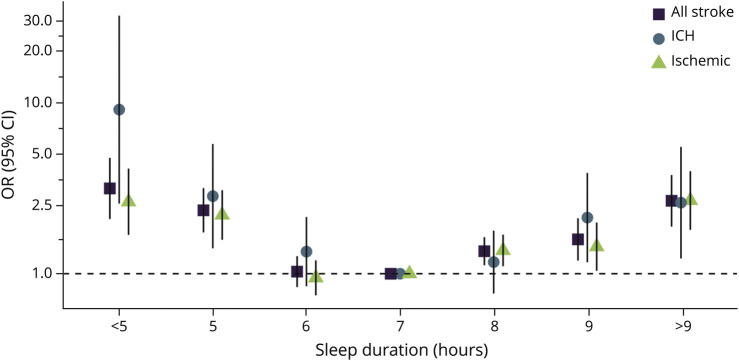
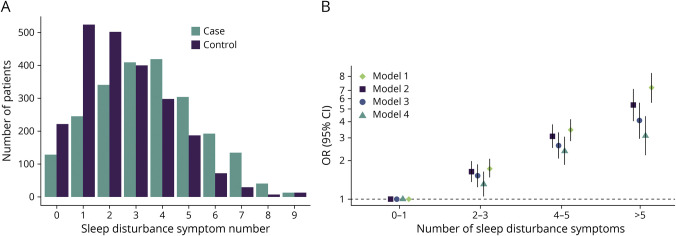
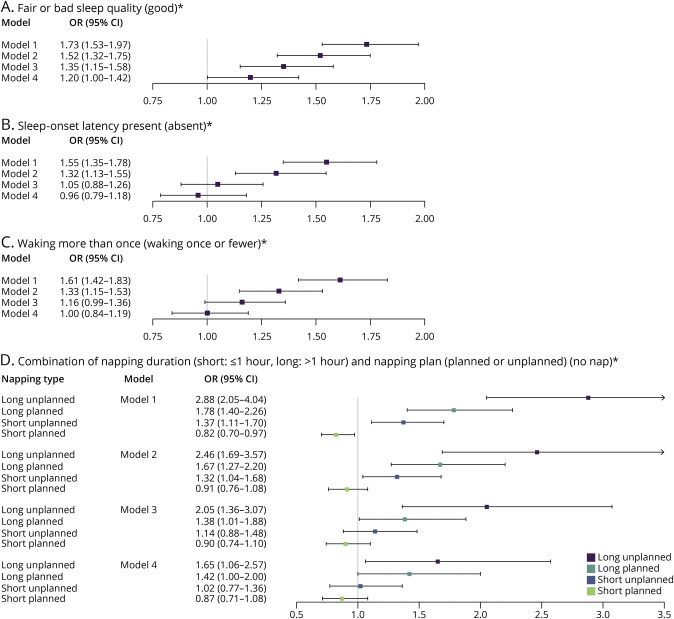
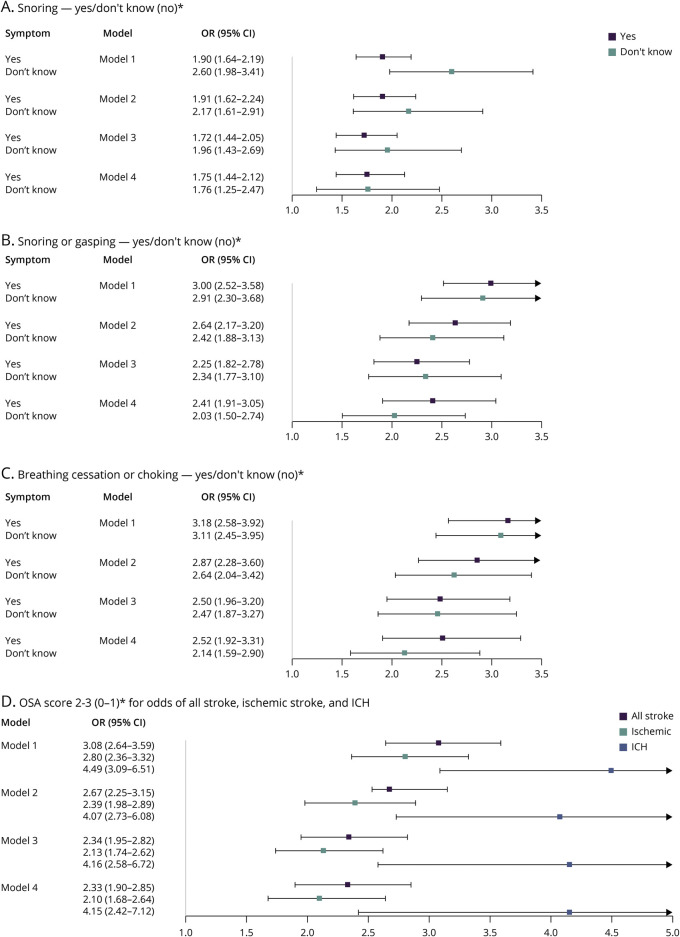
Overall, 4,496 matched participants were included, with 1,799 of them having experienced an ischemic stroke and 439 an intracerebral hemorrhage. Short sleep (<5 hours: OR 3.15, 95% CI 2.09-4.76), long sleep (>9 hours: OR 2.67, 95% CI 1.89-3.78), impaired quality (OR 1.52, 95% CI 1.32-1.75), difficulty getting to sleep (OR 1.32, 95% CI 1.13-1.55) or maintaining sleep (OR 1.33, 95% CI 1.15-1.53), unplanned napping (OR 1.48, 95% CI 1.20-1.84), prolonged napping (>1 hour: OR 1.88, 95% CI 1.49-2.38), snoring (OR 1.91, 95% CI 1.62-2.24), snorting (OR 2.64, 95% CI 2.17-3.20), and breathing cessation (OR 2.87, 95% CI 2.28-3.60) were all significantly associated with an increased odds of acute stroke in the primary model. A derived obstructive sleep apnea score of 2-3 (2.67, 2.25-3.15) and cumulative sleep symptoms (>5: ) were also associated with a significantly increased odds of acute stroke, with the latter showing a graded association. After an extensive adjustment, significance was maintained for most of the symptoms (not difficulty getting to/maintaining sleep and unplanned napping), with similar findings for stroke subtypes.
We found that sleep disturbance symptoms were common and associated with a graded increased risk of stroke. These symptoms may be a marker of increased individual risk or represent independent risk factors. Future clinical trials are warranted to determine the efficacy of sleep interventions in stroke prevention.
睡眠障碍的症状很常见,可能是中风的重要可改变风险因素。我们评估了一系列睡眠障碍症状与国际环境中急性中风风险之间的关联。
INTERSTROKE 研究是一项针对首次急性中风患者和年龄(±5 岁)和性别相匹配的对照者的国际病例对照研究。通过问卷评估了前一个月的睡眠症状。条件逻辑回归估计了睡眠障碍症状与急性中风之间的关联,用比值比(OR)和 95%置信区间(CI)表示。主要模型调整了基线时的年龄、职业、婚姻状况和改良 Rankin 量表,随后的模型调整了潜在的中介因素(行为/疾病风险因素)。
总体而言,纳入了 4496 对匹配的参与者,其中 1799 人患有缺血性中风,439 人患有颅内出血。短睡眠(<5 小时:OR 3.15,95%CI 2.09-4.76)、长睡眠(>9 小时:OR 2.67,95%CI 1.89-3.78)、睡眠质量差(OR 1.52,95%CI 1.32-1.75)、入睡困难(OR 1.32,95%CI 1.13-1.55)或维持睡眠(OR 1.33,95%CI 1.15-1.53)、无计划小睡(OR 1.48,95%CI 1.20-1.84)、长时间小睡(>1 小时:OR 1.88,95%CI 1.49-2.38)、打鼾(OR 1.91,95%CI 1.62-2.24)、鼻息(OR 2.64,95%CI 2.17-3.20)和呼吸暂停(OR 2.87,95%CI 2.28-3.60)在主要模型中均与急性中风的几率增加显著相关。衍生的阻塞性睡眠呼吸暂停评分 2-3(2.67,2.25-3.15)和累积睡眠症状(>5:)也与急性中风的几率显著增加相关,后者呈分级关联。经过广泛调整后,大多数症状(入睡困难/维持睡眠和无计划小睡除外)的显著性仍然存在,中风亚型也有类似的发现。
我们发现睡眠障碍症状很常见,并与中风风险的逐渐增加相关。这些症状可能是个体风险增加的标志,也可能是独立的风险因素。需要进行未来的临床试验来确定睡眠干预措施在中风预防中的疗效。