Alberga Angela S, Edache Iyoma Y, Sigal Ronald J, von Ranson Kristin M, Russell-Mayhew Shelly, Kenny Glen P, Doucette Steve, Prud'homme Denis, Hadjiyannakis Stasia, Cameron Jameason D, Goldfield Gary S
Department of Health Kinesiology and Applied Physiology Concordia University Montreal Quebec Canada.
Departments of Medicine, Cardiac Sciences and Community Health Sciences, Faculties of Medicine and Kinesiology University of Calgary Calgary Alberta Canada.
Obes Sci Pract. 2022 Sep 6;9(2):158-171. doi: 10.1002/osp4.620. eCollection 2023 Apr.
There are well-recognized benefits of behavioral interventions that include exercise for children and adolescents with obesity. However, such behavioral weight management programs may precipitate unintended consequences. It is unclear if different exercise modalities impact eating behaviors differently in youth with obesity.
The purpose of this study was to examine the effects of aerobic, resistance, and combined aerobic and resistance exercise training on eating attitudes and behaviors (uncontrolled eating, restrained eating, emotional eating, external eating and food craving) among adolescents with overweight and obesity.
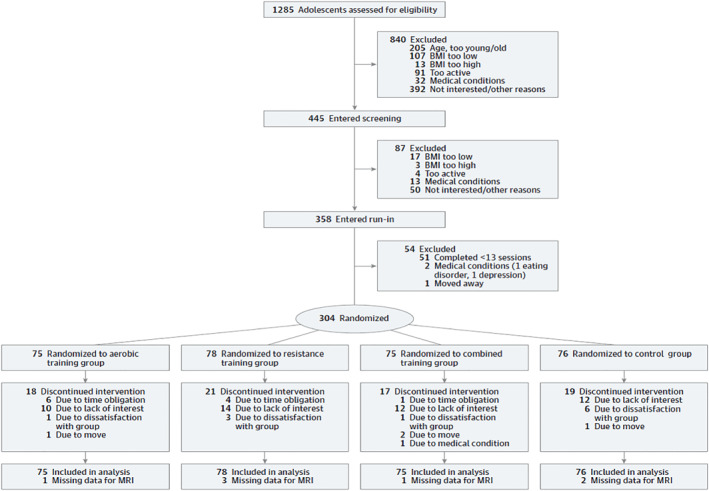
= 304 (70% female) adolescents with overweight and obesity participated in the 6-month Healthy Eating Aerobic and Resistance Training in Youth (HEARTY) randomized controlled trial. All participants were inactive post-pubertal adolescents (15.6 ± 1.4 years) with a mean BMI = 34.6 ± 4.5 kg/m. The Food Craving Inventory (food cravings), Dutch Eating Behavior Questionnaire (restrained eating, emotional eating, external eating), and the Three-Factor Eating Questionnaire (uncontrolled eating) were used to assess eating attitudes and behaviors.
All exercise groups showed within-group decreases in external eating and food cravings. Participants randomized to the Combined training group and were more adherent showed the greatest improvements in eating behaviors and cravings.
A 6-month exercise intervention produced improvements in disordered eating behaviors and food cravings, but effects may be gender and modality-specific. Findings highlight the need to tailor exercise intervention to participant characteristics for the promotion of healthier eating and weight management outcomes in youth with obesity.
Clinical Trial Registration # and Date: ClinicalTrials.Gov NCT00195858, September 12, 2005.
行为干预(包括让肥胖儿童和青少年进行锻炼)具有公认的益处。然而,此类行为体重管理计划可能会引发意想不到的后果。目前尚不清楚不同的运动方式对肥胖青少年的饮食行为是否有不同影响。
本研究旨在探讨有氧训练、抗阻训练以及有氧与抗阻联合训练对超重和肥胖青少年饮食态度和行为(无节制饮食、克制饮食、情绪化饮食、外在性饮食和食物渴望)的影响。
304名(70%为女性)超重和肥胖青少年参与了为期6个月的青少年健康饮食有氧与抗阻训练(HEARTY)随机对照试验。所有参与者均为青春期后不活跃的青少年(15.6±1.4岁),平均体重指数(BMI)为34.6±4.5kg/m²。使用食物渴望量表(食物渴望)、荷兰饮食行为问卷(克制饮食、情绪化饮食、外在性饮食)和三因素饮食问卷(无节制饮食)来评估饮食态度和行为。
所有运动组的外在性饮食和食物渴望在组内均有所下降。随机分配到联合训练组且依从性更高的参与者在饮食行为和渴望方面改善最大。
为期6个月的运动干预改善了饮食紊乱行为和食物渴望,但效果可能因性别和运动方式而异。研究结果强调,为促进肥胖青少年更健康的饮食和体重管理结果,需要根据参与者特征量身定制运动干预措施。
临床试验注册号和日期:ClinicalTrials.Gov NCT00195858,2005年9月12日。