Jin Jinlian, Zhou Haiyan, Sun Shulin, Tian Zhe, Ren Haibing, Feng Jinwu, Jiang Xinping
Gezhouba Central Hospital of Sinopharm, The Third Clinical Medical College of China Three Gorges University, Yichang, Hubei, China.
Front Oncol. 2023 Mar 22;13:1121594. doi: 10.3389/fonc.2023.1121594. eCollection 2023.
The mortality of colorectal cancer patients with pelvic bone metastasis is imminent, and timely diagnosis and intervention to improve the prognosis is particularly important. Therefore, this study aimed to build a bone metastasis prediction model based on Gray level Co-occurrence Matrix (GLCM) - based Score to guide clinical diagnosis and treatment.
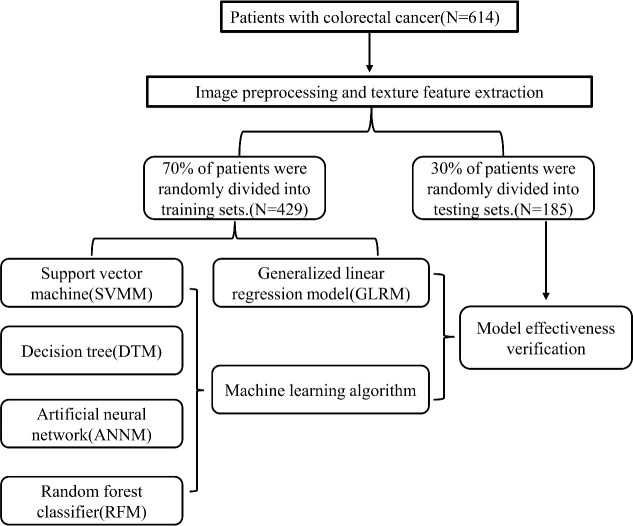
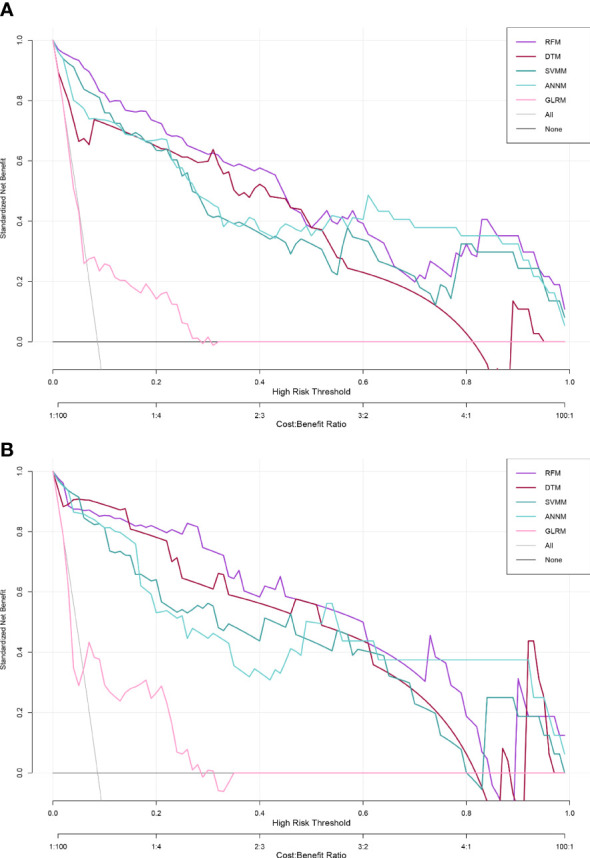
We retrospectively included 614 patients with colorectal cancer who underwent pelvic multiparameter magnetic resonance image(MRI) from January 2015 to January 2022 in the gastrointestinal surgery department of Gezhouba Central Hospital of Sinopharm. GLCM-based Score and Machine learning algorithm, that is,artificial neural net7work model(ANNM), random forest model(RFM), decision tree model(DTM) and support vector machine model(SVMM) were used to build prediction model of bone metastasis in colorectal cancer patients. The effectiveness evaluation of each model mainly included decision curve analysis(DCA), area under the receiver operating characteristic (AUROC) curve and clinical influence curve(CIC).
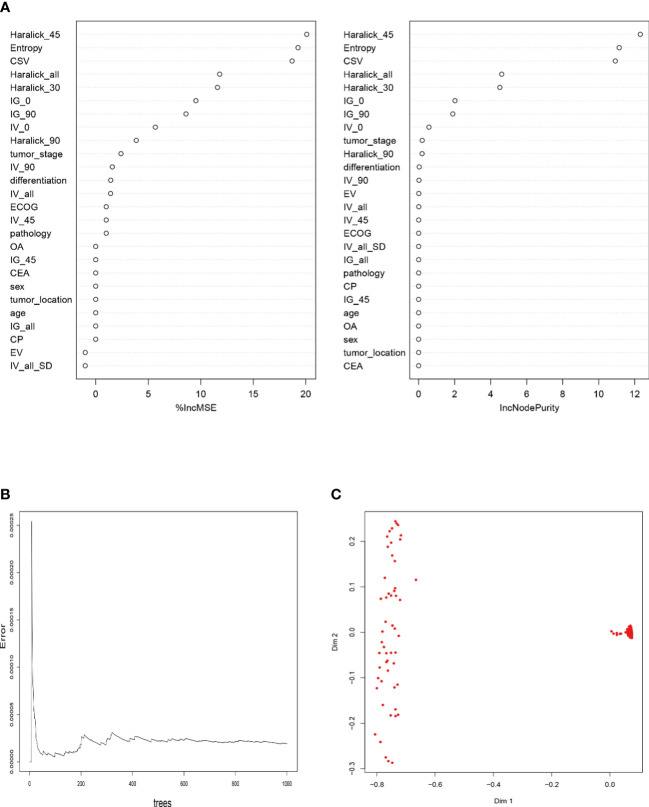
We captured fourteen categories of radiomics data based on GLCM for variable screening of bone metastasis prediction models. Among them, Haralick_90, IV_0, IG_90, Haralick_30, CSV, Entropy and Haralick_45 were significantly related to the risk of bone metastasis, and were listed as candidate variables of machine learning prediction models. Among them, the prediction efficiency of RFM in combination with Haralick_90, Haralick_all, IV_0, IG_90, IG_0, Haralick_30, CSV, Entropy and Haralick_45 in training set and internal verification set was [AUC: 0.926,95% CI: 0.873-0.979] and [AUC: 0.919,95% CI: 0.868-0.970] respectively. The prediction efficiency of the other four types of prediction models was between [AUC: 0.716,95% CI: 0.663-0.769] and [AUC: 0.912,95% CI: 0.859-0.965].
The automatic segmentation model based on diffusion-weighted imaging(DWI) using depth learning method can accurately segment the pelvic bone structure, and the subsequently established radiomics model can effectively detect bone metastases within the pelvic scope, especially the RFM algorithm, which can provide a new method for automatically evaluating the pelvic bone turnover of colorectal cancer patients.
骨盆骨转移的结直肠癌患者死亡率高,及时诊断并进行干预以改善预后尤为重要。因此,本研究旨在构建基于灰度共生矩阵(GLCM)评分的骨转移预测模型,以指导临床诊疗。
我们回顾性纳入了2015年1月至2022年1月在国药葛洲坝中心医院胃肠外科接受骨盆多参数磁共振成像(MRI)检查的614例结直肠癌患者。采用基于GLCM的评分和机器学习算法,即人工神经网络模型(ANNM)、随机森林模型(RFM)、决策树模型(DTM)和支持向量机模型(SVMM),构建结直肠癌患者骨转移预测模型。各模型的有效性评估主要包括决策曲线分析(DCA)、受试者操作特征曲线下面积(AUROC)和临床影响曲线(CIC)。
我们基于GLCM获取了14类影像组学数据,用于骨转移预测模型的变量筛选。其中,Haralick_90、IV_0、IG_90、Haralick_30、CSV、熵和Haralick_45与骨转移风险显著相关,被列为机器学习预测模型的候选变量。其中,RFM联合Haralick_90、Haralick_all、IV_0、IG_90、IG_0、Haralick_30、CSV、熵和Haralick_45在训练集和内部验证集的预测效率分别为[AUC:0.926,95%CI:0.873 - 0.979]和[AUC:0.919,95%CI:0.868 - 0.970]。其他四种预测模型的预测效率在[AUC:0.716,95%CI:0.663 - 0.769]和[AUC:0.912,95%CI:0.859 - 0.965]之间。
采用深度学习方法基于扩散加权成像(DWI)的自动分割模型能够准确分割骨盆骨结构,随后建立的影像组学模型能够有效检测骨盆范围内的骨转移,尤其是RFM算法,可为结直肠癌患者骨盆骨转移的自动评估提供新方法。