Department of Traumatology and Acute Critical Medicine, Osaka University Graduate School of Medicine, 2-15 Yamadaoka, Suita City, Osaka, 565-0871, Japan.
J Physiol Anthropol. 2023 Apr 13;42(1):6. doi: 10.1186/s40101-023-00322-7.
Acute mountain sickness (AMS) affects around 30% of people climbing Mt. Fuji, but its pathogenesis is incompletely understood. The influence of a rapid ascent to high altitude by climbing and summiting Mt. Fuji on cardiac function in the general population is unknown, and its association with altitude sickness has not been clarified.
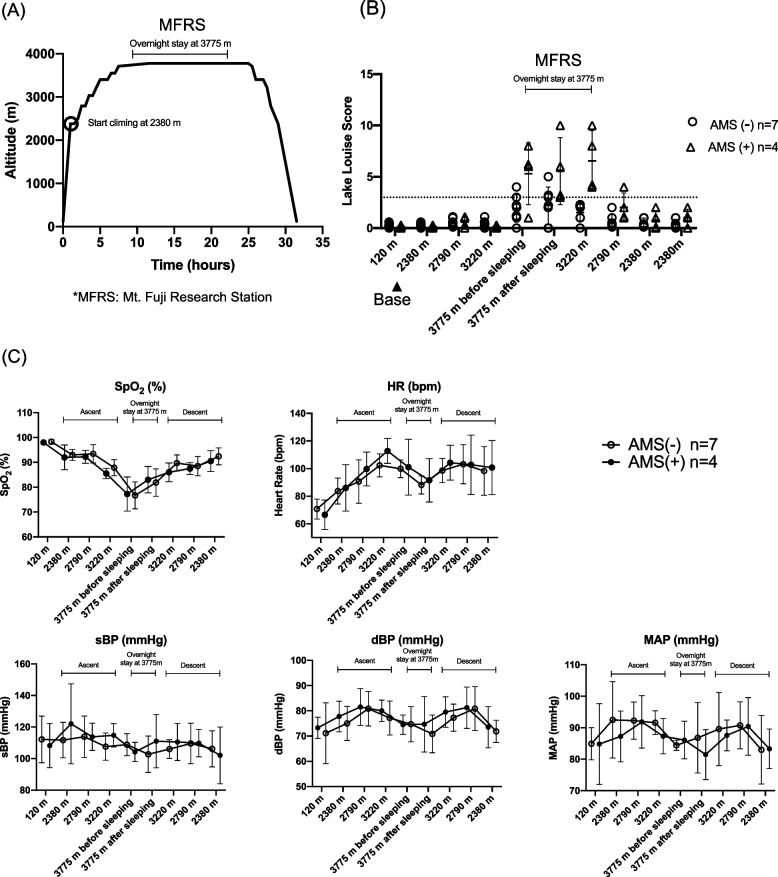
Subjects climbing Mt. Fuji were included. Heart rate, oxygen saturation, systolic blood pressure, cardiac index (CI) and stroke volume index were measured multiple times at 120 m as baseline values and at Mt. Fuji Research Station (MFRS) at 3,775 m. Each value and its difference from the baseline value (Δ) of subjects with AMS (defined as Lake Louise Score [LLS] ≥ 3 with headache after sleeping at 3,775 m) were compared with those of non-AMS subjects.
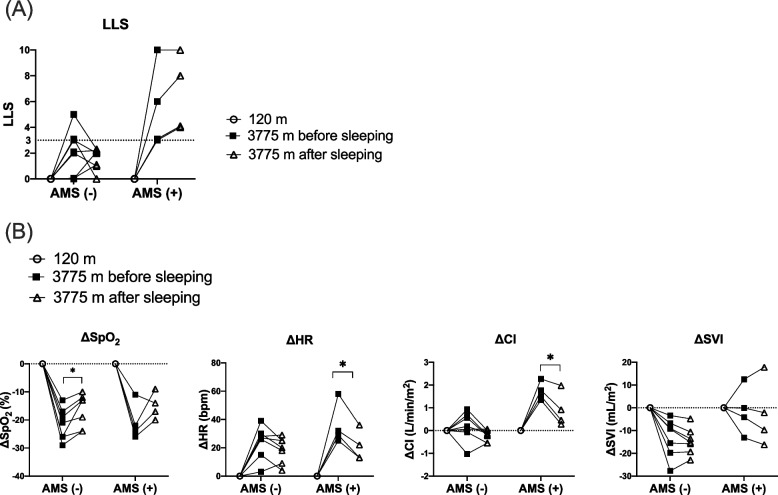
Eleven volunteers who climbed from 2,380 m to MFRS within 8 h and stayed overnight at MFRS were included. Four suffered AMS. Compared with the non-AMS subjects, CI in the AMS subjects was significantly higher than that before sleeping (median [interquartile range]: 4.9 [4.5, 5.0] vs. 3.8 [3.4, 3.9] mL/min/m; p = 0.04), and their ΔCI was significantly higher before sleeping (1.6 [1.4, 2.1] vs. 0.2 [0.0, 0.7] mL/min/m; p < 0.01) and after sleeping (0.7 [0.3, 1.7] vs. -0.2 [-0.5, 0.0] mL/min/m; p < 0.01). ΔCI in the AMS subjects dropped significantly after sleeping versus before sleeping (3.8 [3.6, 4.5] vs. 4.9 [4.5, 5.0] mL/min/m; p = 0.04).
Higher values of CI and ΔCI were observed at high altitude in the AMS subjects. A high cardiac output might be associated with the development of AMS.
约 30%攀登富士山的人会出现急性高山病(AMS),但其发病机制尚不完全清楚。快速攀登富士山并登顶对普通人群的心脏功能的影响尚不清楚,其与高山病的关系也尚未阐明。
纳入攀登富士山的受试者。在 120 米处(作为基线值)和 3775 米处的富士山研究站(MFRS)多次测量心率、血氧饱和度、收缩压、心指数(CI)和每搏输出量指数。将 AMS 受试者(定义为在 3775 米处睡眠后出现头痛的 Lake Louise 评分[LLS]≥3)的每个值及其与基线值的差值(Δ)与非 AMS 受试者进行比较。
共纳入 11 名志愿者,他们在 8 小时内从 2380 米攀登至 MFRS 并在 MFRS 过夜。4 人患有 AMS。与非 AMS 受试者相比,AMS 受试者的 CI 在睡眠前明显升高(中位数[四分位间距]:4.9[4.5,5.0]比 3.8[3.4,3.9]mL/min/m;p=0.04),其ΔCI 在睡眠前明显升高(1.6[1.4,2.1]比 0.2[0.0,0.7]mL/min/m;p<0.01)和睡眠后(0.7[0.3,1.7]比-0.2[-0.5,0.0]mL/min/m;p<0.01)。与睡眠前相比,AMS 受试者的ΔCI 在睡眠后明显下降(3.8[3.6,4.5]比 4.9[4.5,5.0]mL/min/m;p=0.04)。
在 AMS 受试者中,在高海拔时观察到更高的 CI 和ΔCI 值。高心输出量可能与 AMS 的发生有关。