• 文献检索
  • 文档翻译
  • 深度研究
  • 学术资讯
  • Suppr Zotero 插件Zotero 插件
  • 邀请有礼
  • 套餐&价格
  • 历史记录
应用&插件
Suppr Zotero 插件Zotero 插件浏览器插件Mac 客户端Windows 客户端微信小程序
定价
高级版会员购买积分包购买API积分包
服务
文献检索文档翻译深度研究API 文档MCP 服务
关于我们
关于 Suppr公司介绍联系我们用户协议隐私条款
关注我们

Suppr 超能文献

核心技术专利:CN118964589B侵权必究
粤ICP备2023148730 号-1Suppr @ 2026

文献检索

告别复杂PubMed语法,用中文像聊天一样搜索,搜遍4000万医学文献。AI智能推荐,让科研检索更轻松。

立即免费搜索

文件翻译

保留排版,准确专业,支持PDF/Word/PPT等文件格式,支持 12+语言互译。

免费翻译文档

深度研究

AI帮你快速写综述,25分钟生成高质量综述,智能提取关键信息,辅助科研写作。

立即免费体验

2010-2019 年非洲 25 国季节性流感流行时间:回顾性分析。

Timing of seasonal influenza epidemics for 25 countries in Africa during 2010-19: a retrospective analysis.

机构信息

Influenza Division, National Center for Immunization and Respiratory Diseases, Centers for Disease Control and Prevention, Atlanta, GA, USA; Faculty of Epidemiology and Population Health, London School of Hygiene & Tropical Medicine, London, UK; Immunization Systems Branch, Global Immunization Division, Center for Global Health, Centers for Disease Control and Prevention, Atlanta, GA, USA.

National Center for Emerging and Zoonotic Infectious Diseases, Centers for Disease Control and Prevention, Atlanta, GA, USA.

出版信息

Lancet Glob Health. 2023 May;11(5):e729-e739. doi: 10.1016/S2214-109X(23)00109-2.

DOI:10.1016/S2214-109X(23)00109-2
PMID:37061311
原文链接:https://pmc.ncbi.nlm.nih.gov/articles/PMC10126228/
Abstract

BACKGROUND

Using country-specific surveillance data to describe influenza epidemic activity could inform decisions on the timing of influenza vaccination. We analysed surveillance data from African countries to characterise the timing of seasonal influenza epidemics to inform national vaccination strategies.

METHODS

We used publicly available sentinel data from African countries reporting to the WHO Global Influenza Surveillance and Response FluNet platform that had 3-10 years of data collected during 2010-19. We calculated a 3-week moving proportion of samples positive for influenza virus and assessed epidemic timing using an aggregate average method. The start and end of each epidemic were defined as the first week when the proportion of positive samples exceeded or went below the annual mean, respectively, for at least 3 consecutive weeks. We categorised countries into five epidemic patterns: northern hemisphere-dominant, with epidemics occurring in October-March; southern hemisphere-dominant, with epidemics occurring in April-September; primarily northern hemisphere with some epidemic activity in southern hemisphere months; primarily southern hemisphere with some epidemic activity in northern hemisphere months; and year-round influenza transmission without a discernible northern hemisphere or southern hemisphere predominance (no clear pattern).

FINDINGS

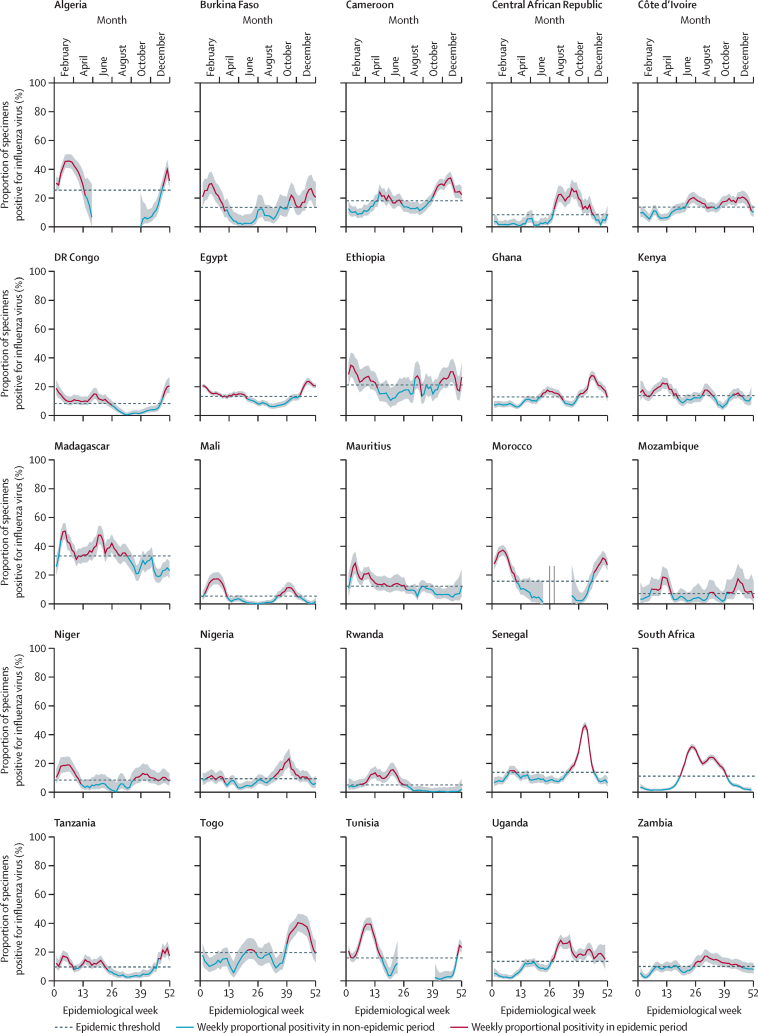
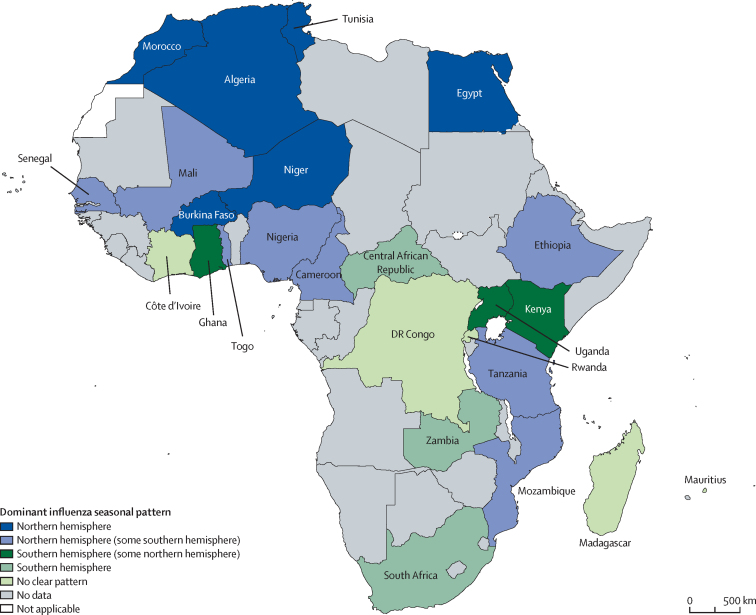
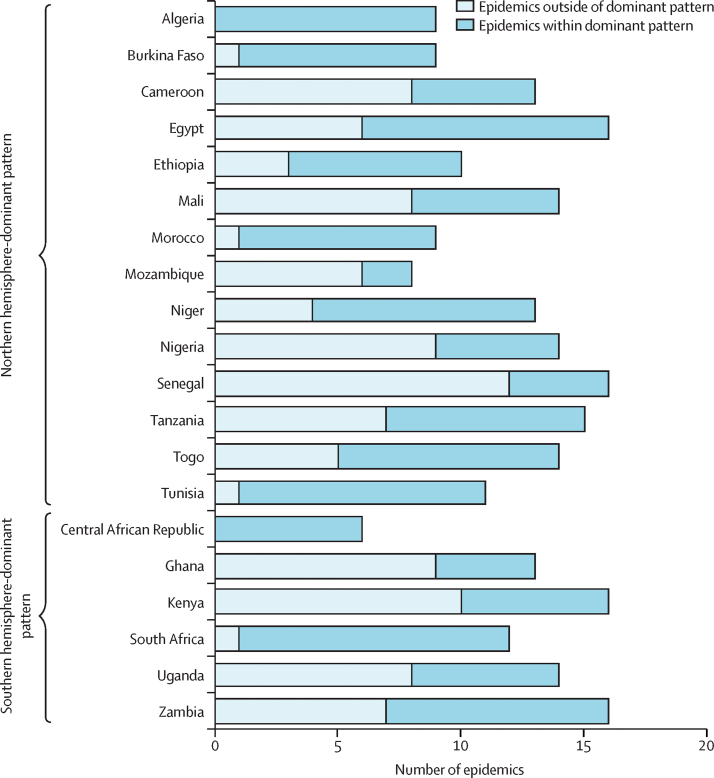
Of the 34 countries reporting data to FluNet, 25 had at least 3 years of data, representing 46% of the countries in Africa and 89% of Africa's population. Study countries reported RT-PCR respiratory virus results for a total of 503 609 specimens (median 12 971 [IQR 9607-20 960] per country-year), of which 74 001 (15%; median 2078 [IQR 1087-3008] per country-year) were positive for influenza viruses. 248 epidemics occurred across 236 country-years of data (median 10 [range 7-10] per country). Six (24%) countries had a northern hemisphere pattern (Algeria, Burkina Faso, Egypt, Morocco, Niger, and Tunisia). Eight (32%) had a primarily northern hemisphere pattern with some southern hemisphere epidemics (Cameroon, Ethiopia, Mali, Mozambique, Nigeria, Senegal, Tanzania, and Togo). Three (12%) had a primarily southern hemisphere pattern with some northern hemisphere epidemics (Ghana, Kenya, and Uganda). Three (12%) had a southern hemisphere pattern (Central African Republic, South Africa, and Zambia). Five (20%) had no clear pattern (Côte d'Ivoire, DR Congo, Madagascar, Mauritius, and Rwanda).

INTERPRETATION

Most countries had identifiable influenza epidemic periods that could be used to inform authorities of non-seasonal and seasonal influenza activity, guide vaccine timing, and promote timely interventions.

FUNDING

None.

TRANSLATIONS

For the Berber, Luganda, Xhosa, Chewa, Yoruba, Igbo, Hausa and Afan Oromo translations of the abstract see Supplementary Materials section.

摘要

背景

利用特定国家的监测数据来描述流感流行活动,可以为流感疫苗接种的时机提供信息。我们分析了来自非洲国家的监测数据,以描述季节性流感流行的时间,为国家疫苗接种策略提供信息。

方法

我们使用了世界卫生组织全球流感监测和应对 FluNet 平台报告的来自非洲国家的公开哨兵数据,这些数据在 2010-19 年期间收集了 3-10 年的数据。我们计算了 3 周移动比例,即流感病毒阳性样本的比例,并使用综合平均法评估流行时间。每个流行期的开始和结束分别定义为阳性样本比例首次超过或低于年度平均值的第一周,连续至少 3 周。我们将国家分为五种流行模式:北半球占主导地位,流行期在 10 月至 3 月;南半球占主导地位,流行期在 4 月至 9 月;主要是北半球,南半球有一些流行期;主要是南半球,北半球有一些流行期;以及无明显北半球或南半球优势的全年流感传播(无明显模式)。

结果

在向 FluNet 报告数据的 34 个国家中,有 25 个国家至少有 3 年的数据,占非洲国家的 46%,占非洲人口的 89%。研究国家报告了总共 503609 份 RT-PCR 呼吸道病毒检测结果(每个国家/年中位数为 12971 [IQR 9607-20960]),其中 74001 份(15%;中位数 2078 [IQR 1087-3008])为流感病毒阳性。在 236 个国家/年的数据中,发生了 248 次流行(中位数为每个国家/年 10 次[范围为 7-10])。有 6 个(24%)国家存在北半球模式(阿尔及利亚、布基纳法索、埃及、摩洛哥、尼日尔和突尼斯)。8 个(32%)国家主要是北半球模式,南半球有一些流行期(喀麦隆、埃塞俄比亚、马里、莫桑比克、尼日利亚、塞内加尔、坦桑尼亚和多哥)。3 个(12%)国家主要是南半球模式,北半球有一些流行期(加纳、肯尼亚和乌干达)。3 个(12%)国家存在南半球模式(中非共和国、南非和赞比亚)。5 个(20%)国家无明显模式(科特迪瓦、刚果民主共和国、马达加斯加、毛里求斯和卢旺达)。

解释

大多数国家都有可识别的流感流行期,可以为当局提供非季节性和季节性流感活动的信息,指导疫苗接种时机,并促进及时干预。

资金

无。

https://cdn.ncbi.nlm.nih.gov/pmc/blobs/c504/10126228/8fcf05feed82/gr3.jpg
https://cdn.ncbi.nlm.nih.gov/pmc/blobs/c504/10126228/1da55ab09e7e/gr1.jpg
https://cdn.ncbi.nlm.nih.gov/pmc/blobs/c504/10126228/52e0d9970509/gr2.jpg
https://cdn.ncbi.nlm.nih.gov/pmc/blobs/c504/10126228/8fcf05feed82/gr3.jpg
https://cdn.ncbi.nlm.nih.gov/pmc/blobs/c504/10126228/1da55ab09e7e/gr1.jpg
https://cdn.ncbi.nlm.nih.gov/pmc/blobs/c504/10126228/52e0d9970509/gr2.jpg
https://cdn.ncbi.nlm.nih.gov/pmc/blobs/c504/10126228/8fcf05feed82/gr3.jpg

相似文献

1
Timing of seasonal influenza epidemics for 25 countries in Africa during 2010-19: a retrospective analysis.2010-2019 年非洲 25 国季节性流感流行时间:回顾性分析。
Lancet Glob Health. 2023 May;11(5):e729-e739. doi: 10.1016/S2214-109X(23)00109-2.
2
A SARS-CoV-2 Surveillance System in Sub-Saharan Africa: Modeling Study for Persistence and Transmission to Inform Policy.撒哈拉以南非洲的新冠病毒监测系统:关于持续存在和传播以指导政策的建模研究
J Med Internet Res. 2020 Nov 19;22(11):e24248. doi: 10.2196/24248.
3
Global patterns of seasonal influenza activity, duration of activity and virus (sub)type circulation from 2010 to 2020.2010 年至 2020 年全球季节性流感活动、活动持续时间和病毒(亚型)循环模式。
Influenza Other Respir Viruses. 2022 Jul;16(4):696-706. doi: 10.1111/irv.12969. Epub 2022 Feb 24.
4
Epidemiology of seasonal influenza in the Middle East and North Africa regions, 2010-2016: Circulating influenza A and B viruses and spatial timing of epidemics.中东和北非地区 2010-2016 年季节性流感流行病学:流行的甲型和乙型流感病毒及疫情的时空分布。
Influenza Other Respir Viruses. 2018 May;12(3):344-352. doi: 10.1111/irv.12544. Epub 2018 Feb 19.
5
National Influenza Surveillance in the Philippines from 2006 to 2012: seasonality and circulating strains.2006年至2012年菲律宾的国家流感监测:季节性与流行毒株
BMC Infect Dis. 2016 Dec 19;16(1):762. doi: 10.1186/s12879-016-2087-9.
6
Influenza Seasonality in the Tropics and Subtropics - When to Vaccinate?热带和亚热带地区的流感季节性——何时接种疫苗?
PLoS One. 2016 Apr 27;11(4):e0153003. doi: 10.1371/journal.pone.0153003. eCollection 2016.
7
Epidemiology and timing of seasonal influenza epidemics in the Asia-Pacific region, 2010-2017: implications for influenza vaccination programs.2010-2017 年亚太地区季节性流感流行的流行病学和时间分布:对流感疫苗接种计划的影响。
BMC Public Health. 2019 Mar 21;19(1):331. doi: 10.1186/s12889-019-6647-y.
8
Timing of influenza epidemics and vaccines in the American tropics, 2002-2008, 2011-2014.2002 - 2008年及2011 - 2014年美国热带地区流感流行与疫苗接种时间
Influenza Other Respir Viruses. 2016 May;10(3):170-5. doi: 10.1111/irv.12371. Epub 2016 Feb 8.
9
Global patterns in monthly activity of influenza virus, respiratory syncytial virus, parainfluenza virus, and metapneumovirus: a systematic analysis.全球流感病毒、呼吸道合胞病毒、副流感病毒和偏肺病毒月度活动模式的系统分析。
Lancet Glob Health. 2019 Aug;7(8):e1031-e1045. doi: 10.1016/S2214-109X(19)30264-5.
10
Latitudinal variations in seasonal activity of influenza and respiratory syncytial virus (RSV): a global comparative review.流感和呼吸道合胞病毒(RSV)季节性活动的纬度变化:全球比较综述。
PLoS One. 2013;8(2):e54445. doi: 10.1371/journal.pone.0054445. Epub 2013 Feb 14.

引用本文的文献

1
Evaluating infectious disease forecasts with allocation scoring rules.使用分配评分规则评估传染病预测。
J R Stat Soc Ser A Stat Soc. 2024 Dec 18. doi: 10.1093/jrsssa/qnae136.
2
Molecular Evolution of Influenza A Viruses From Mauritius, 2017-2019.2017 - 2019年毛里求斯甲型流感病毒的分子进化
Influenza Other Respir Viruses. 2025 May;19(5):e70108. doi: 10.1111/irv.70108.
3
Phylogenetic Study of Local Patterns Influenza A(H3N2) Virus Transmission in a Semi-Isolated Population in a Remote Island in Japan Between 2011 and 2013.

本文引用的文献

1
Seasonal influenza vaccination policies in the 194 WHO Member States: The evolution of global influenza pandemic preparedness and the challenge of sustaining equitable vaccine access.194个世卫组织成员国的季节性流感疫苗接种政策:全球流感大流行防范工作的演变以及维持公平疫苗可及性面临的挑战。
Vaccine X. 2021 Apr 20;8:100097. doi: 10.1016/j.jvacx.2021.100097. eCollection 2021 Aug.
2
Global burden of influenza-associated lower respiratory tract infections and hospitalizations among adults: A systematic review and meta-analysis.全球成人流感相关下呼吸道感染和住院负担:系统评价和荟萃分析。
PLoS Med. 2021 Mar 1;18(3):e1003550. doi: 10.1371/journal.pmed.1003550. eCollection 2021 Mar.
3
2011年至2013年日本偏远岛屿半隔离人群中甲型H3N2流感病毒传播局部模式的系统发育研究
Influenza Other Respir Viruses. 2025 Mar;19(3):e70089. doi: 10.1111/irv.70089.
4
Microfluidic qPCR for detection of 21 common respiratory viruses in children with influenza-like illness.微流控 qPCR 检测儿童流感样疾病中 21 种常见呼吸道病毒。
Sci Rep. 2024 Nov 16;14(1):28292. doi: 10.1038/s41598-024-79407-x.
5
COVID-19 pandemic interventions reshaped the global dispersal of seasonal influenza viruses.COVID-19 大流行干预措施改变了季节性流感病毒的全球传播。
Science. 2024 Nov 8;386(6722):eadq3003. doi: 10.1126/science.adq3003.
6
Estimating Influenza Illnesses Averted by Year-Round and Seasonal Campaign Vaccination for Young Children, Kenya.肯尼亚全年和季节性针对幼儿的疫苗接种活动预防流感病例数的估算。
Emerg Infect Dis. 2024 Nov;30(11):2362-2369. doi: 10.3201/eid3011.240375.
7
The Detection of Influenza Virus Before and During the COVID-19 Pandemic in Cameroon.喀麦隆在新冠大流行前后对流感病毒的检测。
Influenza Other Respir Viruses. 2024 May;18(5):e13313. doi: 10.1111/irv.13313.
8
Use of Sentinel Surveillance Platforms for Monitoring SARS-CoV-2 Activity: Evidence From Analysis of Kenya Influenza Sentinel Surveillance Data.利用哨兵监测平台监测 SARS-CoV-2 活动:来自肯尼亚流感哨兵监测数据分析的证据。
JMIR Public Health Surveill. 2024 Mar 25;10:e50799. doi: 10.2196/50799.
9
Quantified impacts of non-pharmaceutical interventions on influenza circulation during the COVID-19 pandemic in 13 African countries, 2020-2022.2020-2022 年期间 13 个非洲国家 COVID-19 大流行期间非药物干预措施对流感传播的量化影响。
Influenza Other Respir Viruses. 2024 Jan 18;18(1):e13241. doi: 10.1111/irv.13241. eCollection 2024 Jan.
10
Etiology of Acute Lower Respiratory Illness Hospitalizations Among Infants in 4 Countries.4个国家婴儿急性下呼吸道疾病住院的病因
Open Forum Infect Dis. 2023 Nov 16;10(12):ofad580. doi: 10.1093/ofid/ofad580. eCollection 2023 Dec.
A cost-effectiveness analysis of South Africa's seasonal influenza vaccination programme.
南非季节性流感疫苗接种计划的成本效益分析。
Vaccine. 2021 Jan 8;39(2):412-422. doi: 10.1016/j.vaccine.2020.11.028. Epub 2020 Dec 1.
4
Influenza surveillance capacity improvements in Africa during 2011-2017.2011-2017 年期间非洲流感监测能力的提升。
Influenza Other Respir Viruses. 2021 Jul;15(4):495-505. doi: 10.1111/irv.12818. Epub 2020 Nov 4.
5
Establishing seasonal and alert influenza thresholds in Morocco.在摩洛哥建立季节性和警戒流感阈值。
BMC Public Health. 2020 Jun 29;20(1):1029. doi: 10.1186/s12889-020-09145-y.
6
Influenza vaccine effectiveness against hospitalizations in children and older adults-Data from South America, 2013-2017. A test negative design.2013 - 2017年南美洲儿童和老年人流感疫苗预防住院的有效性:一项检测阴性设计的数据
Vaccine X. 2019 Nov 2;3:100047. doi: 10.1016/j.jvacx.2019.100047. eCollection 2019 Dec 10.
7
Global patterns in monthly activity of influenza virus, respiratory syncytial virus, parainfluenza virus, and metapneumovirus: a systematic analysis.全球流感病毒、呼吸道合胞病毒、副流感病毒和偏肺病毒月度活动模式的系统分析。
Lancet Glob Health. 2019 Aug;7(8):e1031-e1045. doi: 10.1016/S2214-109X(19)30264-5.
8
Evaluating tools to define influenza baseline and threshold values using surveillance data, Egypt, season 2016/17.利用监测数据评估定义流感基线和阈值的工具,埃及,2016/17 年季节。
J Infect Public Health. 2020 Mar;13(3):430-437. doi: 10.1016/j.jiph.2019.05.005. Epub 2019 May 26.
9
Redefining influenza seasonality at a global scale and aligning it to the influenza vaccine manufacturing cycle: A descriptive time series analysis.重新定义全球范围的流感季节性,并使其与流感疫苗制造周期保持一致:一项描述性时间序列分析。
J Infect. 2019 Feb;78(2):140-149. doi: 10.1016/j.jinf.2018.10.006. Epub 2018 Nov 23.
10
Transmission dynamics of influenza in two major cities of Uganda.乌干达两个主要城市的流感传播动态。
Epidemics. 2018 Sep;24:43-48. doi: 10.1016/j.epidem.2018.03.002. Epub 2018 Mar 19.