Institute of Medical Science (Kundu), University of Toronto; Centre for Addiction and Mental Health (Kouzoukas, Zawertailo, Fougere, Dragonetti, Selby, Schwartz); Departments of Pharmacology and Toxicology (Zawertailo), and Family and Community Medicine (Dragonetti, Selby), and Dalla Lana School of Public Health (Schwartz), University of Toronto, Toronto, Ont.
CMAJ Open. 2023 Apr 18;11(2):E336-E344. doi: 10.9778/cmajo.20210325. Print 2023 Mar-Apr.
Although evidence-based smoking cessation guidelines are available, the applicability of these guidelines for the cessation of electronic cigarette and dual e-cigarette and combustible cigarette use is not yet established. In this review, we aimed to identify current evidence or recommendations for cessation interventions for e-cigarette users and dual users tailored to adolescents, youth and adults, and to provide direction for future research.
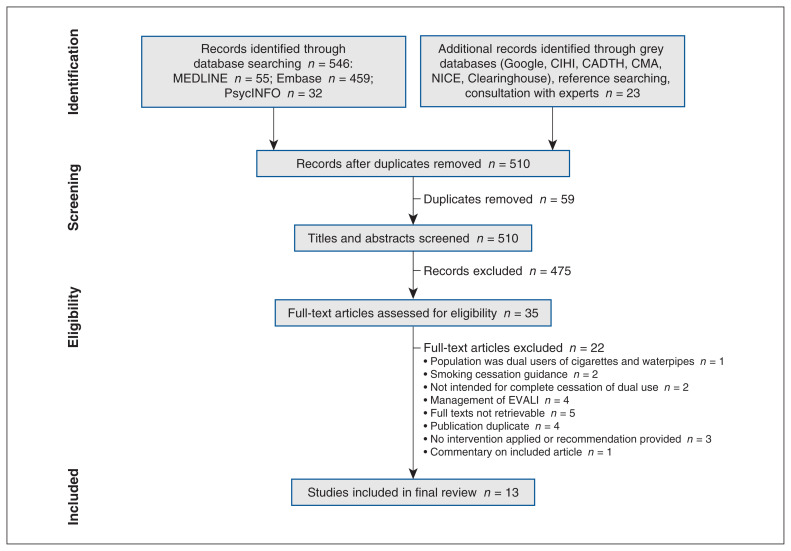
We systematically searched MEDLINE, Embase, PsycINFO and grey literature for publications that provided evidence or recommendations on vaping cessation for e-cigarette users and complete cessation of cigarette and e-cigarette use for dual users. We excluded publications focused on smoking cessation, harm reduction by e-cigarettes, cannabis vaping, and management of lung injury associated with e-cigarette or vaping use. Data were extracted on general characteristics and recommendations made in the publications, and different critical appraisal tools were used for quality assessment.
A total of 13 publications on vaping cessation interventions were included. Most articles were youth-focused, and behavioural counselling and nicotine replacement therapy were the most recommended interventions. Whereas 10 publications were appraised as "high quality" evidence, 5 articles adapted evidence from evaluation of smoking cessation. No study was found on complete cessation of cigarettes and e-cigarettes for dual users.
There is little evidence in support of effective vaping cessation interventions and no evidence for dual use cessation interventions. For an evidence-based cessation guideline, clinical trials should be rigorously designed to evaluate the effectiveness of behavioural interventions and medications for e-cigarette and dual use cessation among different subpopulations.
尽管有基于证据的戒烟指南,但这些指南在电子烟和电子烟与可燃香烟同时使用的戒烟方面的适用性尚未确定。在本次综述中,我们旨在确定针对青少年、青年和成年电子烟使用者和双重使用者的电子烟戒烟干预措施的当前证据或建议,并为未来的研究提供方向。
我们系统地检索了 MEDLINE、Embase、PsycINFO 和灰色文献,以查找提供有关电子烟使用者电子烟戒烟和双重使用者完全戒烟的证据或建议的出版物。我们排除了专注于戒烟、电子烟减害、大麻蒸气、电子烟或蒸气使用相关肺损伤管理的出版物。我们提取了出版物中的一般特征和建议,并使用不同的关键评估工具进行质量评估。
共纳入 13 篇关于电子烟戒烟干预措施的出版物。大多数文章都是针对青少年的,行为咨询和尼古丁替代疗法是最推荐的干预措施。虽然有 10 篇文章被评估为“高质量”证据,但有 5 篇文章改编了评估吸烟戒烟的证据。没有发现关于双重使用者完全戒烟的研究。
几乎没有证据支持有效的电子烟戒烟干预措施,也没有关于双重使用戒烟干预措施的证据。为了制定基于证据的戒烟指南,应该严格设计临床试验,以评估行为干预和药物在不同亚人群中对电子烟和双重使用戒烟的有效性。