Department of Clinical Pharmacy, Affiliated Hospital of Yunnan University, 176 Qing Nian Road, Kunming, 650118, Yunnan Province, People's Republic of China.
Kunming Medical University, Kunming, People's Republic of China.
Virol J. 2023 Apr 19;20(1):74. doi: 10.1186/s12985-023-02019-w.
CVB5 can cause respiratory infections. However, the molecular epidemiological information about CVB5 in respiratory tract samples is still limited. Here, we report five cases in which CVB5 was detected in sputum sample of pneumonia children patients from Kunming, Southwest China.
CVB5 isolates were obtained from sputum samples of patients with pneumonia. Whole-genome sequencing of CVB5 isolates was performed using segmented PCR, and phylogenetic, mutation and recombination analysis. The effect of mutations in the VP1 protein on hydration were analyzed by Protscale. The tertiary models of VP1 proteins were established by Colabfold, and the effect of mutations in VP1 protein on volume modifications and binding affinity were analyzed by Pymol software and PROVEAN.
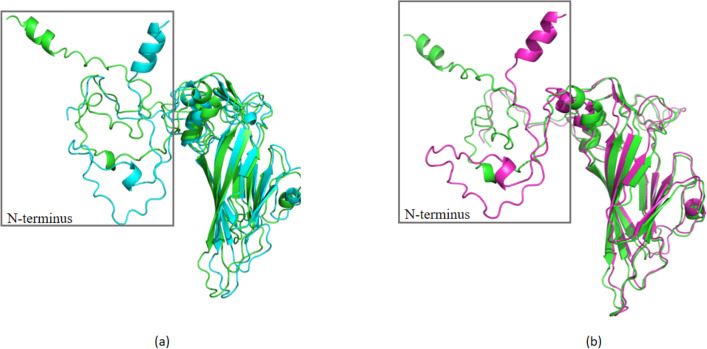
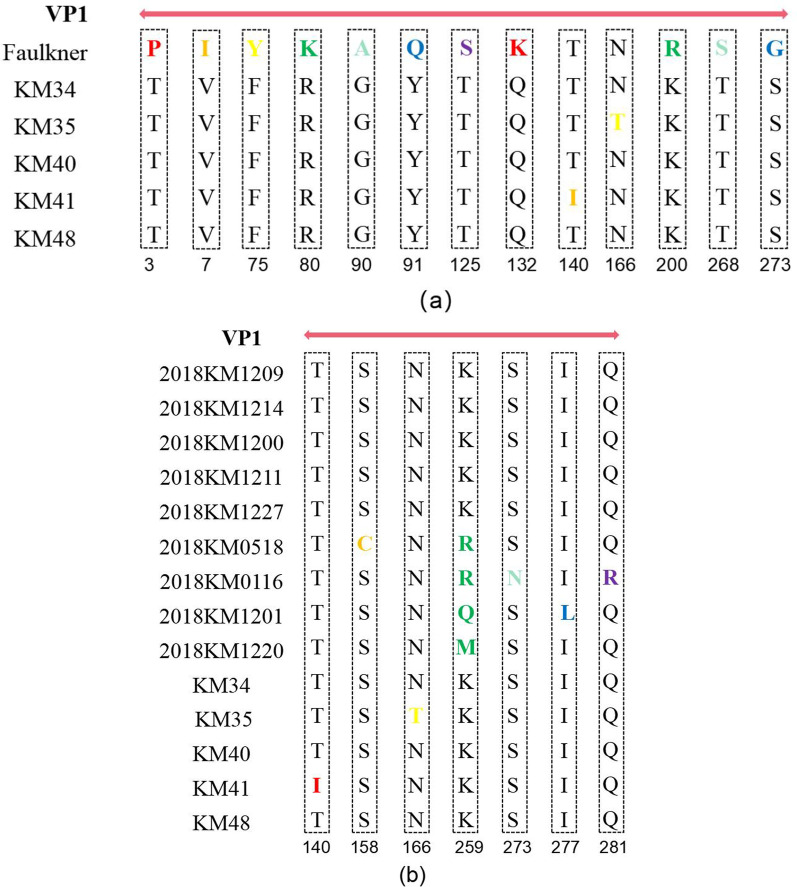
A total of five CVB5 complete genome sequences were obtained. No obvious homologous recombination signals comparing with other coxsackie B viruses were observed in the five isolates. Phylogenetic analysis showed that the five CVB5 sputum isolates were from an independent branch in genogroup E. Due to the mutation, the structure and spatial of the VP1 protein N-terminus have changed significantly. Comparing to the Faulkner (CVB5 prototype strain), PROVEAN revealed three deleterious substitutions: Y75F, N166T (KM35), T140I (KM41). The last two of the three deleterious substitutions significantly increased the hydrophobicity of the residues.
We unexpectedly found five cases of CVB5 infection instead of rhinoviruses infection during our routine surveillance of rhinoviruses in respiratory tract samples. All five patients were hospitalized with pneumonia symptoms and were not tested for enterovirus during their hospitalization. This report suggests that enterovirus surveillance in patients with respiratory symptoms should be strengthened.
CVB5 可引起呼吸道感染。然而,呼吸道样本中 CVB5 的分子流行病学信息仍然有限。本研究报告了在中国西南部昆明市,从肺炎患儿的痰样本中检测到 CVB5 的 5 例病例。
从肺炎患儿的痰样本中分离出 CVB5 病毒株。采用分段 PCR 对 CVB5 分离株进行全基因组测序,并进行系统进化、突变和重组分析。通过 Protscale 分析 VP1 蛋白突变对水合作用的影响。使用 Colabfold 建立 VP1 蛋白的三级结构模型,并使用 Pymol 软件和 PROVEAN 分析 VP1 蛋白突变对体积修饰和结合亲和力的影响。
共获得 5 株 CVB5 全基因组序列。与其他柯萨奇 B 病毒相比,这 5 个分离株未发现明显的同源重组信号。系统进化分析显示,这 5 株 CVB5 痰分离株来自 E 组的一个独立分支。由于突变,VP1 蛋白 N 端的结构和空间发生了明显变化。与 Faulkner 株(CVB5 原型株)相比,PROVEAN 显示有 3 个有害突变:Y75F、N166T(KM35)、T140I(KM41)。这 3 个有害突变中的后两个显著增加了残基的疏水性。
在我们对呼吸道样本中鼻病毒的常规监测中,我们意外地发现了 5 例 CVB5 感染病例,而不是鼻病毒感染病例。所有 5 例患者均因肺炎症状住院,住院期间未检测到肠道病毒。本报告提示应加强对有呼吸道症状患者的肠道病毒监测。