Department of Health Informatics, Mettu University, Mettu, Ethiopia.
West Gondar Zonal Health Department, Gondar, Ethiopia.
PLoS One. 2023 Apr 25;18(4):e0281427. doi: 10.1371/journal.pone.0281427. eCollection 2023.
Micronutrient deficiencies during pregnancy pose significant public health issues, considering the potential for negative consequences not only during pregnancy but also throughout life. Anemia in pregnant women is becoming a significant problem in developing countries, with scientific evidence indicating that 41.8 percent of women worldwide suffer from anemia. As a result, investigating the pooled prevalence and factors associated with micronutrient intake among pregnant women in East Africa is critical to alleviate the burden of micronutrient deficiency among pregnant women.
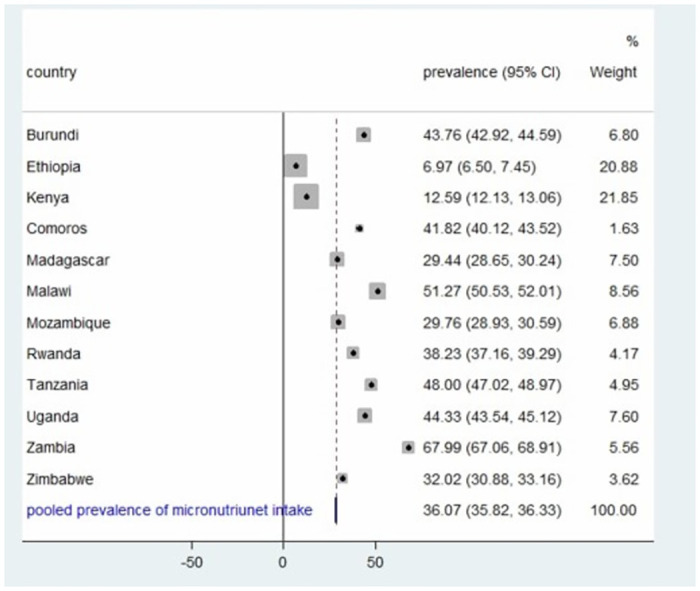
The pooled prevalence of micronutrient intake with a 95% Confidence Interval (CI) was reported and presented in a forest plot for East Africa Countries using STATA version 14.1. Intra-class Correlation Coefficient (ICC), Likelihood Ratio (LR) test, Median Odds Ratio (MOR), and deviance (-2LLR) values were used for model comparison and fitness. Adjusted Odds Ratios (AOR) with a 95% Confidence Interval (CI) and p-value ≤0.05 in the multilevel logistic model were used to declare significant factors associated with micronutrient intake.
The pooled prevalence of micronutrient intake in East African countries was 36.07% (95% CI: 35.82%, 36.33%). In the multilevel logistic regression model, women from the highest wealth quintile were 1.06 [AOR = 1.09, 95%CI: 1.00, 1.11] more likely to take micronutrients compared to their counterparts. Mothers who attained primary education, secondary education, and tertiary education had 1.20 times [AOR = 1.20, 95% CI: 1.15, 1.26], 1.28 times [AOR = 1.28, 95% CI: 1.19, 1.36] and 1.22 times [AOR = 1.22, 95% CI: 1.07, 1.38] more likely take micronutrient compared to mothers who attained no education, respectively.
The overall prevalence of micronutrient intake in East Africa was low. Only 36% of the study participants had micronutrient intake practice. Socioeconomic factors (education level, and household wealth status) have been shown to influence micronutrient intake. Therefore, it is necessitates the continuation of ongoing projects as well as the development of fresh ones that concentrate on these variables and include effective treatments and programs, especially among underprivileged and vulnerable populations.
孕妇微营养素缺乏是一个重大的公共卫生问题,因为这不仅会对孕妇自身造成潜在的负面影响,还会对其整个生命周期造成影响。发展中国家的孕妇贫血问题日益严重,有科学证据表明,全球 41.8%的妇女患有贫血。因此,调查东非国家孕妇微营养素摄入的综合流行率和相关因素对于减轻孕妇微营养素缺乏的负担至关重要。
采用 STATA 版本 14.1 对东非国家的微营养素摄入综合流行率(95%置信区间 [CI])进行了报告,并以森林图的形式呈现。使用组内相关系数(ICC)、似然比检验(LR 检验)、中位数优势比(MOR)和偏差(-2LLR)值进行模型比较和拟合度评估。多水平逻辑回归模型中调整后的优势比(AOR)及其 95%置信区间(CI)和 p 值≤0.05 用于声明与微营养素摄入相关的显著因素。
东非国家微营养素摄入的综合流行率为 36.07%(95%CI:35.82%,36.33%)。在多水平逻辑回归模型中,处于最高财富五分位数的妇女摄入微营养素的可能性比其对应者高 1.06 倍(AOR=1.09,95%CI:1.00,1.11)。接受过小学教育、中学教育和高等教育的母亲摄入微营养素的可能性分别高出 1.20 倍(AOR=1.20,95%CI:1.15,1.26)、1.28 倍(AOR=1.28,95%CI:1.19,1.36)和 1.22 倍(AOR=1.22,95%CI:1.07,1.38)。
东非地区的微营养素摄入综合流行率较低,仅有 36%的研究参与者存在微营养素摄入行为。社会经济因素(教育水平和家庭财富状况)已被证明会影响微营养素摄入。因此,有必要继续开展现有的项目,并开发新的项目,重点关注这些变量,并纳入有效的治疗和方案,特别是针对贫困和弱势群体。