Centre for the Research and Technology of Agro-Environmental and Biological Sciences (CITAB)/Institute for Innovation, Capacity Building and Sustainability of Agri-Food Production (Inov4Agro), University of Trás-os-Montes and Alto Douro (UTAD), 5000-801 Vila Real, Portugal.
Phytochemistry and Healthy Food Lab (LabFAS), Department of Food Science and Technology, CEBAS, CSIC, University Campus of Espinardo-25, 30100 Murcia, Spain.
Molecules. 2023 May 4;28(9):3885. doi: 10.3390/molecules28093885.
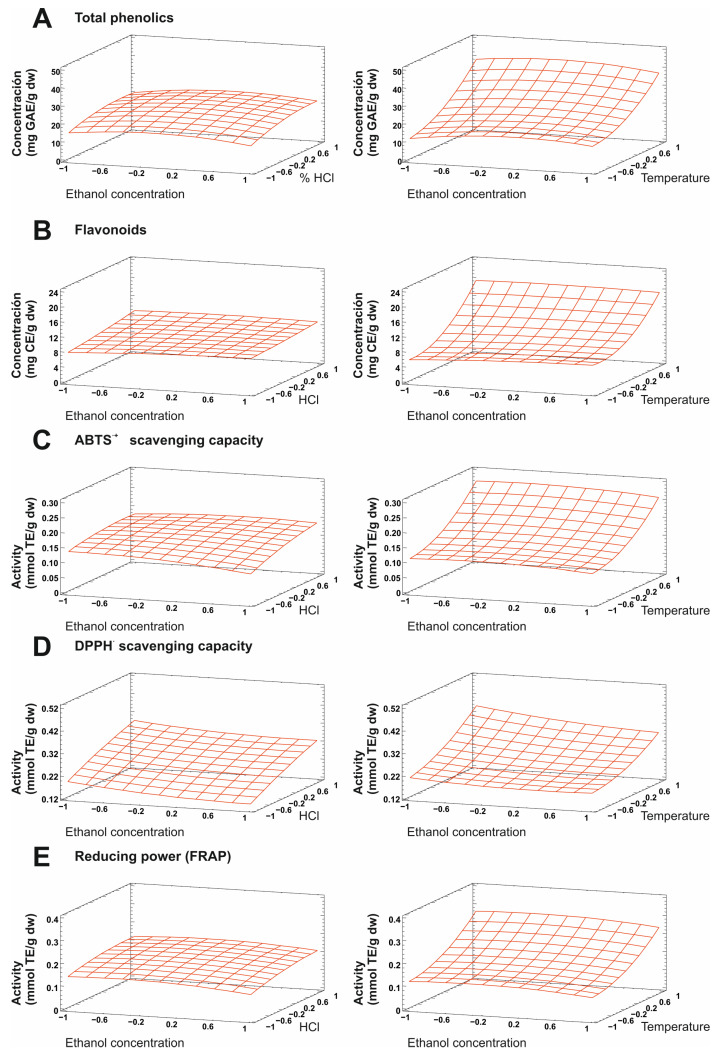
This study aims to take advantage of the wine industry by-products and extract bioactive compounds from grape pomace by applying methodologies susceptible to be integrated easily into industrial workflows because of the association with standard instrumentation and facilities, while the main factors affecting the efficiency of the process have been optimized. The sampling consisted of two grape varieties: 'Touriga Nacional' and 'Sousão'. A response surface methodology (RSM) method was used to optimize the extraction conditions based on three independent variables according to the chemical characteristics and stability/lability traits associated with polyphenols; the main bioactive phytochemical in grape pomace: solvent (50%, 70%, and 90% ethanol); temperature (20 °C, 40 °C, and 60 °C); and pH (0.5% HCl, 2% HCl, and 3.5% HCl). The phytochemical profile, as well as the radical scavenging and reducing powers were determined on 27 different samples. The highest yield and antioxidant activity corresponded to extracts obtained at 60 °C using 3.5% HCl and 70% ethanol. The values for total phenols and flavonoids were 44.93 mg of gallic acid equivalents (GAE) and 22.95 mg of catechins equivalents (CE) per gram, respectively. Concerning the evaluation of antioxidant capacity using various assays such as ABTS, DPPH, and FRAP, the results obtained were 0.30, 0.43, and 0.36 mmol of Trolox equivalent antioxidant capacity (TEAC) per gram, correspondingly. The analysis of the extract obtained with the best extraction performance using these parameters via High-Performance Liquid Chromatography-Mass Spectrometry has been also performed, allowing us to identify fourteen (14) compounds, including phenolic acids ( = 3), flavonols ( = 7), and anthocyanins ( = 4). As a result of this process, the best conditions for the production of a natural and environmentally friendly dye, not only avoiding waste but also reusing these by-products, were achieved.
本研究旨在利用葡萄酒行业的副产物,通过应用易于与标准仪器和设施相结合的方法,从葡萄渣中提取生物活性化合物,同时优化影响工艺效率的主要因素。采样包括两个葡萄品种:“Touriga Nacional”和“Sousão”。根据与多酚相关的化学特性和稳定性/不稳定性特征,采用响应面法(RSM)方法优化提取条件,该方法基于三个独立变量;葡萄渣中主要的生物活性植物化学物质:溶剂(50%、70%和 90%乙醇);温度(20°C、40°C 和 60°C);和 pH 值(0.5%HCl、2%HCl 和 3.5%HCl)。在 27 个不同的样品上测定了植物化学特征以及自由基清除和还原能力。最高的产率和抗氧化活性对应于在 60°C 下使用 3.5%HCl 和 70%乙醇获得的提取物。总酚和类黄酮的含量分别为 44.93 毫克没食子酸当量(GAE)和 22.95 毫克儿茶素当量(CE)/克。关于使用各种测定法(如 ABTS、DPPH 和 FRAP)评估抗氧化能力,获得的结果分别为 0.30、0.43 和 0.36 毫摩尔 Trolox 当量抗氧化能力(TEAC)/克。使用这些参数对提取性能最佳的提取物进行高效液相色谱-质谱分析,也进行了分析,鉴定出了十四种化合物,包括酚酸(=3)、类黄酮(=7)和花青素(=4)。通过这个过程,不仅避免了浪费,还重新利用了这些副产物,从而实现了生产天然和环保染料的最佳条件。