Molecular and Cellular Glycobiology Unit, Department of Biological Sciences, SungKyunKwan University, Seoburo 2066, Jangan-Gu, Suwon 16419, Republic of Korea.
Environmental Diseases Research Center, Korea Research Institute of Bioscience and Biotechnology, 125 Gwahak-ro, Daejeon 34141, Republic of Korea.
Int J Mol Sci. 2023 May 5;24(9):8226. doi: 10.3390/ijms24098226.
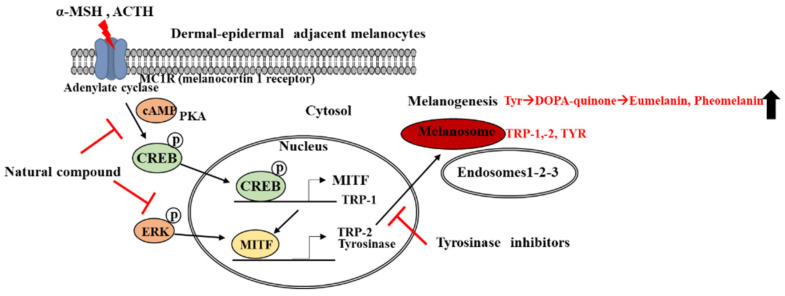
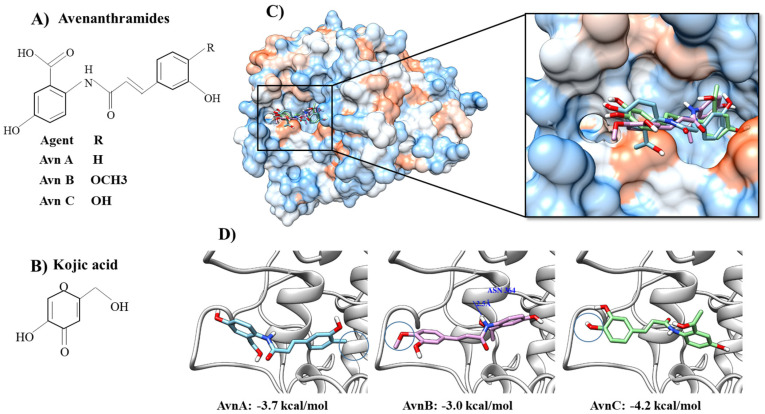
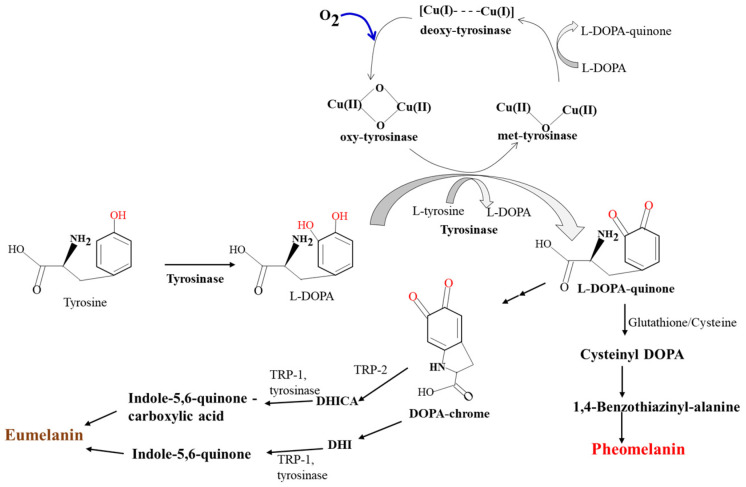
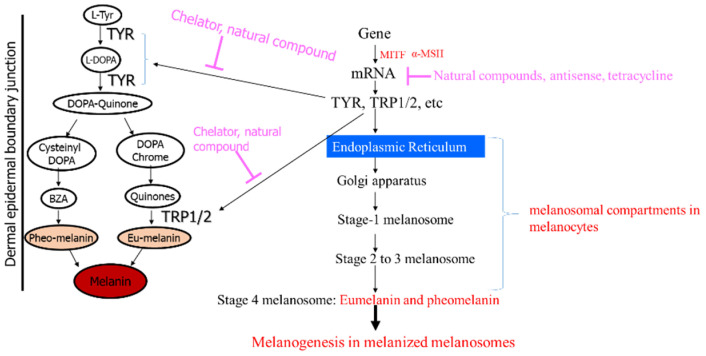
Currently, there are three major assaying methods used to validate in vitro whitening activity from natural products: methods using mushroom tyrosinase, human tyrosinase, and dopachrome tautomerase (or tyrosinase-related protein-2, TRP-2). Whitening agent development consists of two ways, melanin synthesis inhibition in melanocytes and downregulation of melanocyte stimulation. For melanin levels, the melanocyte cell line has been used to examine melanin synthesis with the expression levels of TRP-1 and TRP-2. The proliferation of epidermal surfaced cells and melanocytes is stimulated by cellular signaling receptors, factors, or mediators including endothelin-1, α-melanocyte-stimulating hormone, nitric oxide, histamine, paired box 3, microphthalmia-associated transcription factor, pyrimidine dimer, ceramide, stem cell factors, melanocortin-1 receptor, and cAMP. In addition, the promoter region of melanin synthetic genes including tyrosinase is upregulated by melanocyte-specific transcription factors. Thus, the inhibition of growth and melanin synthesis in gene expression levels represents a whitening research method that serves as an alternative to tyrosinase inhibition. Many researchers have recently presented the bioactivity-guided fractionation, discovery, purification, and identification of whitening agents. Melanogenesis inhibition can be obtained using three different methods: tyrosinase inhibition, copper chelation, and melanin-related protein downregulation. There are currently four different types of inhibitors characterized based on their enzyme inhibition mechanisms: competitive, uncompetitive, competitive/uncompetitive mixed-type, and noncompetitive inhibitors. Reversible inhibitor types act as suicide substrates, where traditional inhibitors are classified as inactivators and reversible inhibitors based on the molecule-recognizing properties of the enzyme. In a minor role, transcription factors can also be downregulated by inhibitors. Currently, the active site copper iron-binding inhibitors such as kojic acid and chalcone exhibit tyrosinase inhibitory activity. Because the tyrosinase catalysis site structure is important for the mechanism determination of tyrosinase inhibitors, understanding the enzyme recognition and inhibitory mechanism of inhibitors is essential for the new development of tyrosinase inhibitors. The present review intends to classify current natural products identified by means of enzyme kinetics and copper chelation to exhibit tyrosinase enzyme inhibition.
目前,有三种主要的方法可用于验证天然产物的体外美白活性:使用蘑菇酪氨酸酶、人酪氨酸酶和多巴色素互变异构酶(或酪氨酸酶相关蛋白-2,TRP-2)的方法。美白剂的开发包括两种方式,即抑制黑色素细胞中的黑色素合成和下调黑色素细胞刺激。对于黑色素水平,黑素细胞系已被用于通过 TRP-1 和 TRP-2 的表达水平来检查黑色素合成。表皮表面细胞和黑色素细胞的增殖受到细胞信号受体、因子或介质的刺激,包括内皮素-1、α-促黑素细胞激素、一氧化氮、组胺、配对盒 3、小眼相关转录因子、嘧啶二聚体、神经酰胺、干细胞因子、黑色素皮质素-1 受体和 cAMP。此外,黑色素合成基因包括酪氨酸酶的启动子区域被黑色素细胞特异性转录因子上调。因此,在基因表达水平上抑制生长和黑色素合成代表了一种美白研究方法,可以替代酪氨酸酶抑制。最近,许多研究人员提出了基于生物活性的分馏、发现、纯化和鉴定美白剂的方法。可以使用三种不同的方法获得黑色素生成抑制作用:酪氨酸酶抑制、铜螯合和黑色素相关蛋白下调。目前,根据其酶抑制机制,有四种不同类型的抑制剂:竞争性、非竞争性、竞争性/非竞争性混合类型和非竞争性抑制剂。可逆抑制剂类型作为自杀底物起作用,其中传统抑制剂根据酶的分子识别特性分为失活剂和可逆抑制剂。在次要作用下,抑制剂也可以下调转录因子。目前,活性部位铜铁结合抑制剂如曲酸和查尔酮表现出酪氨酸酶抑制活性。由于酪氨酸酶催化部位结构对于确定酪氨酸酶抑制剂的机制很重要,因此了解抑制剂的酶识别和抑制机制对于新的酪氨酸酶抑制剂的开发至关重要。本综述旨在根据酶动力学和铜螯合作用对当前已鉴定的天然产物进行分类,以显示对酪氨酸酶的抑制作用。