Department of Pharmaceutics, Center for Pharmacometrics and Systems Pharmacology, College of Pharmacy, University of Florida, Florida, Orlando, USA.
Critical Path Institute, Arizona, Tucson, USA.
CPT Pharmacometrics Syst Pharmacol. 2023 Jul;12(7):1016-1028. doi: 10.1002/psp4.12973. Epub 2023 May 3.
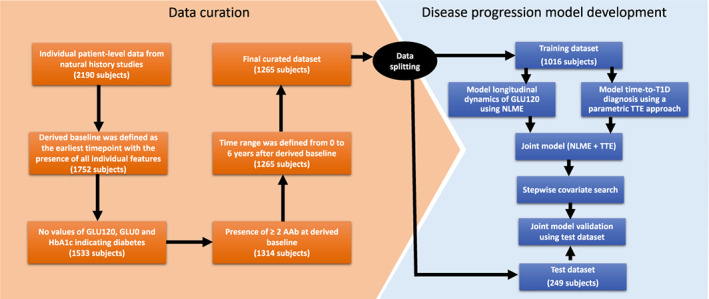
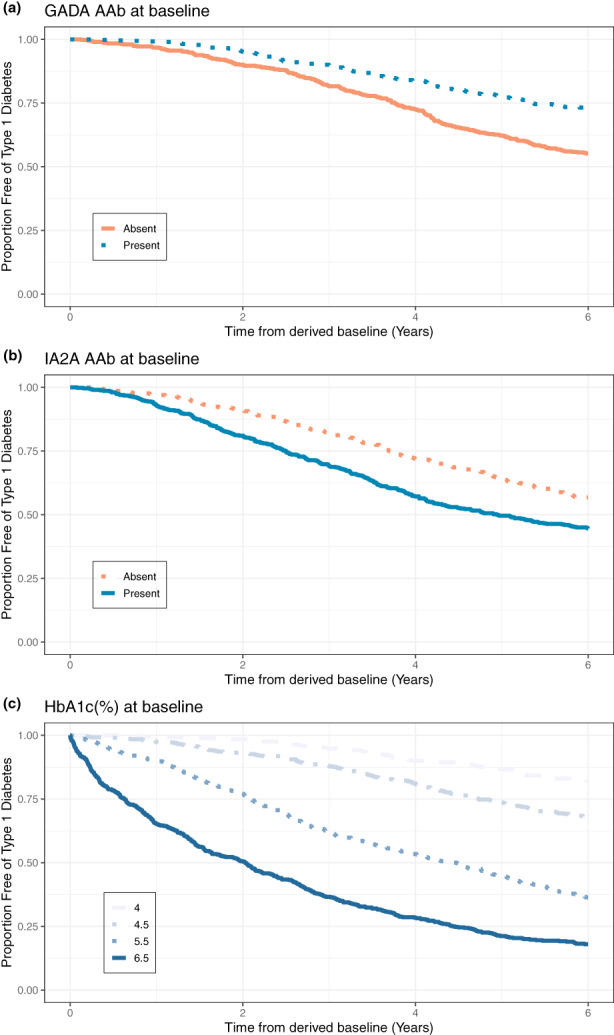
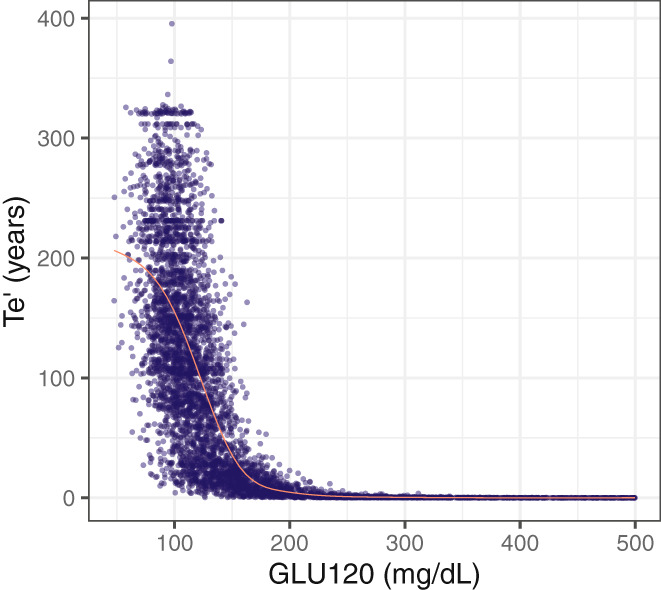
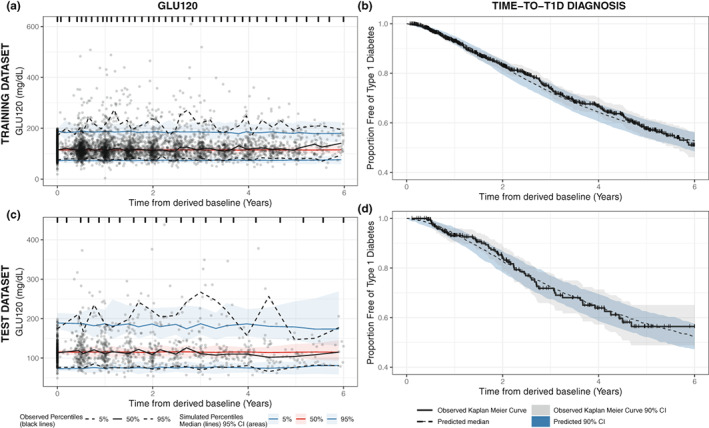
Clinical trials seeking type 1 diabetes prevention are challenging in terms of identifying patient populations likely to progress to type 1 diabetes within limited (i.e., short-term) trial durations. Hence, we sought to improve such efforts by developing a quantitative disease progression model for type 1 diabetes. Individual-level data obtained from the TrialNet Pathway to Prevention and The Environmental Determinants of Diabetes in the Young natural history studies were used to develop a joint model that links the longitudinal glycemic measure to the timing of type 1 diabetes diagnosis. Baseline covariates were assessed using a stepwise covariate modeling approach. Our study focused on individuals at risk of developing type 1 diabetes with the presence of two or more diabetes-related autoantibodies (AAbs). The developed model successfully quantified how patient features measured at baseline, including HbA1c and the presence of different AAbs, alter the timing of type 1 diabetes diagnosis with reasonable accuracy and precision (<30% RSE). In addition, selected covariates were statistically significant (p < 0.0001 Wald test). The Weibull model best captured the timing to type 1 diabetes diagnosis. The 2-h oral glucose tolerance values assessed at each visit were included as a time-varying biomarker, which was best quantified using the sigmoid maximum effect function. This model provides a framework to quantitatively predict and simulate the time to type 1 diabetes diagnosis in individuals at risk of developing the disease and thus, aligns with the needs of pharmaceutical companies and scientists seeking to advance therapies aimed at interdicting the disease process.
临床研究旨在预防 1 型糖尿病,在有限(即短期)的试验持续时间内识别可能进展为 1 型糖尿病的患者群体极具挑战性。因此,我们试图通过开发用于 1 型糖尿病的定量疾病进展模型来改善此类工作。从 TrialNet 预防途径和年轻型糖尿病的环境决定因素的自然史研究中获得的个体水平数据用于开发一个联合模型,该模型将纵向血糖测量值与 1 型糖尿病的诊断时间联系起来。使用逐步协变量建模方法评估基线协变量。我们的研究重点是存在两种或更多种与糖尿病相关的自身抗体(AAb)的处于 1 型糖尿病风险中的个体。所开发的模型成功地量化了患者在基线时测量的特征(包括 HbA1c 和不同 AAb 的存在)如何以合理的准确性和精密度(<30% RSE)改变 1 型糖尿病的诊断时间。此外,选定的协变量具有统计学意义(p<0.0001 Wald 检验)。威布尔模型最能捕捉到 1 型糖尿病诊断的时间。每次就诊时评估的 2 小时口服葡萄糖耐量值被作为一个时变生物标志物,最好使用最大效应函数的 S 形来量化。该模型提供了一个框架,可对处于疾病发展风险中的个体的 1 型糖尿病诊断时间进行定量预测和模拟,因此符合制药公司和科学家的需求,他们寻求推进旨在阻断疾病进程的治疗方法。