Broad Institute of MIT and Harvard, Cambridge, MA, USA.
Department of Molecular Biology and Howard Hughes Medical Institute, Massachusetts General Hospital, Boston, MA, USA.
Nat Metab. 2023 May;5(5):765-776. doi: 10.1038/s42255-023-00774-2. Epub 2023 May 17.
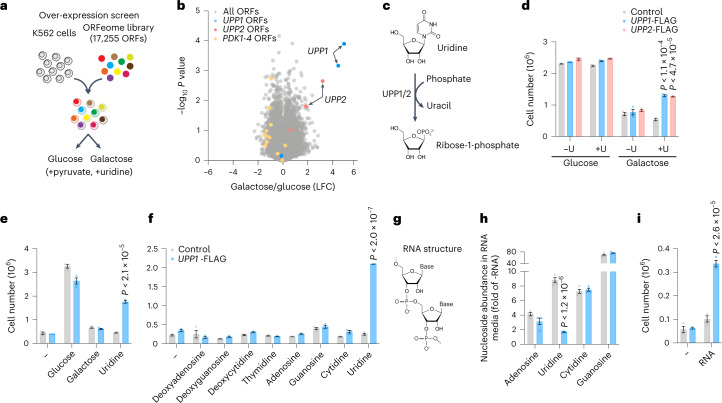
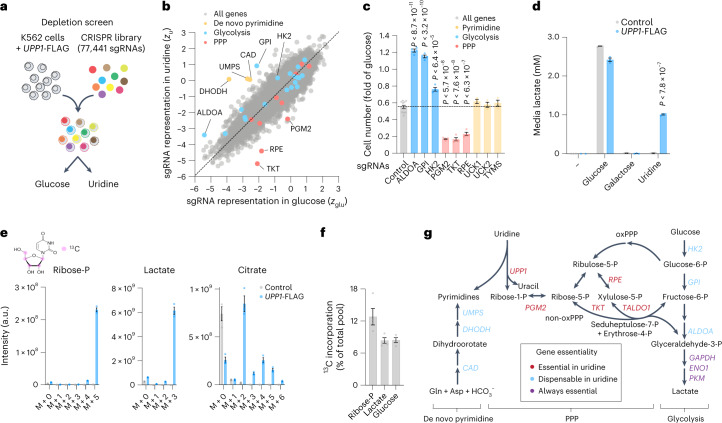
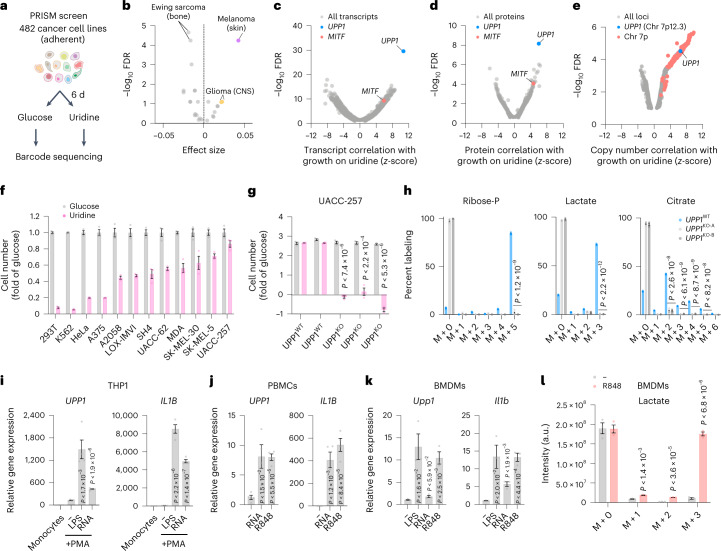
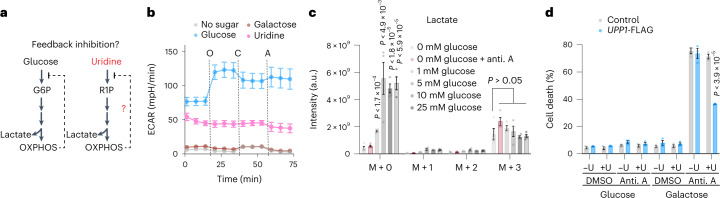
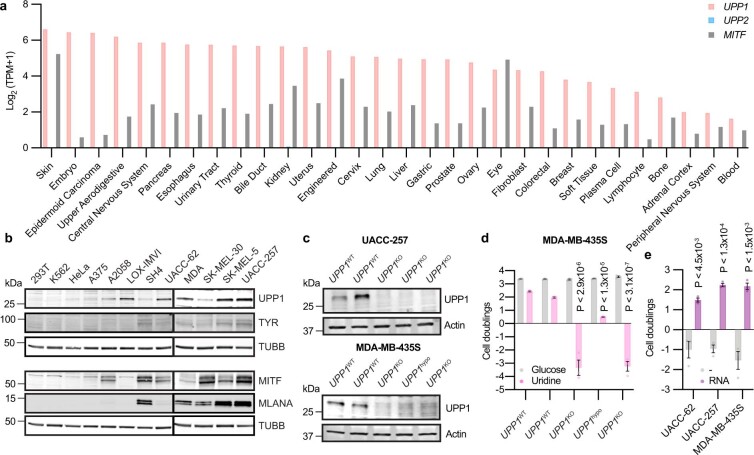
Glucose is vital for life, serving as both a source of energy and carbon building block for growth. When glucose is limiting, alternative nutrients must be harnessed. To identify mechanisms by which cells can tolerate complete loss of glucose, we performed nutrient-sensitized genome-wide genetic screens and a PRISM growth assay across 482 cancer cell lines. We report that catabolism of uridine from the medium enables the growth of cells in the complete absence of glucose. While previous studies have shown that uridine can be salvaged to support pyrimidine synthesis in the setting of mitochondrial oxidative phosphorylation deficiency, our work demonstrates that the ribose moiety of uridine or RNA can be salvaged to fulfil energy requirements via a pathway based on: (1) the phosphorylytic cleavage of uridine by uridine phosphorylase UPP1/UPP2 into uracil and ribose-1-phosphate (R1P), (2) the conversion of uridine-derived R1P into fructose-6-P and glyceraldehyde-3-P by the non-oxidative branch of the pentose phosphate pathway and (3) their glycolytic utilization to fuel ATP production, biosynthesis and gluconeogenesis. Capacity for glycolysis from uridine-derived ribose appears widespread, and we confirm its activity in cancer lineages, primary macrophages and mice in vivo. An interesting property of this pathway is that R1P enters downstream of the initial, highly regulated steps of glucose transport and upper glycolysis. We anticipate that 'uridine bypass' of upper glycolysis could be important in the context of disease and even exploited for therapeutic purposes.
葡萄糖对生命至关重要,既是能量的来源,也是生长的碳构建块。当葡萄糖受到限制时,必须利用替代营养物质。为了确定细胞可以耐受完全丧失葡萄糖的机制,我们在 482 种癌细胞系中进行了营养敏感的全基因组遗传筛选和 PRISM 生长测定。我们报告说,从培养基中分解尿苷可以使细胞在完全没有葡萄糖的情况下生长。虽然先前的研究表明,在线粒体氧化磷酸化缺陷的情况下,尿苷可以被回收用于支持嘧啶合成,但我们的工作表明,尿苷或 RNA 的核糖部分可以通过以下途径被回收来满足能量需求:(1)尿苷磷酸化酶 UPP1/UPP2 将尿苷磷酸化为尿嘧啶和核糖-1-磷酸(R1P),(2)非氧化戊糖磷酸途径的分支将尿苷衍生的 R1P 转化为果糖-6-P 和甘油醛-3-P,(3)它们通过糖酵解利用为 ATP 产生、生物合成和糖异生提供燃料。来自尿苷衍生的核糖的糖酵解能力似乎很广泛,我们在癌细胞系、原代巨噬细胞和体内小鼠中证实了其活性。该途径的一个有趣特性是,R1P 进入葡萄糖运输和上糖酵解的初始高度调节步骤的下游。我们预计,上糖酵解的“尿苷旁路”在疾病情况下可能很重要,甚至可能被用于治疗目的。