Brožová Klára, Hantusch Brigitte, Kenner Lukas, Kratochwill Klaus
Core Facility Proteomics, Medical University of Vienna, 1090 Vienna, Austria.
Department of Pathology, Medical University of Vienna, 1090 Vienna, Austria.
Proteomes. 2023 May 3;11(2):17. doi: 10.3390/proteomes11020017.
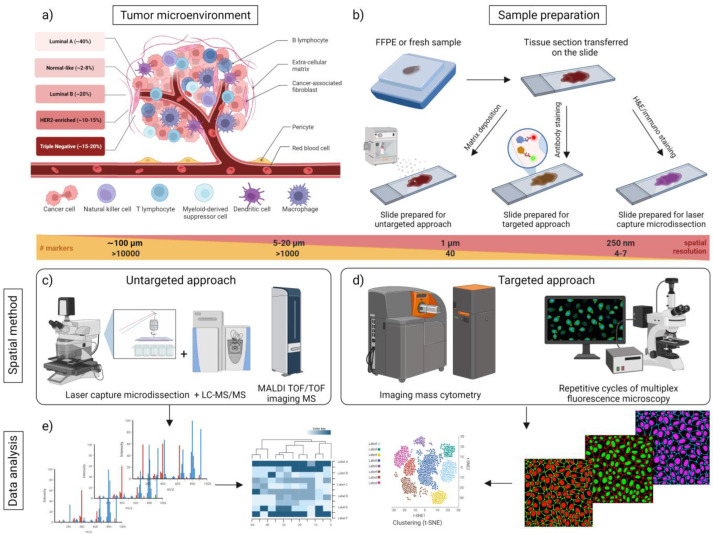
Breast cancer (BC) is a major global health issue, affecting a significant proportion of the female population and contributing to high rates of mortality. One of the primary challenges in the treatment of BC is the disease's heterogeneity, which can lead to ineffective therapies and poor patient outcomes. Spatial proteomics, which involves the study of protein localization within cells, offers a promising approach for understanding the biological processes that contribute to cellular heterogeneity within BC tissue. To fully leverage the potential of spatial proteomics, it is critical to identify early diagnostic biomarkers and therapeutic targets, and to understand protein expression levels and modifications. The subcellular localization of proteins is a key factor in their physiological function, making the study of subcellular localization a major challenge in cell biology. Achieving high resolution at the cellular and subcellular level is essential for obtaining an accurate spatial distribution of proteins, which in turn can enable the application of proteomics in clinical research. In this review, we present a comparison of current methods of spatial proteomics in BC, including untargeted and targeted strategies. Untargeted strategies enable the detection and analysis of proteins and peptides without a predetermined molecular focus, whereas targeted strategies allow the investigation of a predefined set of proteins or peptides of interest, overcoming the limitations associated with the stochastic nature of untargeted proteomics. By directly comparing these methods, we aim to provide insights into their strengths and limitations and their potential applications in BC research.
乳腺癌(BC)是一个重大的全球健康问题,影响着相当比例的女性人口,并导致高死亡率。BC治疗的主要挑战之一是该疾病的异质性,这可能导致治疗无效和患者预后不良。空间蛋白质组学涉及细胞内蛋白质定位的研究,为理解导致BC组织内细胞异质性的生物学过程提供了一种有前景的方法。为了充分利用空间蛋白质组学的潜力,识别早期诊断生物标志物和治疗靶点以及了解蛋白质表达水平和修饰至关重要。蛋白质的亚细胞定位是其生理功能的关键因素,使得亚细胞定位研究成为细胞生物学中的一项重大挑战。在细胞和亚细胞水平实现高分辨率对于获得蛋白质的准确空间分布至关重要,这反过来又能使蛋白质组学应用于临床研究。在本综述中,我们对BC中空间蛋白质组学的当前方法进行了比较,包括非靶向和靶向策略。非靶向策略能够在没有预定分子焦点的情况下检测和分析蛋白质及肽,而靶向策略允许对一组预定义的感兴趣的蛋白质或肽进行研究,克服了与非靶向蛋白质组学的随机性相关的局限性。通过直接比较这些方法,我们旨在深入了解它们的优势和局限性以及它们在BC研究中的潜在应用。