Watterson Taylor L, Chui Michelle A
Department of Family Medicine and Community Health, University of Wisconsin School of Medicine and Public Health, 750 Highland Avenue, Madison, WI 53705, USA.
Social and Administrative Sciences Division, University of Wisconsin-Madison School of Pharmacy, 777 Highland Avenue, Madison, WI 53705, USA.
Pharmacy (Basel). 2023 May 9;11(3):84. doi: 10.3390/pharmacy11030084.
Community retail pharmacists are experiencing unsafe levels of stress and excessive demands within the workplace. One aspect of workload stress that has been overlooked among pharmacists is occupational fatigue. Occupational fatigue is a characteristic of excessive workload including increased work demands and reduced capacity and resources to complete the work. The goal of this study is to describe the subjective perceptions of occupational fatigue in community pharmacists by using (Aim 1) a previously developed Pharmacist Fatigue Instrument and (Aim 2) semi-structured interviews.
Wisconsin community pharmacists were eligible to participate in the study and recruited via a practice-based research network. Participants were asked to complete a demographic questionnaire, a Pharmacist Fatigue Instrument, and semi-structured interview. Survey data were analyzed using descriptive statistics. Interview transcripts were analyzed using qualitative deductive content analysis.
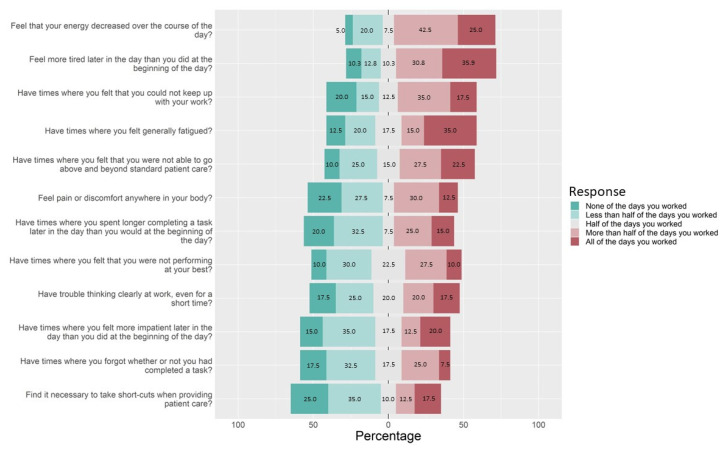
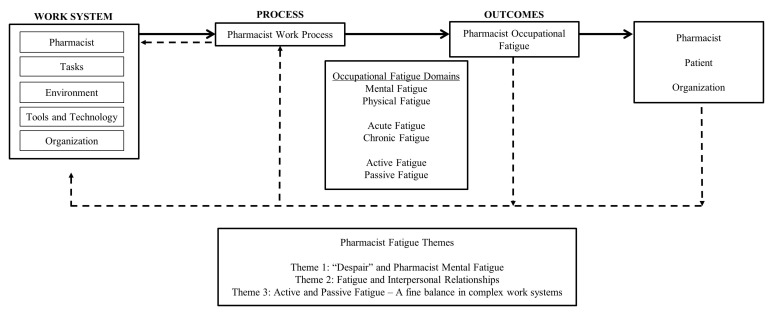
Totally, 39 pharmacists participated in the study. From the Pharmacist Fatigue Instrument, 50% of the participants stated they had times where they were not able to go above and beyond standard patient care on more than half of the days they worked. A total of 30% of the participants reported that they found it necessary to take short-cuts when providing patient care on more than half of the days they worked. Pharmacist interviews were separated into overarching themes including mental fatigue, physical fatigue, active fatigue, and passive fatigue.
The findings highlighted the pharmacists' feelings of despair and mental fatigue, fatigue's connectedness to interpersonal relationships, and the complex nature of pharmacy work systems. Interventions aimed at improving occupational fatigue in community pharmacies should consider key themes of fatigue that pharmacists are experiencing.
社区零售药剂师在工作场所承受着不安全水平的压力和过度的工作要求。药剂师工作压力中一个被忽视的方面是职业疲劳。职业疲劳是工作量过大的一种表现,包括工作要求增加以及完成工作的能力和资源减少。本研究的目的是通过使用(目标1)先前开发的药剂师疲劳量表和(目标2)半结构化访谈来描述社区药剂师对职业疲劳的主观感受。
威斯康星州的社区药剂师有资格参与本研究,并通过基于实践的研究网络招募。参与者被要求完成一份人口统计学问卷、一份药剂师疲劳量表和半结构化访谈。调查数据采用描述性统计进行分析。访谈记录采用定性演绎内容分析法进行分析。
共有39名药剂师参与了本研究。根据药剂师疲劳量表,50%的参与者表示,在超过一半的工作日里,他们有时无法超越标准的患者护理工作。共有30%的参与者报告说,在超过一半的工作日里,他们发现在提供患者护理时采取捷径是必要的。药剂师访谈被分为几个总体主题,包括精神疲劳、身体疲劳、主动疲劳和被动疲劳。
研究结果突出了药剂师的绝望感和精神疲劳、疲劳与人际关系的联系以及药房工作系统的复杂性。旨在改善社区药房职业疲劳的干预措施应考虑药剂师所经历的疲劳的关键主题。