Faculdade de Farmácia da Universidade de Lisboa, Lisbon, Portugal.
Facultad de Medicina y Odontología de la Universidad de Santiago de Compostela, A Coruña, Galicia, Spain.
Int J Clin Pharm. 2023 Dec;45(6):1349-1358. doi: 10.1007/s11096-023-01592-y. Epub 2023 May 29.
Spontaneous reporting is the most used method to monitor post-marketing safety information. Although patient involvement in spontaneous reporting has increased overtime, little is known about factors associated with patients' adverse drug reaction (ADR) reporting.
To identify and assess the sociodemographic characteristics, attitudes and knowledge that influence spontaneous reporting and the reasons associated with ADR underreporting by patients.
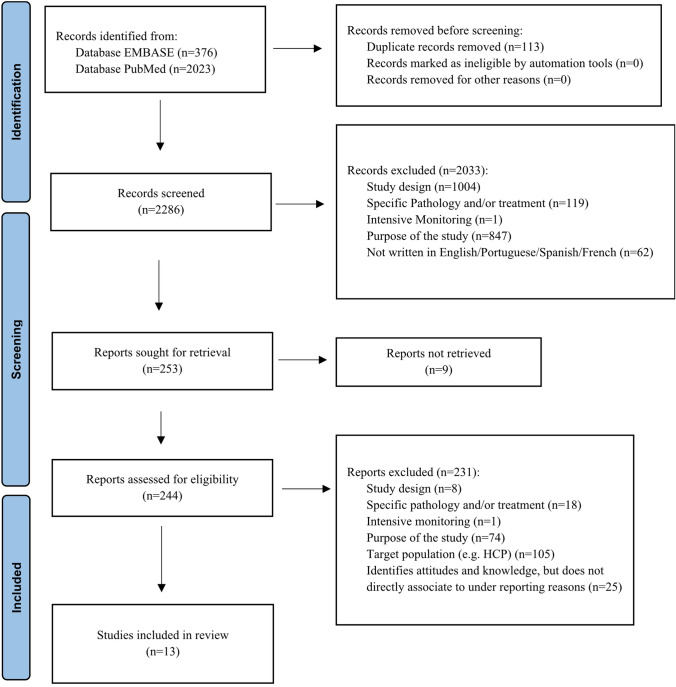
A systematic review was conducted according to PRISMA guidelines. A search on the MEDLINE and EMBASE scientific databases was performed to retrieve studies published between 1 January 2006 and 1 November 2022. Studies were included if they addressed knowledge and attitudes associated with ADR underreporting.
A total of 2512 citations were identified, of which 13 studies were included. Sociodemographic characteristics were frequently identified with ADR reporting in 6 studies, being age (3/13) and level of education (3/13) the most often reported. Older age groups (2/13) and individuals with higher level of education (3/13) were more likely to report ADRs. Underreporting was shown to be motivated by reasons related to knowledge, attitudes, and excuses. Ignorance (10/13), complacency (6/13), and lethargy (6/13) were the most frequent reasons for not reporting.
This study highlighted the scarcity of research conducted with the aim of assessing ADR underreporting by patients. Knowledge, attitudes, and excuses were commonly observed in the decision to report ADRs. These motives are characteristics that can be changed; hence strategies must be designed to raise awareness, continually educate, and empower this population to change the paradigm of underreporting.
自发报告是监测上市后安全性信息最常用的方法。尽管患者参与自发报告的比例随着时间的推移有所增加,但对于与患者药物不良反应(ADR)报告相关的因素知之甚少。
确定并评估影响自发报告的社会人口统计学特征、态度和知识,以及患者 ADR 漏报的相关原因。
根据 PRISMA 指南进行系统综述。在 MEDLINE 和 EMBASE 科学数据库上进行检索,以获取 2006 年 1 月 1 日至 2022 年 11 月 1 日期间发表的研究。如果研究涉及与 ADR 漏报相关的知识和态度,则将其纳入。
共确定了 2512 条引用,其中包括 13 项研究。6 项研究频繁发现与 ADR 报告相关的社会人口统计学特征,其中年龄(3/13)和教育程度(3/13)是最常报告的特征。年龄较大的群体(2/13)和教育程度较高的个体(3/13)更有可能报告 ADR。漏报的原因与知识、态度和借口有关。不报告的最常见原因是无知(10/13)、自满(6/13)和懒惰(6/13)。
本研究强调了针对患者 ADR 漏报情况进行评估的研究相对较少。知识、态度和借口是决定报告 ADR 的常见因素。这些动机是可以改变的特征;因此,必须设计策略来提高认识、持续教育,并赋予这一人群权力,以改变漏报的模式。