Department of Epidemiology, Harvard T.H. Chan School of Public Health, 667 Huntington Avenue, Kresge 906A, Boston, MA, 02115, USA.
Clinical and Translational Epidemiology Unit, Massachusetts General Hospital and Harvard Medical School, Boston, MA, USA.
Microbiome. 2023 May 30;11(1):121. doi: 10.1186/s40168-023-01542-w.
The gut microbiome regulates host energy balance and adiposity-related metabolic consequences, but it remains unknown how the gut microbiome modulates body weight response to physical activity (PA).
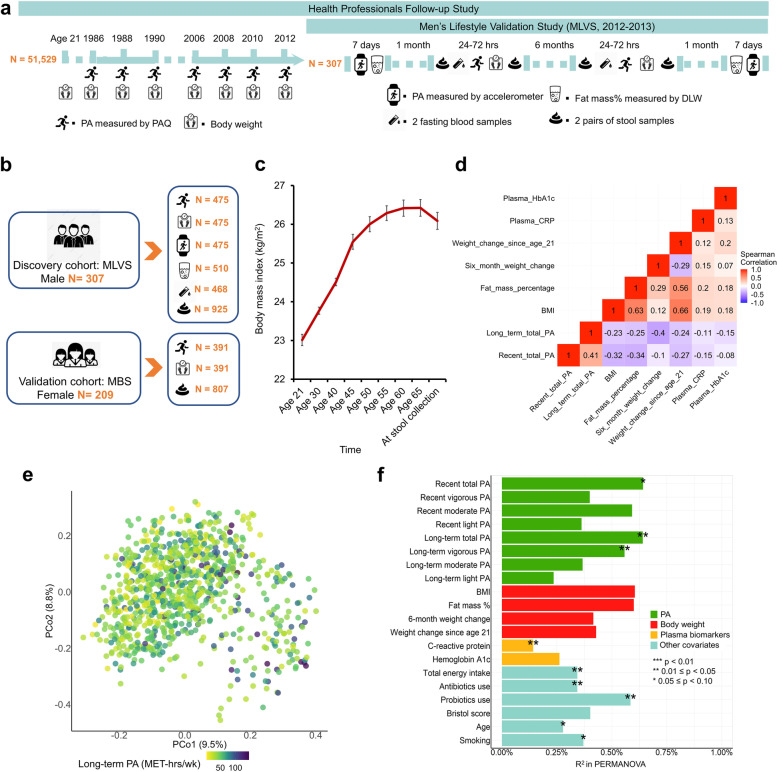
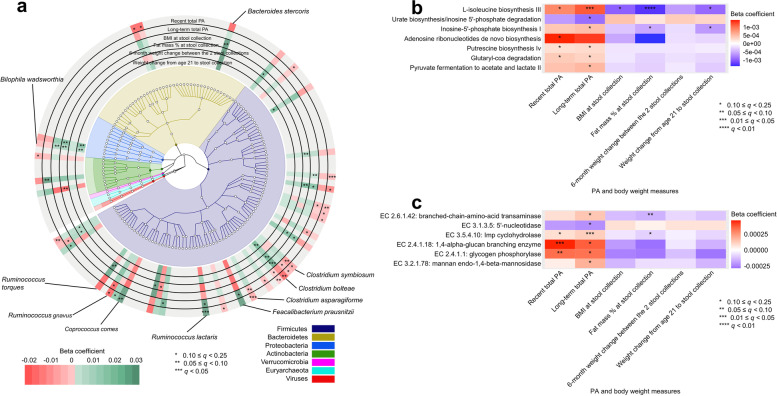
Nested in the Health Professionals Follow-up Study, a subcohort of 307 healthy men (mean[SD] age, 70[4] years) provided stool and blood samples in 2012-2013. Data from cohort long-term follow-ups and from the accelerometer, doubly labeled water, and plasma biomarker measurements during the time of stool collection were used to assess long-term and short-term associations of PA with adiposity. The gut microbiome was profiled by shotgun metagenomics and metatranscriptomics. A subcohort of 209 healthy women from the Nurses' Health Study II was used for validation.
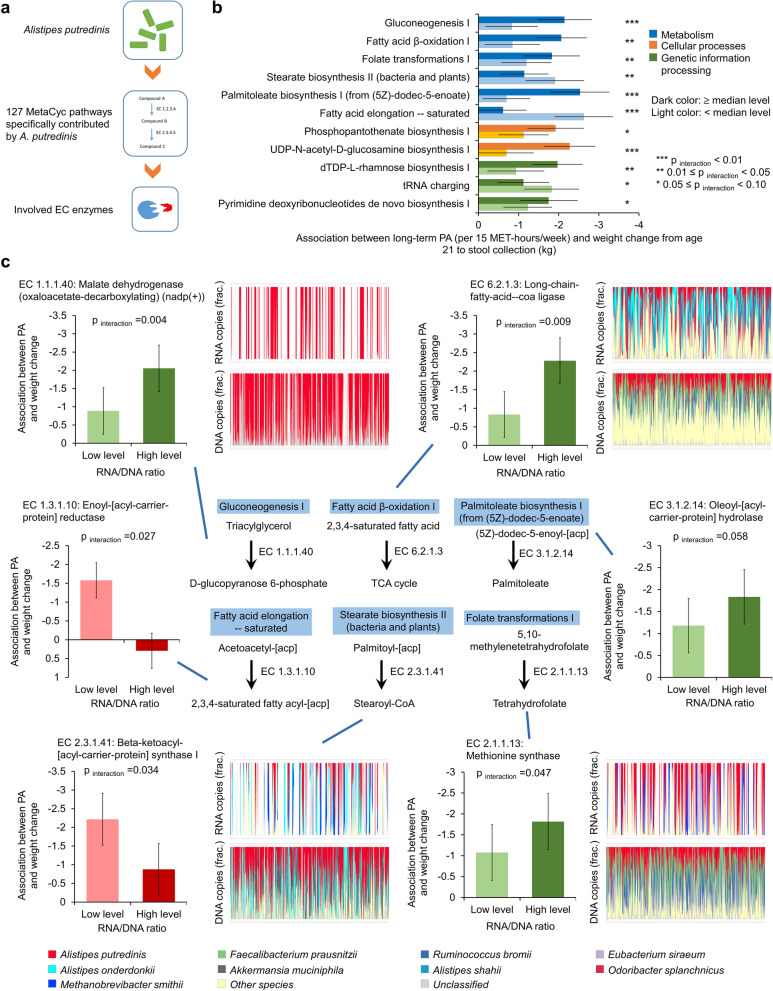
The microbial species Alistipes putredinis was found to modify the association between PA and body weight. Specifically, in individuals with higher abundance of A. putredinis, each 15-MET-hour/week increment in long-term PA was associated with 2.26 kg (95% CI, 1.53-2.98 kg) less weight gain from age 21 to the time of stool collection, whereas those with lower abundance of A. putredinis only had 1.01 kg (95% CI, 0.41-1.61 kg) less weight gain (p = 0.019). Consistent modification associated with A. putredinis was observed for short-term PA in relation to BMI, fat mass%, plasma HbA1c, and 6-month weight change. This modification effect might be partly attributable to four metabolic pathways encoded by A. putredinis, including folate transformation, fatty acid β-oxidation, gluconeogenesis, and stearate biosynthesis.
A greater abundance of A. putredinis may strengthen the beneficial association of PA with body weight change, suggesting the potential of gut microbial intervention to improve the efficacy of PA in body weight management. Video Abstract.
肠道微生物组调节宿主的能量平衡和与肥胖相关的代谢后果,但目前尚不清楚肠道微生物组如何调节身体对体力活动(PA)的体重反应。
嵌套在健康专业人员随访研究中,一个由 307 名健康男性(平均[SD]年龄,70[4]岁)组成的亚队列于 2012-2013 年提供粪便和血液样本。队列长期随访的数据以及在粪便收集期间使用的加速度计、双标记水和血浆生物标志物测量值,用于评估 PA 与肥胖的长期和短期关联。通过 shotgun 宏基因组学和宏转录组学来描述肠道微生物组。使用来自护士健康研究 II 的 209 名健康女性的亚队列进行验证。
发现 Alistipes putredinis 微生物物种可改变 PA 与体重之间的关联。具体来说,在 A. putredinis 丰度较高的个体中,长期 PA 每增加 15-MET 小时/周,与从 21 岁到粪便收集时体重增加 2.26 公斤(95%CI,1.53-2.98 公斤)相关,而 A. putredinis 丰度较低的个体仅体重增加 1.01 公斤(95%CI,0.41-1.61 公斤)(p=0.019)。在与 BMI、脂肪百分比、血浆 HbA1c 和 6 个月体重变化相关的短期 PA 中,观察到与 A. putredinis 一致的修饰作用。这种修饰作用可能部分归因于 A. putredinis 编码的四种代谢途径,包括叶酸转化、脂肪酸β-氧化、糖异生和硬脂酸生物合成。
A. putredinis 的丰度增加可能会增强 PA 与体重变化之间的有益关联,表明肠道微生物干预有可能改善 PA 在体重管理中的效果。