Department of Ophthalmology, Elisabeth-TweeSteden Hospital, Hilvarenbeekseweg 60, 5022 GC, Tilburg, The Netherlands.
Department of Optics, Pharmacology and Anatomy, University of Alicante, Crta San Vicente del Raspeig S/N 03016, San Vicente del Raspeig, Alicante, Spain.
Graefes Arch Clin Exp Ophthalmol. 2023 Aug;261(8):2315-2326. doi: 10.1007/s00417-023-06128-8. Epub 2023 May 31.
This study aimed to evaluate and compare the clinical outcomes obtained after cataract surgery with an aspheric monofocal intraocular lens (IOL) and an enhanced IOL with a modified optical profile.
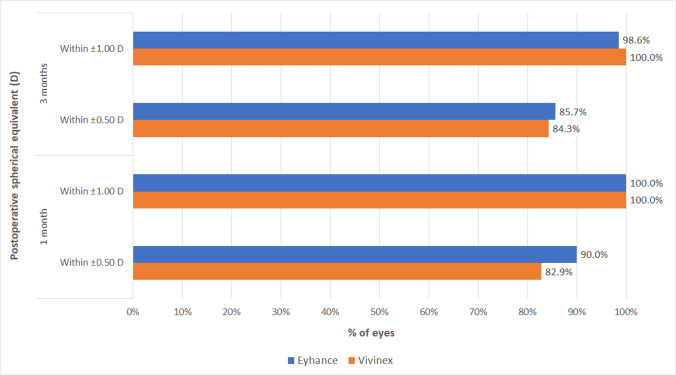
Randomised clinical trial enrolling 70 patients (age, 52-87 years) undergoing cataract surgery. Two groups were created according to the type of IOL implanted: Vivinex iSert from Hoya Surgical Optics (Vivinex group, 35 patients) and Tecnis Eyhance ICB00 from Johnson & Johnson Vision (Eyhance group, 35 patients). Uncorrected (UDVA) and corrected distance visual acuity (CDVA), uncorrected (UIVA) and distance-corrected intermediate visual acuity (DCIVA), refraction, and self-perceived visual function (Catquest-9SF) were evaluated during a 3-month follow-up.
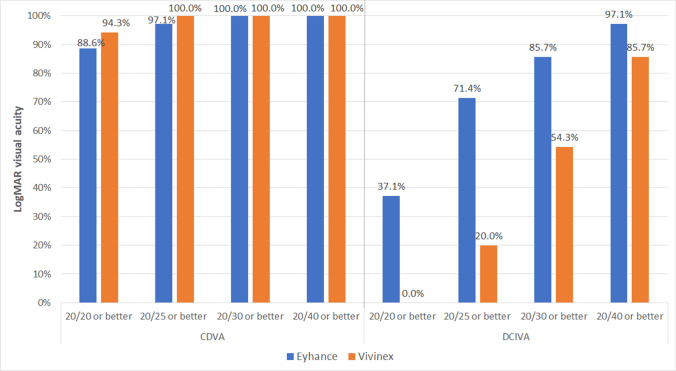
No significant differences were found between IOL groups in UDVA and CDVA (p ≥ 0.093). In contrast, monocular and binocular UIVA and DCIVA were significantly better in the Eyhance group at 1 (p ≤ 0.015) and 3 months postoperatively (p ≤ 0.002). Postoperative DCIVA 20/25 or better was obtained in 71.4% and 20.0% of patients in Eyhance and Vivinex groups, respectively. Differences in postoperative Rasch calibrated Catquest scores between Eyhance and Vivinex groups did not reach statistical significance (p ≥ 0.102). However, significant correlations were only found between the change in UIVA and Catquest scores (0.364 ≤ r ≤ 0.444, p ≤ 0.041) in the Eyhance group.
The modified monofocal IOL evaluated provides better intermediate visual function in comparison with a standard aspheric monofocal IOL, but the impact of this benefit on the self-perceived level of vision achieved after surgery according to the patient seemed to be limited.
本研究旨在评估和比较白内障手术后使用非球面单焦点人工晶状体(IOL)和具有改良光学轮廓的增强型 IOL 获得的临床结果。
这是一项随机临床试验,共纳入 70 名(年龄 52-87 岁)接受白内障手术的患者。根据植入的 IOL 类型将患者分为两组:HOYA Surgical Optics 的 Vivinex iSert(Vivinex 组,35 例)和 Johnson & Johnson Vision 的 Tecnis Eyhance ICB00(Eyhance 组,35 例)。在 3 个月的随访期间,评估未矫正(UDVA)和矫正远视力(CDVA)、未矫正(UIVA)和远距矫正中间视力(DCIVA)、屈光度和自我感知的视觉功能(Catquest-9SF)。
在 UDVA 和 CDVA 方面,两组 IOL 之间无显著差异(p≥0.093)。相比之下,Eyhance 组在术后 1 个月(p≤0.015)和 3 个月(p≤0.002)时单眼和双眼 UIVA 和 DCIVA 明显更好。在 Eyhance 和 Vivinex 组中,分别有 71.4%和 20.0%的患者获得术后 20/25 或更好的 DCIVA。在 Eyhance 和 Vivinex 组之间,术后 Rasch 校准的 Catquest 评分差异无统计学意义(p≥0.102)。然而,仅在 Eyhance 组中发现 UIVA 变化与 Catquest 评分之间存在显著相关性(0.364≤r≤0.444,p≤0.041)。
与标准非球面单焦点 IOL 相比,评估的改良单焦点 IOL 可提供更好的中间视力,但根据患者术后自我感知视力水平的提高,这种益处的影响似乎有限。