Centre for Exercise, Nutrition and Health Sciences, School for Policy Studies, University of Bristol, 8 Priory Road, Bristol, BS8 1TZ, UK.
Population Health Sciences, Bristol Medical School, University of Bristol, Canynge Hall, 39 Whatley Road, Bristol, BS8 2PS, UK.
Int J Behav Nutr Phys Act. 2023 May 31;20(1):64. doi: 10.1186/s12966-023-01465-7.
There is limited evidence on what shapes the acceptability of population level dietary and active-travel policies in England. This information would be useful in the decision-making process about which policies should be implemented and how to increase their effectiveness and sustainability. To fill this gap, we explored public and policymakers' views about factors that influence public acceptability of dietary and active-travel policies and how to increase public acceptability for these policies.
We conducted online, semi-structured interviews with 20 members of the public and 20 policymakers in England. A purposive sampling frame was used to recruit members of the public via a recruitment agency, based on age, sex, socioeconomic status and ethnicity. Policymakers were recruited from existing contacts within our research collaborations and via snowball sampling. We explored different dietary and active-travel policies that varied in their scope and focus. Interviews were transcribed verbatim and analysed using thematic reflexive analysis with both inductive and deductive coding.
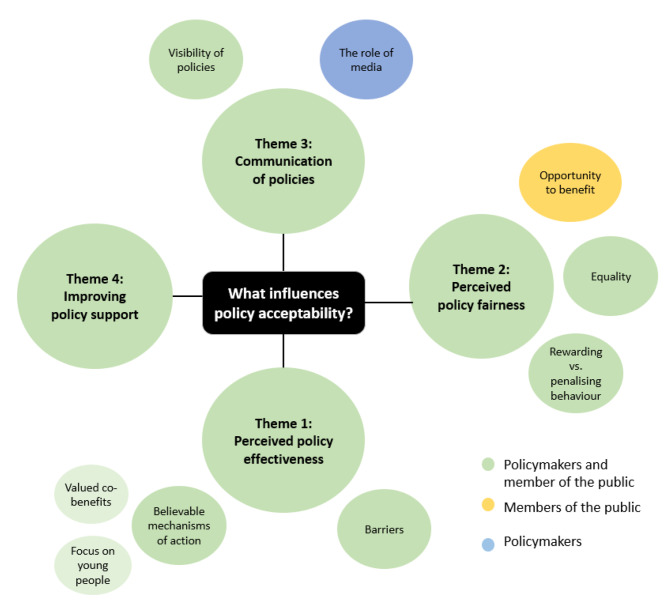
We identified four themes that informed public acceptability of dietary and active-travel policies: (1) perceived policy effectiveness, i.e., policies that included believable mechanisms of action, addressed valued co-benefits and barriers to engage in the behaviour; (2) perceived policy fairness, i.e., policies that provided everyone with an opportunity to benefit (mentioned only by the public), equally considered the needs of various population subgroups and rewarded 'healthy' behaviours rather than only penalising 'unhealthy' behaviours; (3) communication of policies, i.e., policies that were visible and had consistent and positive messages from the media (mentioned only by policymakers) and (4) how to improve policy support, with the main suggestion being an integrated strategy addressing multiple aspects of these behaviours, inclusive policies that consider everyone's needs and use of appropriate channels and messages in policy communication.
Our findings highlight that members' of the public and policymakers' support for dietary and active-travel policies can be shaped by the perceived effectiveness, fairness and communication of policies and provide suggestions on how to improve policy support. This information can inform the design of acceptable policies but can also be used to help communicate existing and future policies to maximise their adoption and sustainability.
在英格兰,关于哪些因素影响人们对人群层面饮食和积极出行政策的接受度,相关证据有限。了解这些信息对于决策应实施哪些政策以及如何提高这些政策的有效性和可持续性非常有用。为了填补这一空白,我们探讨了公众和政策制定者对影响饮食和积极出行政策公众接受度的因素的看法,以及如何提高公众对这些政策的接受度。
我们对英格兰的 20 名公众和 20 名政策制定者进行了在线半结构化访谈。通过招聘机构,根据年龄、性别、社会经济地位和种族,对公众进行了有针对性的抽样。政策制定者是从我们的研究合作关系中的现有联系人以及通过雪球抽样招募的。我们探讨了不同范围和重点的不同饮食和积极出行政策。访谈记录被逐字转录,并使用主题反思分析进行分析,采用归纳和演绎编码。
我们确定了影响饮食和积极出行政策公众接受度的四个主题:(1)感知政策效果,即政策包含可信的作用机制,解决了有价值的共同利益,解决了参与行为的障碍;(2)感知政策公平性,即政策为每个人提供了受益的机会(仅由公众提及),平等考虑了各种人群亚组的需求,并奖励“健康”行为,而不仅仅是惩罚“不健康”行为;(3)政策宣传,即政策是可见的,媒体有一致和积极的信息(仅由政策制定者提及),以及(4)如何提高政策支持,主要建议是采用综合战略,解决这些行为的多个方面,考虑每个人需求的包容性政策,并在政策宣传中使用适当的渠道和信息。
我们的研究结果表明,公众和政策制定者对饮食和积极出行政策的支持可能受到政策感知效果、公平性和宣传的影响,并就如何提高政策支持提供了建议。这些信息可以为设计可接受的政策提供参考,也可以用于帮助宣传现有和未来的政策,以最大限度地提高其采用率和可持续性。