Networks and Urban Systems Centre, University of Greenwich, London, UK.
ISI Foundation, Turin, Italy.
Nat Commun. 2023 Jun 6;14(1):3272. doi: 10.1038/s41467-023-39098-w.
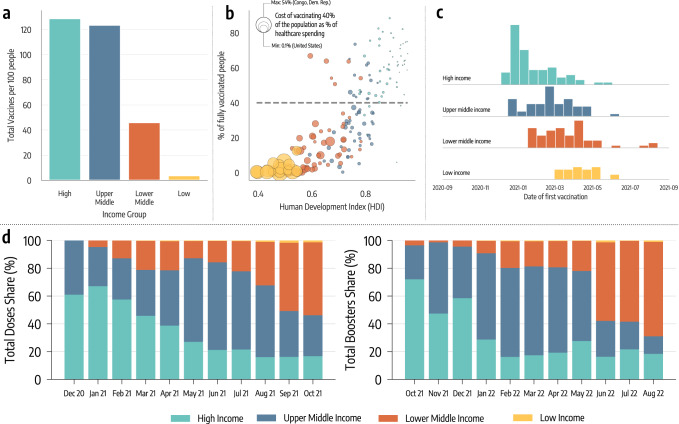
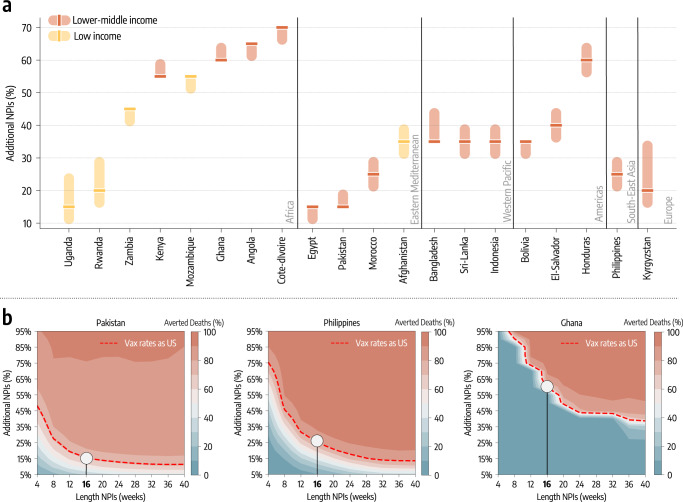
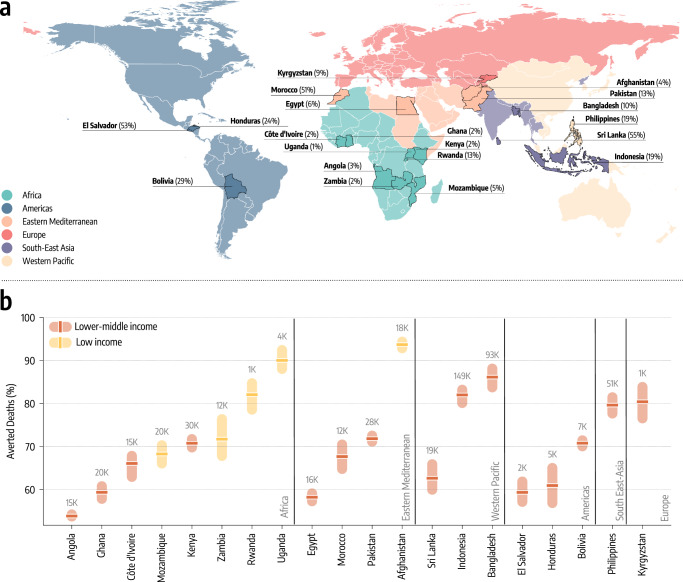
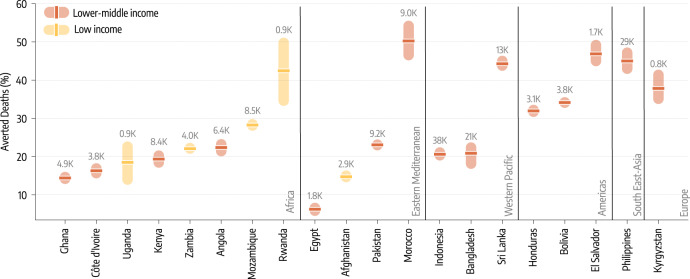
Access to COVID-19 vaccines on the global scale has been drastically hindered by structural socio-economic disparities. Here, we develop a data-driven, age-stratified epidemic model to evaluate the effects of COVID-19 vaccine inequities in twenty lower middle and low income countries (LMIC) selected from all WHO regions. We investigate and quantify the potential effects of higher or earlier doses availability. In doing so, we focus on the crucial initial months of vaccine distribution and administration, exploring counterfactual scenarios where we assume the same per capita daily vaccination rate reported in selected high income countries. We estimate that more than 50% of deaths (min-max range: [54-94%]) that occurred in the analyzed countries could have been averted. We further consider scenarios where LMIC had similarly early access to vaccine doses as high income countries. Even without increasing the number of doses, we estimate an important fraction of deaths (min-max range: [6-50%]) could have been averted. In the absence of the availability of high-income countries, the model suggests that additional non-pharmaceutical interventions inducing a considerable relative decrease of transmissibility (min-max range: [15-70%]) would have been required to offset the lack of vaccines. Overall, our results quantify the negative impacts of vaccine inequities and underscore the need for intensified global efforts devoted to provide faster access to vaccine programs in low and lower-middle-income countries.
在全球范围内,由于结构性的社会经济差异,COVID-19 疫苗的获取受到了严重阻碍。在这里,我们开发了一个数据驱动的、按年龄分层的传染病模型,以评估来自世卫组织所有地区的 20 个中低收入国家(LMIC)中 COVID-19 疫苗不平等的影响。我们调查和量化了更高或更早剂量供应的潜在影响。为此,我们专注于疫苗分发和管理的关键初始阶段,探索了假设在选定高收入国家报告的相同人均每日接种率的反事实情景。我们估计,在分析的国家中,超过 50%的死亡(最小-最大范围:[54-94%])本来可以避免。我们进一步考虑了 LMIC 与高收入国家一样能够尽早获得疫苗剂量的情况。即使不增加疫苗剂量,我们估计也可以避免很大一部分死亡(最小-最大范围:[6-50%])。在高收入国家无法提供疫苗的情况下,该模型表明,需要采取额外的非药物干预措施,使传染性相对降低(最小-最大范围:[15-70%]),以弥补疫苗的缺乏。总体而言,我们的研究结果量化了疫苗不平等的负面影响,并强调需要加强全球努力,以便更快地为低收入和中低收入国家提供疫苗接种计划。