Department of International Health, Johns Hopkins Bloomberg School of Public Health, Baltimore, Maryland, United States of America.
PLoS Comput Biol. 2022 Sep 6;18(9):e1010463. doi: 10.1371/journal.pcbi.1010463. eCollection 2022 Sep.
Based on the principles of equity and effectiveness, the World Health Organization and COVAX formulate vaccine allocation as a mathematical optimization problem. This study aims to solve the optimization problem using agent-based simulations.
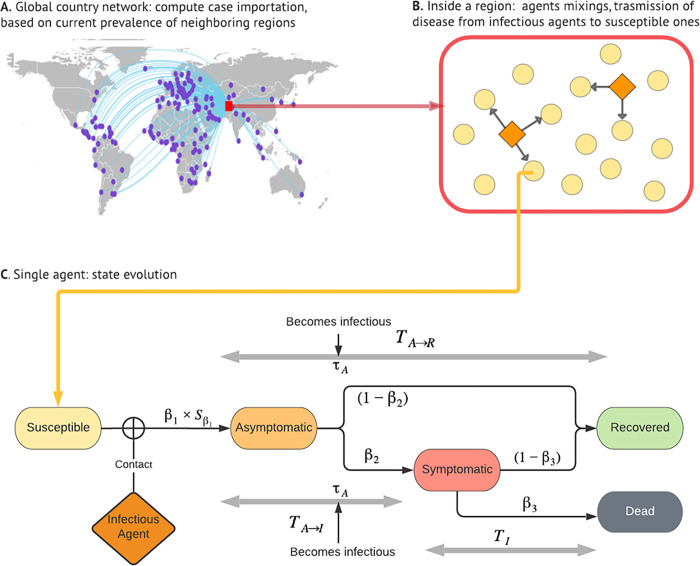
We built open-sourced agent-based models to simulate virus transition among a demographically representative sample of 198 million people in 148 countries using advanced computational services. All countries continuing their current vaccine progress is defined as the baseline scenario. Comparison scenarios include achieving minimum vaccination rates and allocating vaccines based on pandemic levels.
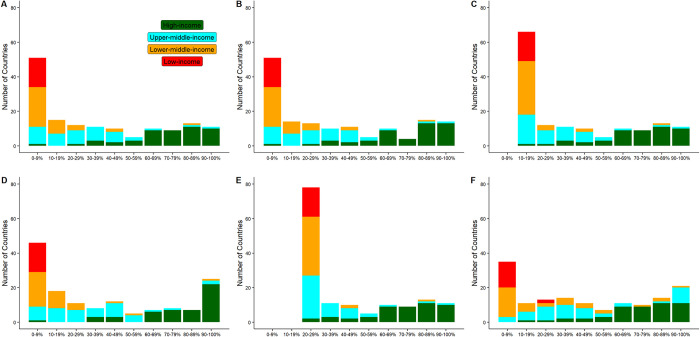
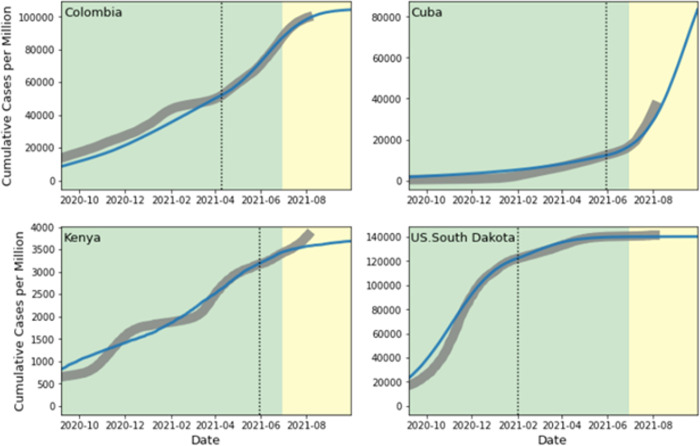
The simulations are fitted using the pandemic data from 148 countries from January 2020 to June 2021. Under the baseline scenario, the world will add 24.36 million cases and 468,945 deaths during the projection period of three months. Inoculating at least 10%, 20%, and 26% of populations in all countries requires 1.12, 3.31, and 5.00 million additional vaccine doses every day, respectively. Achieving these benchmarks reduces new cases by 0.56, 2.74, and 3.32 million, respectively. If allocated by the current global distribution, 5.00 million additional vaccine doses will only avert 1.45 million new cases. If those 5.00 million vaccines are allocated based on projected cases in each country, the averted cases will increase more than six-fold to 9.20 million. Similar differences between allocation methods are observed in averted deaths.
The global distribution of COVID-19 vaccines can be optimized to achieve better outcomes in terms of both equity and effectiveness. Alternative vaccine allocation methods may avert several times more cases and deaths than the current global distribution. With reasonable requirements on additional vaccines, COVAX could adopt alternative allocation strategies that reduce cross-country inequity and save more lives.
基于公平和有效性原则,世界卫生组织和“新冠疫苗实施计划”(COVAX)将疫苗分配制定为一个数学优化问题。本研究旨在使用基于代理的模拟来解决该优化问题。
我们构建了开源的基于代理的模型,使用先进的计算服务,对 19800 万人的 148 个国家的人口进行了具有代表性的模拟,以模拟病毒在人群中的传播。所有国家继续按照当前疫苗接种进度进行接种被定义为基准情景。比较情景包括实现最低疫苗接种率和根据大流行水平分配疫苗。
使用 2020 年 1 月至 2021 年 6 月来自 148 个国家的大流行数据对模拟进行拟合。在基准情景下,在未来三个月的预测期内,全球将新增 2436 万例病例和 468945 例死亡。在所有国家至少接种 10%、20%和 26%人口所需的每日额外疫苗剂量分别为 112 万、331 万和 500 万。实现这些基准可分别减少 560 万、2740 万和 3320 万例新发病例。如果按照当前的全球分配方式,500 万剂额外疫苗只能避免 145 万例新发病例。如果按照各国预计病例数分配这 500 万剂疫苗,避免的病例数将增加六倍以上,达到 920 万例。在避免死亡方面也观察到类似的分配方法差异。
可以优化 COVID-19 疫苗的全球分配,以在公平性和有效性方面取得更好的结果。替代疫苗分配方法可能比当前的全球分配方式避免数倍更多的病例和死亡。在对额外疫苗的合理要求下,COVAX 可以采用替代的分配策略,减少国家间的不平等,挽救更多生命。