Huang Haidong, Wu Ning, Tian Sen, Shi Dongchen, Wang Changhui, Wang Guangfa, Jin Faguang, Li Shiyue, Dong Yuchao, Simoff Michael J, Li Qiang, Bai Chong
Department of Respiratory and Critical Care Medicine, The First Affiliated Hospital of Naval Medical University, Shanghai, China.
Department of Respiratory Medicine, Shanghai Tenth People's Hospital, Tongji University School of Medicine, Shanghai, China.
J Cancer. 2023 May 15;14(8):1398-1406. doi: 10.7150/jca.84220. eCollection 2023.
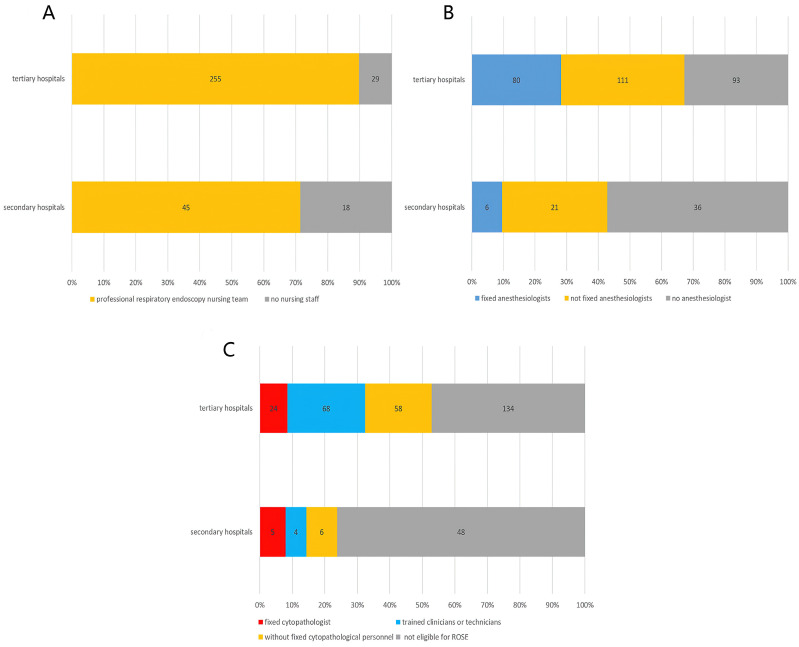
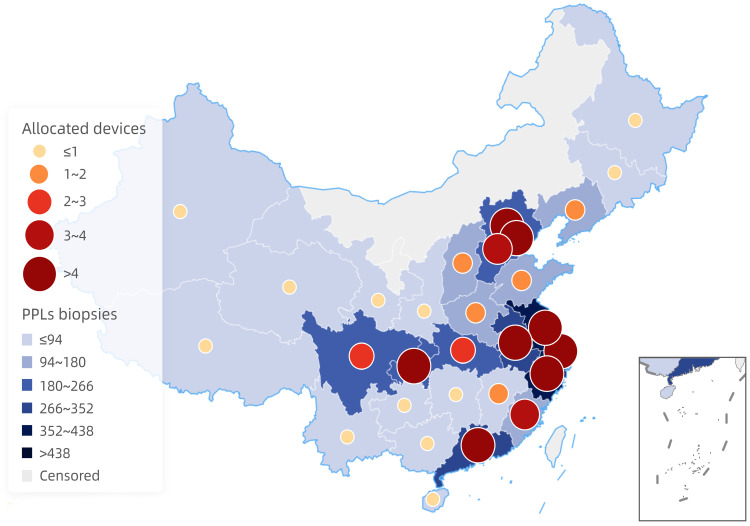
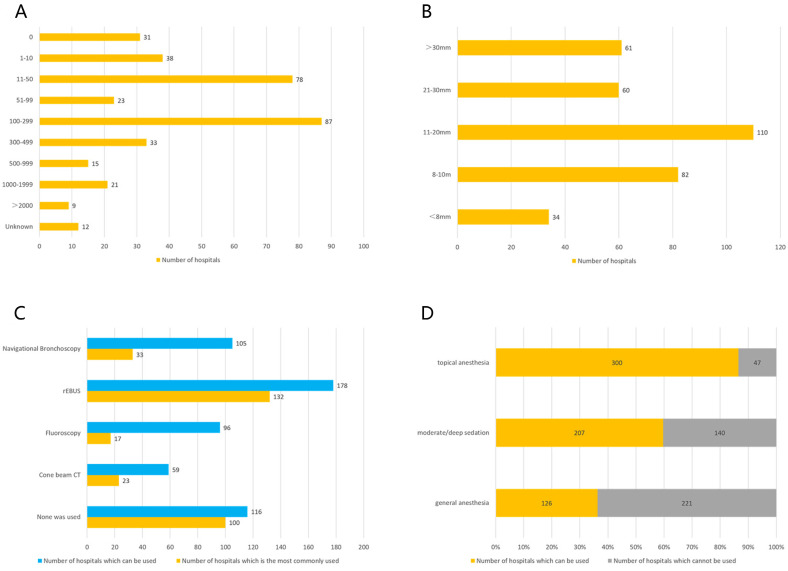
Bronchoscopy has gradually become valuable armamentarium in evaluating and applying endoscopic therapy to peripheral pulmonary lesions (PPLs) around the world. We aimed to make a comprehensive understanding of the application of bronchoscopy in the diagnosis and treatment of PPLs in China. A cross-sectional survey was carried out in China between January 2022 and March 2022. The survey was in the form of an online questionnaire which was filled in with real-time data by the respondents. A total of 347 doctors from 284 tertiary hospitals (81.8%) and 63 secondary general hospitals (18.2%) were included in the data analysis. More than half of the surveyed doctors (55.0%) had independently performed respiratory endoscopy for 5-15 years. Higher proportions of hospitals with a fixed nursing team, anesthesiologists and rapid on-site evaluation (ROSE) during bronchoscopic procedures were performed in tertiary hospitals than those in secondary general hospitals (P<0.001 each). There were 316 hospitals (91.7%) eligible for performing biopsies of PPLs less than 30mm, while more than 300 PPLs biopsies were performed in only 78 hospitals (24.7%) per year. Radial probe endobronchial ultrasound (r-EBUS) (50.3%) was the commonest type of technique used in the guidance of a bronchoscope to PPLs, followed by navigational bronchoscopy (30.3%) and cone beam CT (CBCT) (17.0%). Although two thirds of the surveyed hospitals had at least one bronchoscopic guidance devices, the actual utilization of these devices was not high due to high capital costs and absence of training. To note, more diagnostic procedures and allocated devices were concentrated in the southeast region and coastal cities. Furthermore, therapeutic bronchoscopic interventions for peripheral lung cancer and/or high-risk PPLs could be performed in 124 (35.7%) of the 347 involved hospitals. Bronchoscopy for the diagnosis of PPLs has been carried out in most hospitals in China and yields in different hospitals and regions varied greatly. To date, only a few hospitals in China can develop therapeutic bronchoscopy for PPLs.
在全球范围内,支气管镜检查已逐渐成为评估和应用内镜治疗周围型肺病变(PPL)的重要手段。我们旨在全面了解支气管镜检查在中国PPL诊断和治疗中的应用情况。2022年1月至2022年3月期间在中国进行了一项横断面调查。该调查采用在线问卷的形式,由受访者实时填写数据。数据分析共纳入了来自284家三级医院(81.8%)和63家二级综合医院(18.2%)的347名医生。超过一半(55.0%)的受访医生独立进行呼吸内镜检查5至15年。与二级综合医院相比,三级医院在支气管镜检查过程中配备固定护理团队、麻醉医生和快速现场评估(ROSE)的比例更高(每项P<0.001)。有316家医院(91.7%)有资格对直径小于30mm的PPL进行活检,而每年仅78家医院(24.7%)能进行300多次PPL活检。径向探头支气管内超声(r-EBUS)(50.3%)是支气管镜引导至PPL最常用的技术类型,其次是导航支气管镜检查(30.3%)和锥形束CT(CBCT)(17.0%)。尽管三分之二的受访医院至少有一台支气管镜引导设备,但由于成本高昂且缺乏培训,这些设备的实际使用率并不高。需要注意的是,更多的诊断程序和分配的设备集中在东南部地区和沿海城市。此外,在347家参与调查的医院中,有124家(35.7%)能够对周围型肺癌和/或高危PPL进行治疗性支气管镜干预。支气管镜检查用于PPL诊断在中国大多数医院都已开展,但不同医院和地区的检查结果差异很大。迄今为止,中国只有少数医院能够开展针对PPL的治疗性支气管镜检查。