Malekpour Mohammad-Reza, Abbasi-Kangevari Mohsen, Ghamari Seyyed-Hadi, Khanali Javad, Heidari-Foroozan Mahsa, Moghaddam Sahar Saeedi, Azangou-Khyavy Mohammadreza, Rezazadeh-Khadem Sahba, Rezaei Negar, Shobeiri Parnian, Esfahani Zahra, Rezaei Nazila, Mokdad Ali H, Naghavi Mohsen, Larijani Bagher, Farzadfar Farshad
Non-Communicable Diseases Research Center, Endocrinology and Metabolism Population Sciences Institute, Tehran University of Medical Sciences, Tehran, Iran.
Kiel Institute for the World Economy, Kiel, Germany.
EClinicalMedicine. 2023 Jun 2;60:102022. doi: 10.1016/j.eclinm.2023.102022. eCollection 2023 Jun.
The objective of this study is to investigate the trends of exposure and burden attributable to the four main metabolic risk factors, including high systolic blood pressure (SBP), high fasting plasma glucose (FPG), high body-mass index (BMI), and high low-density lipoproteins cholesterol (LDL) in North Africa and the Middle East from 1990 to 2019.
The data were retrieved from Global Burden of Disease Study 2019. Summary exposure value (SEV) was used for risk factor exposure. Burden attributable to each risk factor was incorporated in the population attributable fraction to estimate the total attributable deaths and disability-adjusted life-years (DALYs).
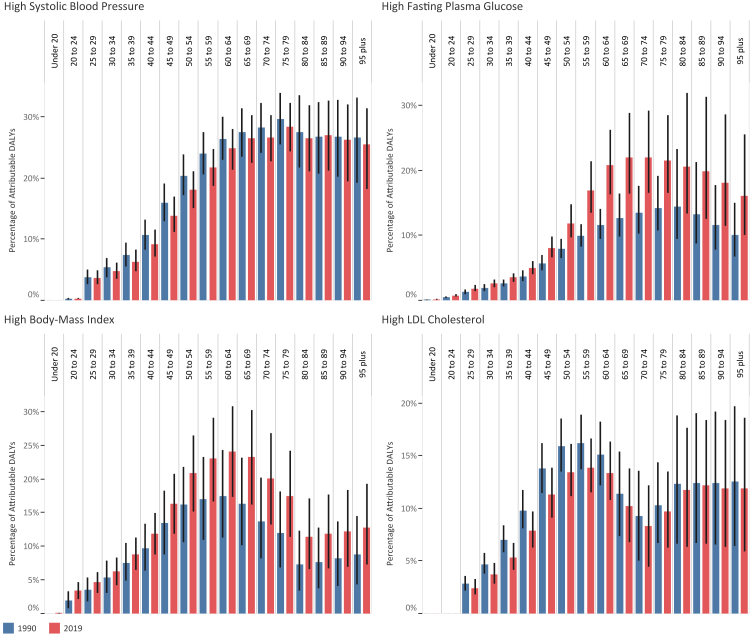
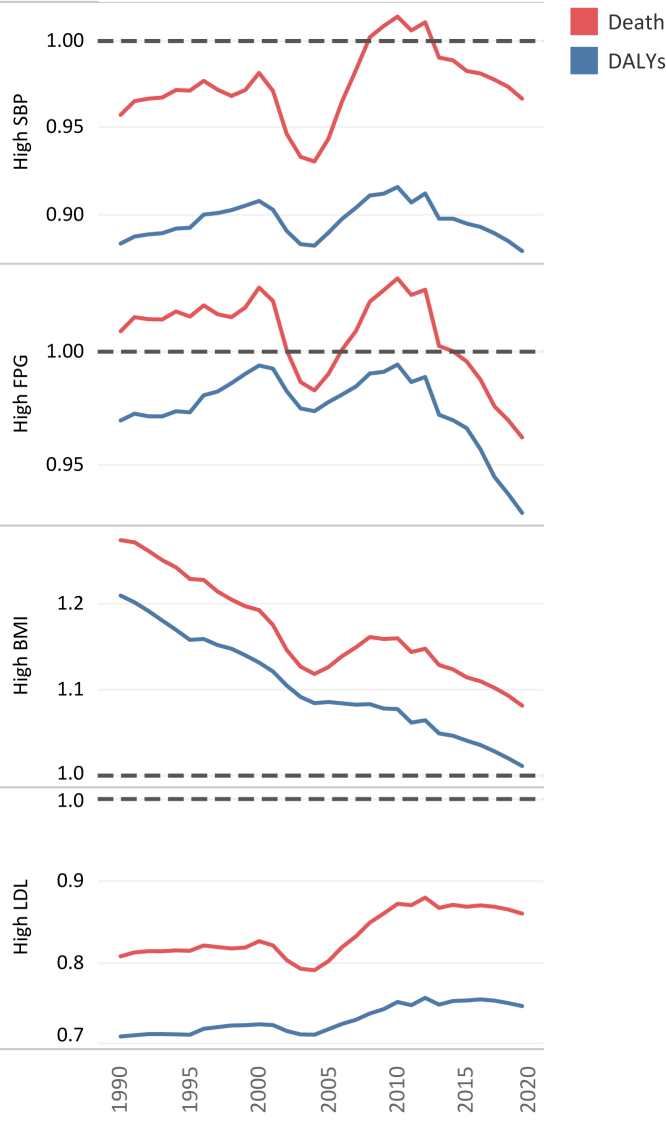
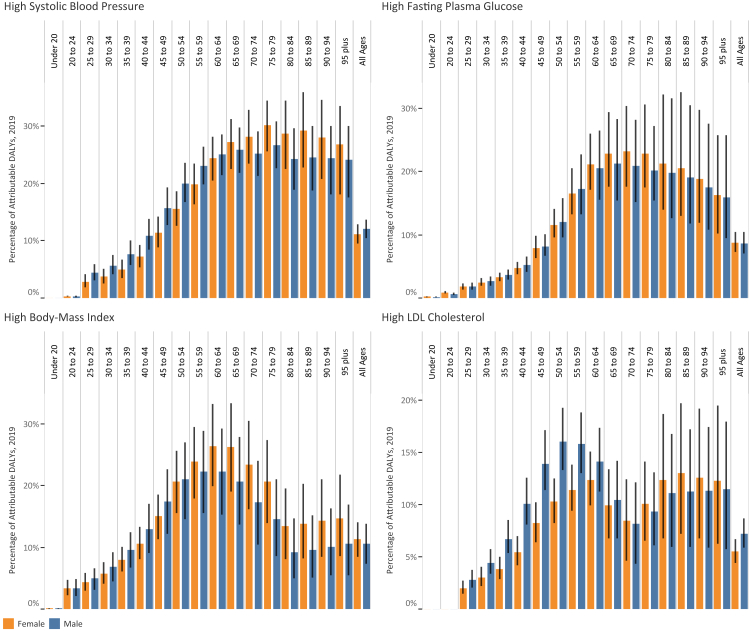
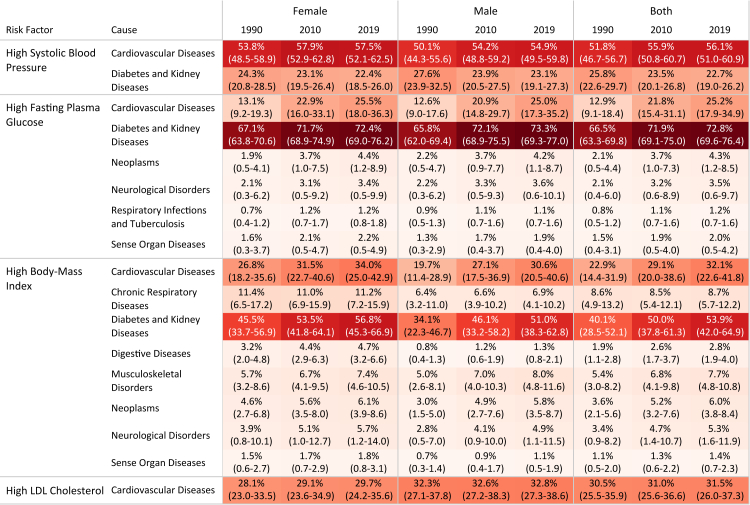
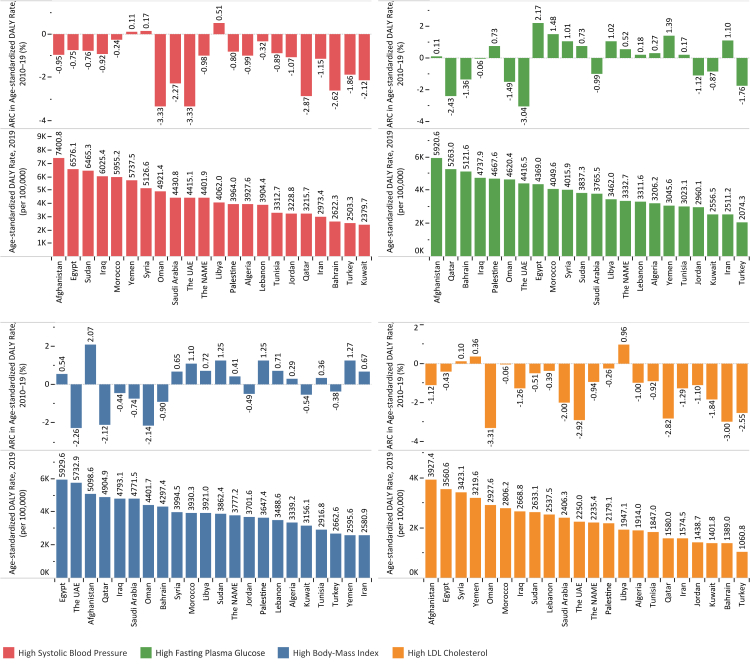
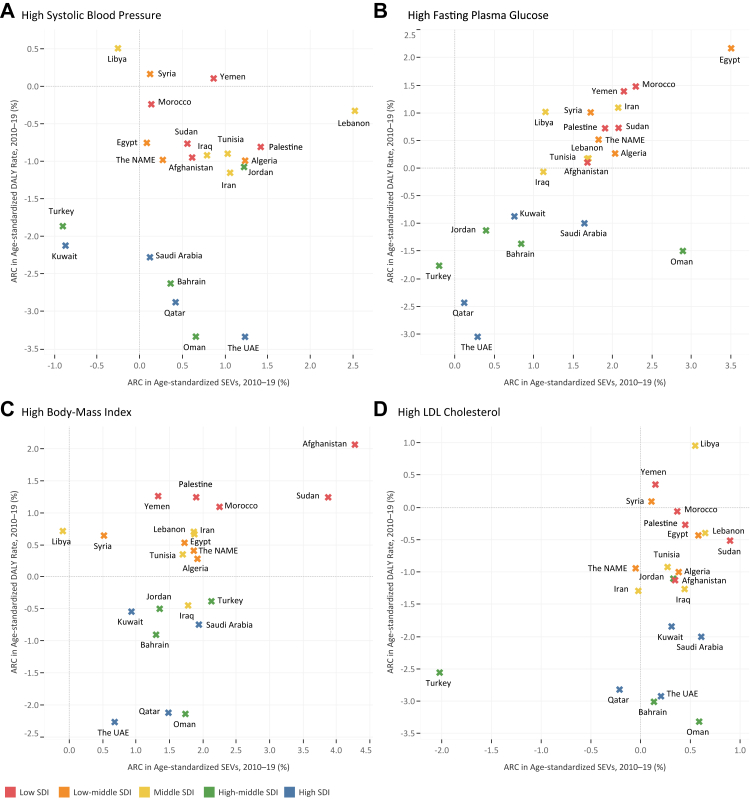
While age-standardized death rate (ASDR) attributable to high-LDL and high-SBP decreased by 26.5% (18.6-35.2) and 23.4% (15.9-31.5) over 1990-2019, respectively, high-BMI with 5.1% (-9.0-25.9) and high-FPG with 21.4% (7.0-37.4) change, grew in ASDR. Moreover, age-standardized DALY rate attributed to high-LDL and high-SBP declined by 30.2% (20.9-39.0) and 25.2% (16.8-33.9), respectively. The attributable age-standardized DALY rate of high-BMI with 8.3% (-6.5-28.8) and high-FPG with 27.0% (14.3-40.8) increase, had a growing trend. Age-standardized SEVs of high-FPG, high-BMI, high-SBP, and high-LDL increased by 92.4% (82.8-103.3), 76.0% (58.9-99.3), 10.4% (3.8-18.0), and 5.5% (4.3-7.1), respectively.
The burden attributed to high-SBP and high-LDL decreased during the 1990-2019 period in the region, while the attributable burden of high-FPG and high-BMI increased. Alarmingly, exposure to all four risk factors increased in the past three decades. There has been significant heterogeneity among the countries in the region regarding the trends of exposure and attributable burden. Urgent action is required at the individual, community, and national levels in terms of introducing effective strategies for prevention and treatment that account for local and socioeconomic factors.
Bill & Melinda Gates Foundation.
本研究的目的是调查1990年至2019年期间北非和中东地区四种主要代谢风险因素(包括收缩压升高、空腹血糖升高、体重指数升高和低密度脂蛋白胆固醇升高)的暴露趋势和归因负担。
数据取自《2019年全球疾病负担研究》。使用汇总暴露值(SEV)来衡量风险因素暴露情况。将每个风险因素的负担纳入人群归因分数,以估计总归因死亡数和伤残调整生命年(DALY)。
1990年至2019年期间,归因于高LDL和高SBP的年龄标准化死亡率(ASDR)分别下降了26.5%(18.6 - 35.2)和23.4%(15.9 - 31.5),而高BMI的ASDR变化为5.1%(-9.0 - 25.9),高FPG的ASDR变化为21.4%(7.0 - 37.4),呈上升趋势。此外,归因于高LDL和高SBP的年龄标准化DALY率分别下降了30.2%(20.9 - 39.0)和25.2%(16.8 - 33.9)。高BMI的归因年龄标准化DALY率上升了8.3%(-6.5 - 28.8),高FPG的上升了27.0%(14.3 - 40.8),呈上升趋势。高FPG、高BMI、高SBP和高LDL的年龄标准化SEV分别上升了92.4%(82.8 - 103.3)、76.0%(58.9 - 99.3)、10.4%(3.8 - 18.0)和5.5%(4.3 - 7.1)。
1990年至2019年期间,该地区归因于高SBP和高LDL的负担有所下降,而高FPG和高BMI的归因负担有所增加。令人担忧的是,在过去三十年中,所有这四种风险因素的暴露都有所增加。该地区各国在暴露趋势和归因负担方面存在显著差异。需要在个人、社区和国家层面采取紧急行动,制定考虑当地和社会经济因素的有效预防和治疗策略。
比尔及梅琳达·盖茨基金会。