Singhal Sharad S, Garg Rachana, Mohanty Atish, Garg Pankaj, Ramisetty Sravani Keerthi, Mirzapoiazova Tamara, Soldi Raffaella, Sharma Sunil, Kulkarni Prakash, Salgia Ravi
Department of Medical Oncology and Therapeutic Research, Beckman Research Institute, City of Hope Comprehensive Cancer Center and National Medical Center, Duarte, CA 91010, USA.
Department of Surgery, Beckman Research Institute, City of Hope Comprehensive Cancer Center and National Medical Center, Duarte, CA 91010, USA.
Cancers (Basel). 2023 May 29;15(11):2961. doi: 10.3390/cancers15112961.
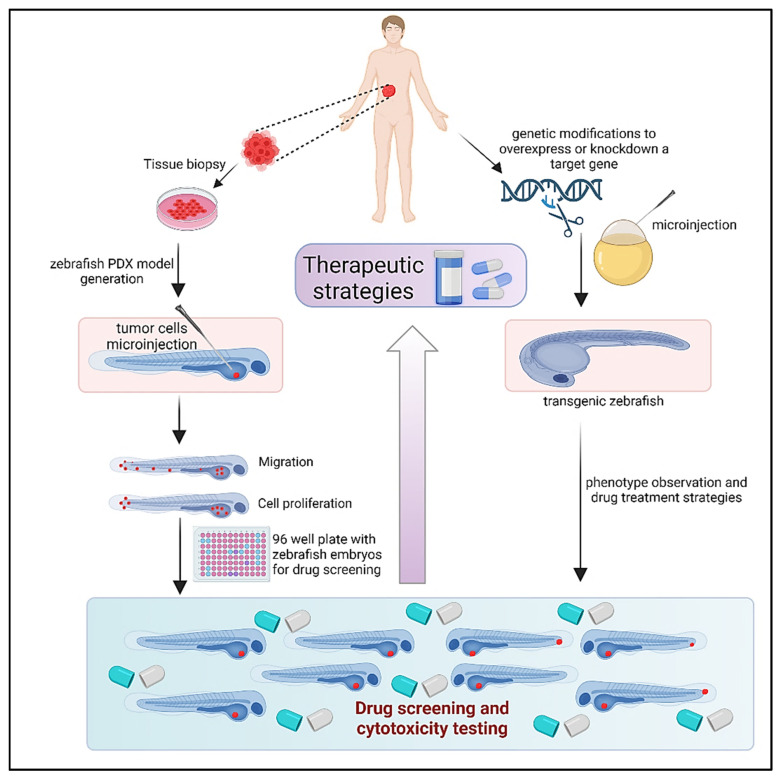
Animal models have been utilized for decades to investigate the causes of human diseases and provide platforms for testing novel therapies. Indeed, breakthrough advances in genetically engineered mouse (GEM) models and xenograft transplantation technologies have dramatically benefited in elucidating the mechanisms underlying the pathogenesis of multiple diseases, including cancer. The currently available GEM models have been employed to assess specific genetic changes that underlay many features of carcinogenesis, including variations in tumor cell proliferation, apoptosis, invasion, metastasis, angiogenesis, and drug resistance. In addition, mice models render it easier to locate tumor biomarkers for the recognition, prognosis, and surveillance of cancer progression and recurrence. Furthermore, the patient-derived xenograft (PDX) model, which involves the direct surgical transfer of fresh human tumor samples to immunodeficient mice, has contributed significantly to advancing the field of drug discovery and therapeutics. Here, we provide a synopsis of mouse and zebrafish models used in cancer research as well as an interdisciplinary 'Team Medicine' approach that has not only accelerated our understanding of varied aspects of carcinogenesis but has also been instrumental in developing novel therapeutic strategies.
几十年来,动物模型一直被用于研究人类疾病的病因,并为测试新疗法提供平台。事实上,基因工程小鼠(GEM)模型和异种移植技术的突破性进展在阐明包括癌症在内的多种疾病发病机制的基础方面发挥了巨大作用。目前可用的GEM模型已被用于评估许多致癌特征背后的特定基因变化,包括肿瘤细胞增殖、凋亡、侵袭、转移、血管生成和耐药性的变化。此外,小鼠模型使定位肿瘤生物标志物变得更容易,以用于癌症进展和复发的识别、预后和监测。此外,患者来源的异种移植(PDX)模型,即将新鲜的人类肿瘤样本直接手术移植到免疫缺陷小鼠体内,为推进药物发现和治疗领域做出了重大贡献。在这里,我们概述了癌症研究中使用的小鼠和斑马鱼模型,以及一种跨学科的“团队医学”方法,该方法不仅加速了我们对致癌作用各个方面的理解,而且在开发新的治疗策略方面也发挥了重要作用。