Radiation Oncology, Azienda Universitaria Ospedaliera Careggi, Università degli Studi di Firenze, Largo Brambila 1, 50134, Florence, Italy.
Radiation Oncology Unit, Fondazione IRCCS Policlinico San Matteo, Pavia, Italy.
Strahlenther Onkol. 2023 Dec;199(12):1173-1190. doi: 10.1007/s00066-023-02097-3. Epub 2023 Jun 22.
Tumor-associated macrophages (TAMs) are the most represented cells of the immune system in the tumor microenvironment (TME). Besides its effects on cancer cells, radiation therapy (RT) can alter TME composition. With this systematic review, we provide a better understanding on how RT can regulate macrophage characterization, namely the M1 antitumor and the M2 protumor polarization, with the aim of describing new effective RT models and exploration of the possibility of integrating radiation with other available therapies.
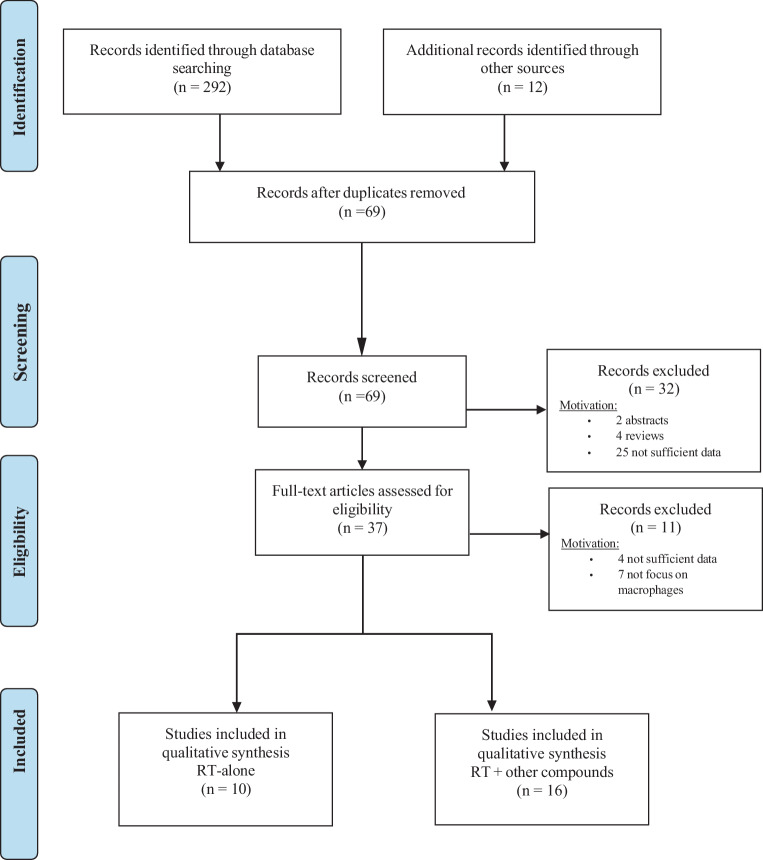
A systematic search in line with the Preferred Reporting Items for Systematic Reviews and Meta-Analyses (PRISMA) guidelines was carried out in PubMed, Google Scholar, and Scopus. Articles from January 2000 to April 2020 which focus on the role of M1 and M2 macrophages in the response to RT were identified.
Of the 304 selected articles, 29 qualitative summary papers were included in our analysis (16 focusing on administration of RT and concomitant systemic molecules, and 13 reporting on RT alone). Based on dose intensity, irradiation was classified into low (low-dose irradiation, LDI; corresponding to less than 1 Gy), moderate (moderate-dose irradiation, MDI; between 1 and 10 Gy), and high (high-dose irradiation, HDI; greater than 10 Gy). While HDI seems to be responsible for induced angiogenesis and accelerated tumor growth through early M2-polarized TAM infiltration, MDI stimulates phagocytosis and local LDI may represent a valid treatment option for possible combination with cancer immunotherapeutic agents.
TAMs seem to have an ambivalent role on the efficacy of cancer treatment. Radiation therapy, which exerts its main antitumor activity via cell killing, can in turn interfere with TAM characterization through different modalities. The plasticity of TAMs makes them an attractive target for anticancer therapies and more research should be conducted to explore this potential therapeutic strategy.
肿瘤相关巨噬细胞(TAMs)是肿瘤微环境(TME)中免疫系统最具代表性的细胞。除了对癌细胞的影响外,放射治疗(RT)还可以改变 TME 的组成。通过这项系统综述,我们更好地了解了 RT 如何调节巨噬细胞的特征,即抗肿瘤的 M1 和促肿瘤的 M2 极化,并描述了新的有效的 RT 模型,探索了将放射与其他可用疗法相结合的可能性。
根据系统评价和荟萃分析的首选报告项目(PRISMA)指南,在 PubMed、Google Scholar 和 Scopus 中进行了系统搜索。确定了 2000 年 1 月至 2020 年 4 月期间专注于 M1 和 M2 巨噬细胞在 RT 反应中作用的文章。
在 304 篇选定的文章中,有 29 篇定性综述文章被纳入我们的分析(16 篇侧重于 RT 和同时进行的全身分子的给药,13 篇报告单独进行 RT)。根据剂量强度,照射分为低(低剂量照射,LDI;对应于小于 1Gy)、中(中剂量照射,MDI;在 1 至 10Gy 之间)和高(高剂量照射,HDI;大于 10Gy)。虽然 HDI 似乎通过早期 M2 极化 TAM 浸润导致诱导血管生成和加速肿瘤生长,但 MDI 刺激吞噬作用,局部 LDI 可能代表与癌症免疫治疗剂联合治疗的有效治疗选择。
TAMs 似乎对癌症治疗的疗效具有矛盾的作用。放射治疗主要通过细胞杀伤发挥其主要抗肿瘤活性,反过来又可以通过不同方式干扰 TAM 的特征。TAMs 的可塑性使它们成为抗癌治疗的一个有吸引力的靶点,应该进行更多的研究来探索这种潜在的治疗策略。