Taheri Morteza, Esmaeili Atefeh, Irandoust Khadijah, Mirmoezzi Masoud, Souissi Amine, Laher Ismail, Dergaa Ismail, Zouhal Hassane
Imam Khomeini International University, Qazvin, Iran.
Islamic Azad University, Central Tehran Branch, Tehran, Iran.
Sci Sports. 2023 May 29. doi: 10.1016/j.scispo.2023.01.002.
The COVID-19 pandemic has changed life styles of millions of people worldwide. This study investigated changes in the health, physical activity levels and eating habits of elite athletes during the COVID-19 pandemic lockdown in Iran.
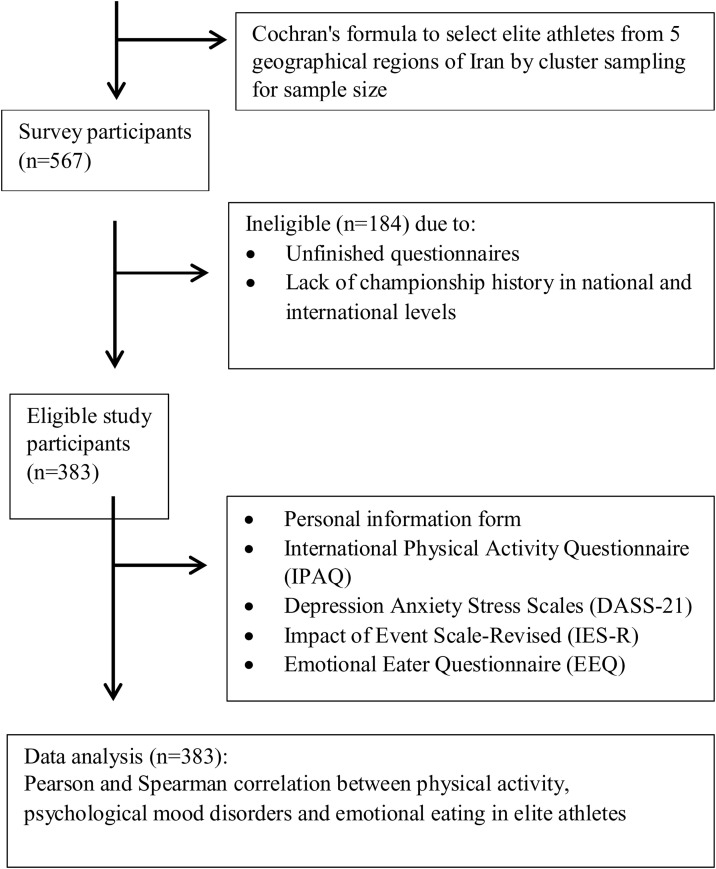
383 (248 female and 135 male) elite athletes (168.82 ± 0.07 cm; 63.92 ± 7.42 kg; the body mass index (BMI): 22.3 ± 0.78 kg/m) participated in this study. The International Physical Activity Questionnaire (IPAQ), Depression Anxiety Stress Scales (DASS-21) and the Impact of Event Scale-Revised (IES-R) study tools were used to measure levels of physical activity and mental health status, respectively. The Emotional Eater Questionnaire (EEQ) was used to assess food consumption related to emotion. Pearson and Spearman correlation analysis test were used in data analysis.
Levels of depression and stress were mild and moderate, while levels of anxiety were severe and very severe in most elite athletes. There were levels of low emotional eating by elite athletes during the COVID-19 pandemic. Physical activity levels were negatively correlated with psychological mood measures (p≤0.05), while there were positive correlations between emotional eating behaviours and psychological mood measures (moderate correlation; p≤0.01) and light physical activity levels (weak correlation; p≤0.05).
This study provides the first preliminary evidence showing that the COVID-19 lockdown conditions negatively influenced the eating habits and levels of physical activity and mental health in elite athletes. Regular high intensity physical activity as health strategy in elite athletes and the general population remains a strategy to improve overall health during the COVID-19 pandemic. Additionally, these findings suggest the need to devise strategies to improve the life styles of elite athletes during pandemics such as the Covid-19 pandemic.
新冠疫情改变了全球数百万人的生活方式。本研究调查了伊朗新冠疫情封锁期间精英运动员的健康状况、身体活动水平和饮食习惯的变化。
383名(248名女性和135名男性)精英运动员(身高168.82±0.07厘米;体重63.92±7.42千克;体重指数(BMI):22.3±0.78千克/平方米)参与了本研究。分别使用国际体力活动问卷(IPAQ)、抑郁焦虑压力量表(DASS-21)和事件影响量表修订版(IES-R)研究工具来测量身体活动水平和心理健康状况。使用情绪性进食问卷(EEQ)评估与情绪相关的食物消费情况。数据分析采用Pearson和Spearman相关分析检验。
大多数精英运动员的抑郁和压力水平为轻度和中度,而焦虑水平为重度和极重度。在新冠疫情期间,精英运动员的情绪性进食水平较低。身体活动水平与心理情绪指标呈负相关(p≤0.05),而情绪性进食行为与心理情绪指标之间呈正相关(中度相关;p≤0.01),与轻度身体活动水平呈正相关(弱相关;p≤0.05)。
本研究提供了首个初步证据,表明新冠疫情封锁状况对精英运动员的饮食习惯、身体活动水平和心理健康产生了负面影响。在新冠疫情期间,定期进行高强度身体活动作为精英运动员和普通人群的健康策略,仍然是改善整体健康的一种策略。此外,这些发现表明,需要制定策略来改善疫情(如新冠疫情)期间精英运动员的生活方式。