Institute of Physiology, University of Bern, Switzerland (A.M.).
PEPperPRINT GmbH, Heidelberg, Germany (Y.M.).
Circulation. 2023 Aug 8;148(6):487-498. doi: 10.1161/CIRCULATIONAHA.122.062776. Epub 2023 Jul 4.
Atrial fibrillation (AF) is by far the most common cardiac arrhythmia. In about 3% of individuals, AF develops as a primary disorder without any identifiable trigger (idiopathic or historically termed lone AF). In line with the emerging field of autoantibody-related cardiac arrhythmias, the objective of this study was to explore whether autoantibodies targeting cardiac ion channels can underlie unexplained AF.
Peptide microarray was used to screen patient samples for autoantibodies. We compared patients with unexplained AF (n=37 pre-existent AF; n=14 incident AF on follow-up) to age- and sex-matched controls (n=37). Electrophysiological properties of the identified autoantibody were then tested in vitro with the patch clamp technique and in vivo with an experimental mouse model of immunization.
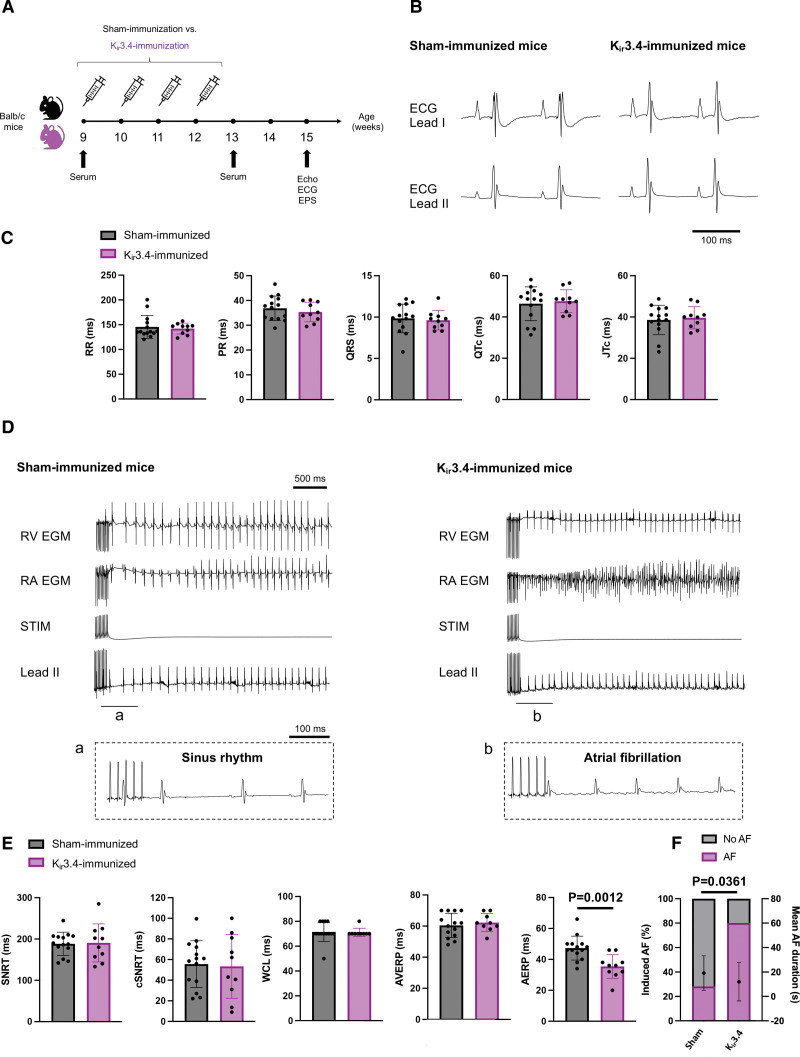
A common autoantibody response against K3.4 protein was detected in patients with AF and even before the development of clinically apparent AF. K3.4 protein forms a heterotetramer that underlies the cardiac acetylcholine-activated inwardly rectifying K current, . Functional studies on human induced pluripotent stem cell-derived atrial cardiomyocytes showed that anti-K3.4 IgG purified from patients with AF shortened action potentials and enhanced the constitutive form of , both key mediators of AF. To establish a causal relationship, we developed a mouse model of K3.4 autoimmunity. Electrophysiological study in K3.4-immunized mice showed that K3.4 autoantibodies significantly reduced atrial effective refractory period and predisposed animals to a 2.8-fold increased susceptibility to AF.
To our knowledge, this is the first report of an autoimmune pathogenesis of AF with direct evidence of K3.4 autoantibody-mediated AF.
心房颤动(AF)是迄今为止最常见的心律失常。在大约 3%的人群中,AF 作为一种无明显诱因的原发性疾病(特发性或既往称为孤立性 AF)发展而来。鉴于自身抗体相关心律失常这一新兴领域,本研究旨在探讨针对心脏离子通道的自身抗体是否可能成为不明原因 AF 的基础。
采用肽微阵列筛选患者样本中的自身抗体。我们将患有不明原因 AF 的患者(预先存在的 AF 组 n=37;随访中出现的新发 AF 组 n=14)与年龄和性别匹配的对照组(n=37)进行比较。然后,我们使用膜片钳技术在体外和免疫实验小鼠模型中检测鉴定出的自身抗体的电生理特性。
在 AF 患者中甚至在出现临床明显 AF 之前,检测到针对 K3.4 蛋白的常见自身抗体反应。K3.4 蛋白形成一个异四聚体,构成心脏乙酰胆碱激活内向整流钾电流,。对源自人类诱导多能干细胞的心房肌细胞的功能研究表明,从 AF 患者中纯化的抗 K3.4 IgG 缩短了动作电位并增强了,这两者都是 AF 的关键介质。为了建立因果关系,我们开发了一种 K3.4 自身免疫的小鼠模型。在 K3.4 免疫的小鼠中进行的电生理研究表明,K3.4 自身抗体显著缩短了心房有效不应期,并使动物对 AF 的易感性增加了 2.8 倍。
据我们所知,这是首例关于 AF 自身免疫发病机制的报告,并有直接证据表明 K3.4 自身抗体介导了 AF。