Ely Kencie, Lagasca Gemma, Andersen Shaun, Patel Deepal, Simanton Edward
Medical Education, University of Nevada Las Vegas School of Medicine, Las Vegas, USA.
Office of Medical Education, University of Nevada Las Vegas, Las Vegas, USA.
Cureus. 2023 Jun 2;15(6):e39875. doi: 10.7759/cureus.39875. eCollection 2023 Jun.
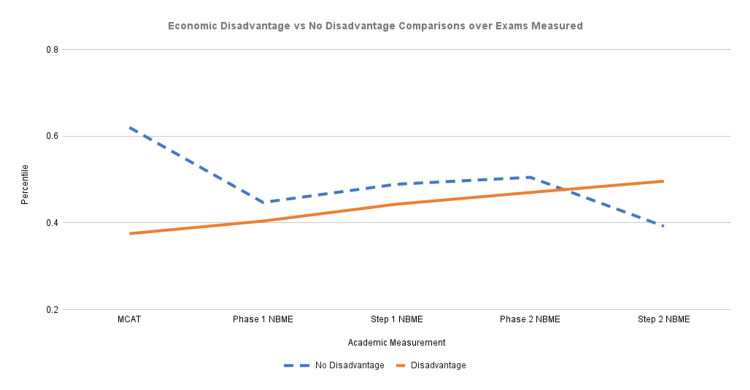
Background Students from lower socioeconomic groups tend to underestimate their chances of acceptance to medical school and their likelihood of success once admitted. Objective The objective of this study is to determine if socioeconomic disadvantage status is linked to lower medical college admission test (MCAT) scores and academic performance in medical school. Methods Using the Association of American Medical Colleges (AAMC) education/occupation (EO) indicator, we compared economically disadvantaged students to students with no financial disadvantage on the MCAT, Phase 1 National Board of Medical Examiners (NBME), United States Medical Licensing Examination (USMLE) Step 1, Phase 2 NBME, and USMLE Step 2 test scores. Results Medical students in the disadvantaged group scored significantly lower on the MCAT than students with no financial disadvantage. The disadvantaged group showed a non-significant lower trend in performance until USMLE Step 2. Conclusions Applicants from lower socioeconomic backgrounds may perform lower on their MCAT and early medical school benchmark exams, but they appear to catch up with and even surpass their peers on their USMLE Step 2 examination.
社会经济地位较低的学生往往会低估自己被医学院录取的机会以及被录取后取得成功的可能性。
本研究的目的是确定社会经济劣势地位是否与较低的医学院入学考试(MCAT)成绩以及医学院的学业成绩相关。
使用美国医学院协会(AAMC)的教育/职业(EO)指标,我们将经济上处于劣势的学生与没有经济劣势的学生在MCAT、第一阶段美国国家医学考试委员会(NBME)、美国医师执照考试(USMLE)第一步、第二阶段NBME以及USMLE第二步考试成绩上进行了比较。
处于劣势组的医学生在MCAT上的得分显著低于没有经济劣势的学生。在USMLE第二步之前,劣势组的成绩呈非显著的较低趋势。
社会经济背景较低的申请者在MCAT和医学院早期基准考试中的表现可能较低,但他们在USMLE第二步考试中似乎能够赶上甚至超过同龄人。